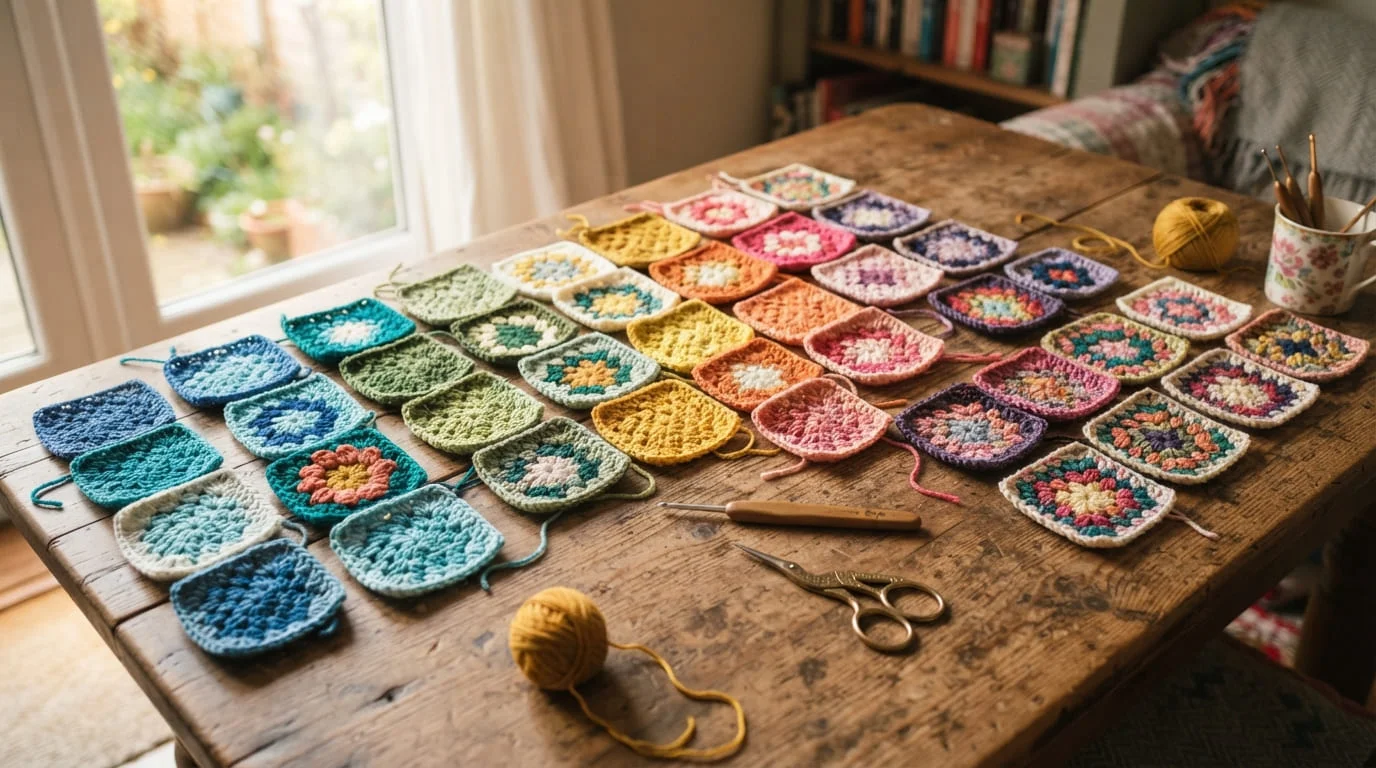
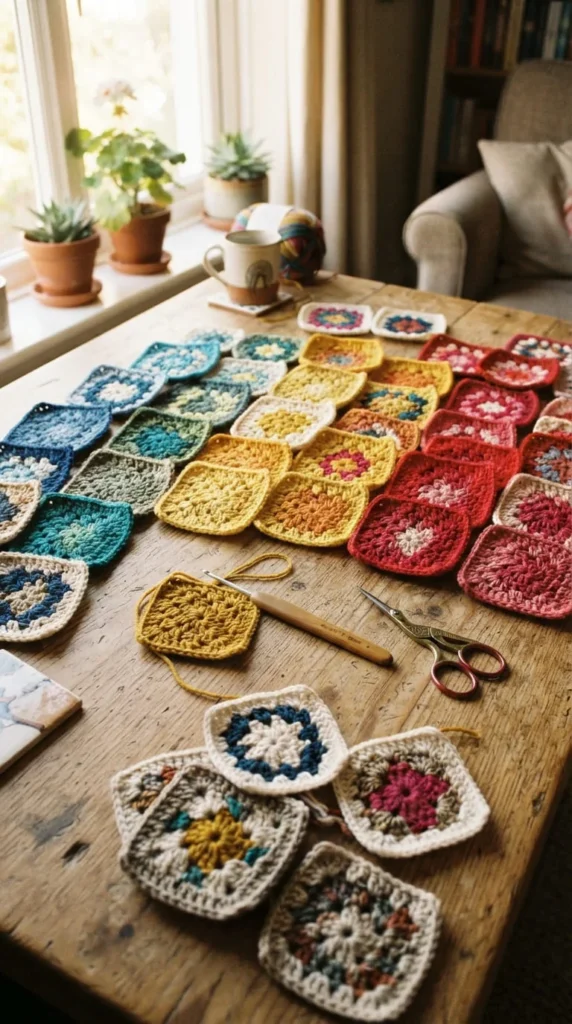
There’s a reason crochet granny square cardigans keep showing up in handmade wardrobes year after year: they’re built from small, manageable pieces instead of one long, intimidating garment, which makes the whole process far less overwhelming than it looks in a finished photo. This list walks through 24 cardigan styles, from six-square cocoon shrugs you can finish in a weekend to layout-heavy patchwork pieces that reward a little planning. Along the way you’ll find practical notes on blocking, joining methods, sizing by square count, and the small details that separate a lumpy first attempt from a cardigan that actually hangs well on the body.
1. Six-Square Cocoon Shrug for a Fast First Project
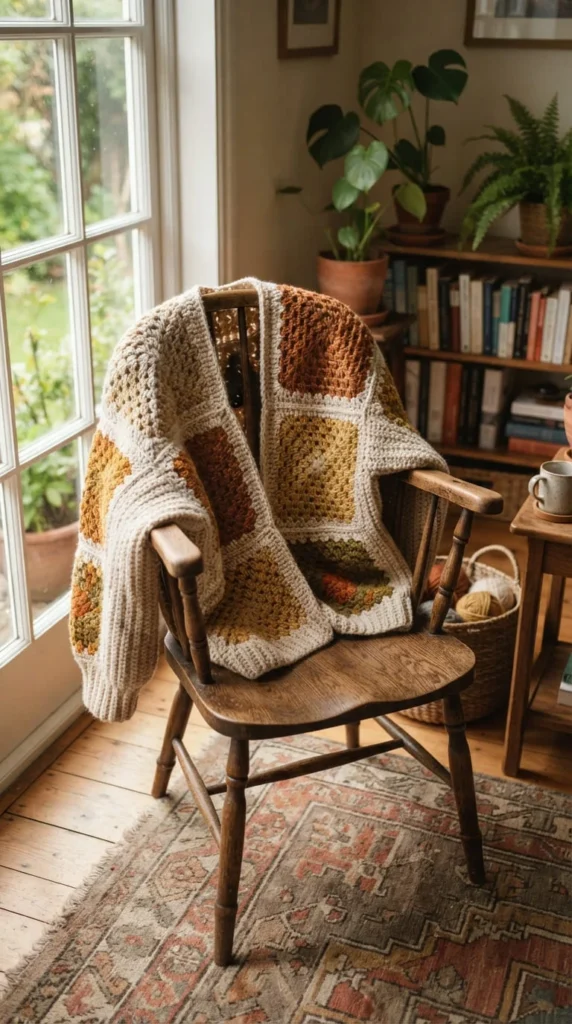
If the idea of joining dozens of small squares sounds exhausting, start here. A cocoon shrug uses just six oversized squares, folded and seamed at a few key points to create sleeves and an open front, with far less joining than a full patchwork cardigan.
Because each square is worked individually, mistakes stay contained. If one square comes out a slightly different size, you can simply remake that one rather than unraveling a large connected piece.
This style works best in a soft, drapey yarn rather than a stiff cotton, since the oversized squares need to fold and hang loosely to create the cocoon shape properly.
Square-size tip: work all six squares to the exact same round count before folding and seaming. Even a one-round difference between squares will throw off how evenly the shrug hangs once it’s assembled.
2. Classic Solid-Square Patchwork Cardigan
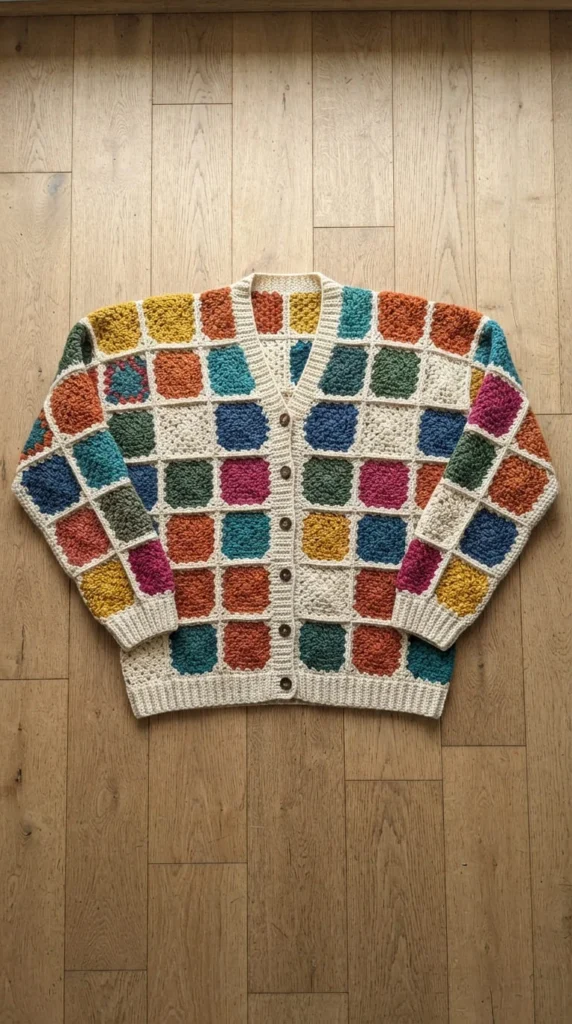
This is the cardigan most people picture when they hear “granny square” — rows of solid-colored squares joined into two front panels, a back panel, and simple sleeve strips. It’s a genuinely good project for learning the full process from square-making through final assembly.
Because you’ll be making dozens of squares, batch your work: crochet all the squares first, block every one of them, then move on to layout and joining rather than trying to join as you go.
Blocking matters more here than almost anywhere else on this list. Unblocked squares vary slightly in size, and those small differences compound across a whole cardigan into visibly wavy seams.
Join method note: a single crochet join creates a slightly raised, textured seam, while a slip stitch through the back loops only gives a flatter, subtler line. Try both on two spare squares before deciding which one you want for the whole project.
3. Sunburst Motif Statement Cardigan
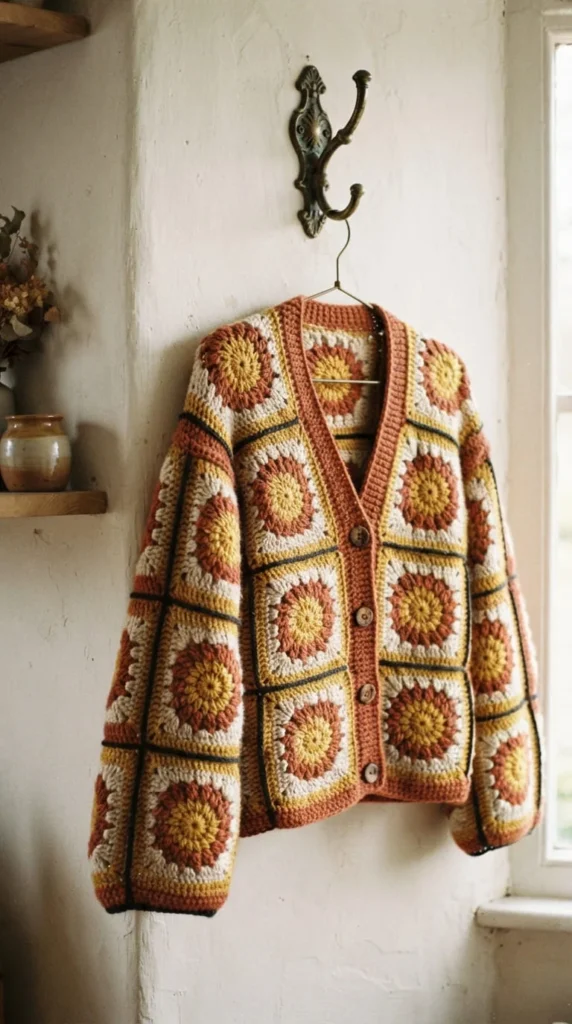
Sunburst squares build outward from a center ring using clusters of double crochet that fan out like rays, giving each motif more visual movement than a plain solid square. Used across a full cardigan, the repeated sunburst pattern becomes a genuine statement piece rather than a background texture.
Because sunburst squares use more yarn per motif than a plain granny square, count on needing more total yardage than a classic patchwork version in the same size.
This style looks especially striking in a warm, saturated palette — rust, mustard, burnt orange — where the radiating lines read clearly against the surrounding stitches.
Time estimate: a sunburst square with more rounds and cluster stitches takes noticeably longer than a plain solid square, so budget extra time if you’re working toward a specific event or gift deadline rather than an open-ended project.
4. Daisy Granny Square Floral Cardigan
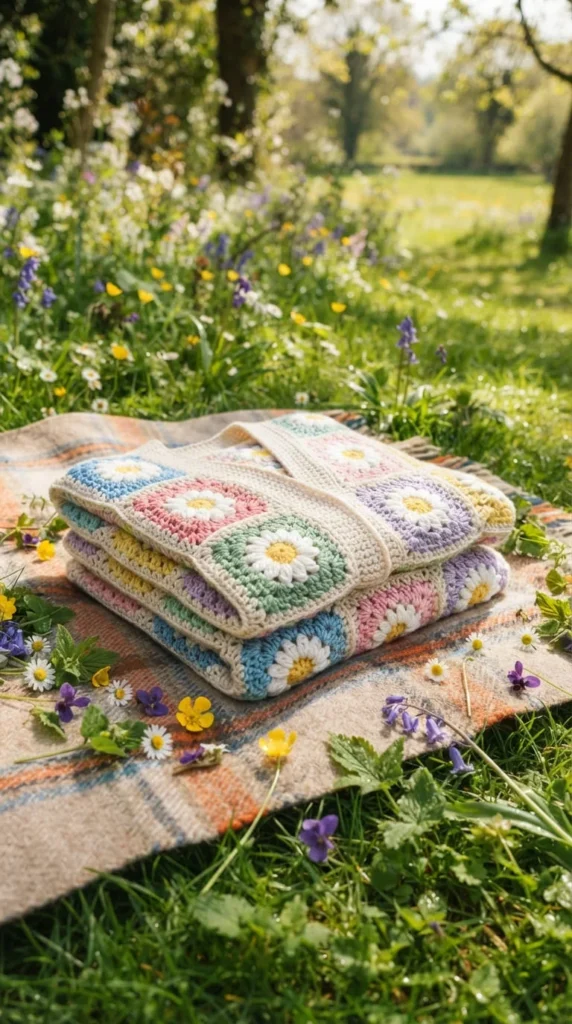
Each motif in this cardigan starts as a small crocheted flower, then gets framed with a few rounds of solid granny stitches to bring it up to full square size. The flower center is usually worked in a contrasting color, which gives the whole cardigan a cheerful, floral feel without embroidery or appliqué.
This is a satisfying project if you enjoy small, detailed motif work more than long rows of plain stitching, since each square is really a mini project of its own.
Keep your flower centers consistent by using the same yarn color and round count throughout, even if the surrounding “frame” rounds vary in color from square to square.
Coverage note: because the flower centers sit slightly raised compared to the surrounding frame, this cardigan has a bit more texture and opacity than a flat solid-square version, which some readers prefer if they’re concerned about see-through gaps in open motif work.
5. Rainbow Gradient Patchwork Cardigan
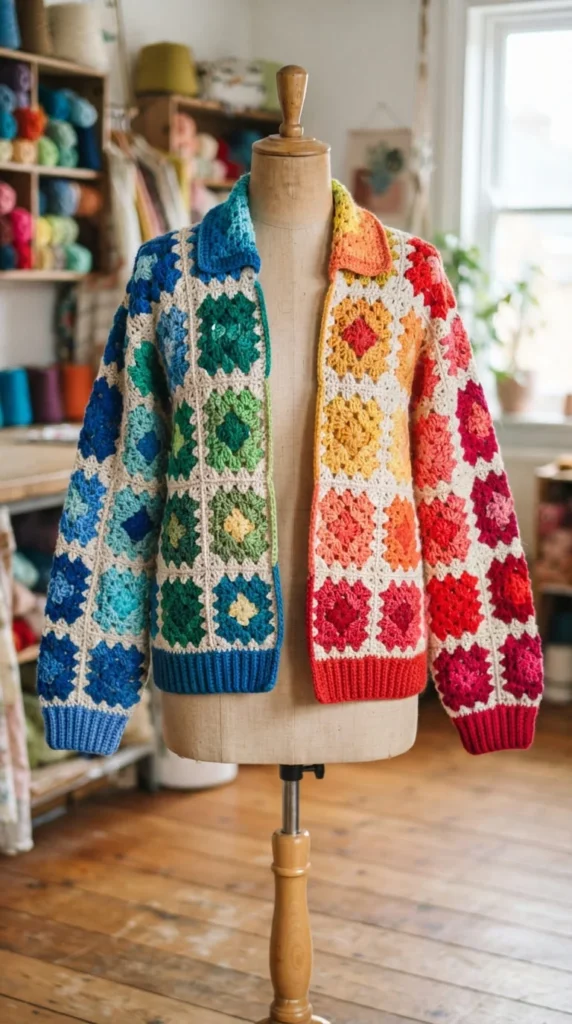
Instead of scattering colors randomly, this cardigan arranges squares in a deliberate gradient, moving gradually from one color to the next across the body. The effect reads as intentional and polished, even though the individual squares themselves are no harder to make than a classic version.
Plan your gradient order before you start crocheting a single square. Lay your yarn balls out in sequence, photograph the order, and refer back to it throughout the project so you don’t lose track over several weeks of work.
A simple numbered grid, even just sketched on paper, keeps this project organized far better than trying to remember the sequence from memory alone.
Layout tip: work slightly more squares in your two anchor colors — the start and end of the gradient — than the colors in between, since those anchor shades tend to dominate the visible edges of the finished cardigan.
6. Monochrome Tonal Granny Cardigan
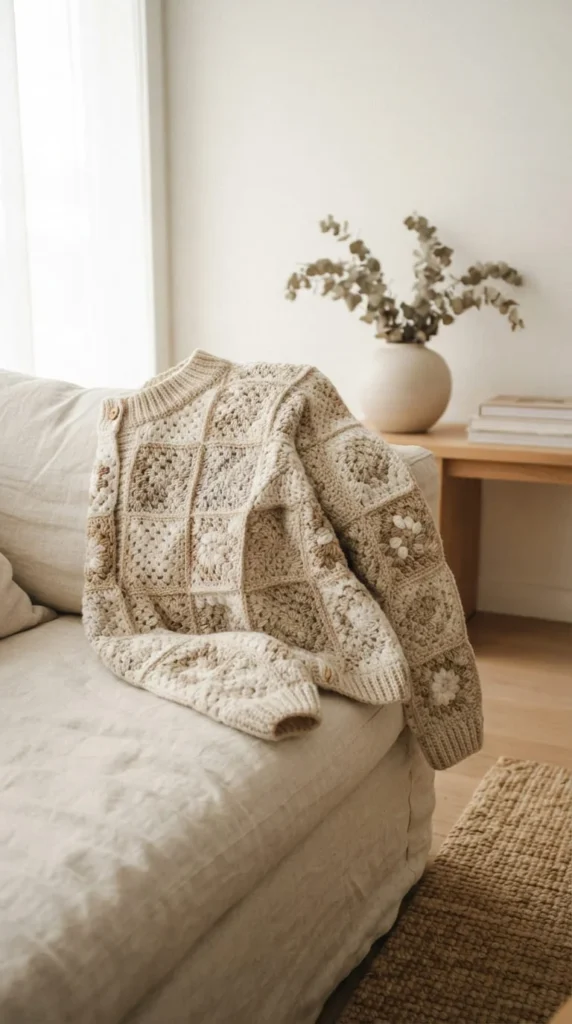
Staying within a single color family — several shades of blue, or a range of warm neutrals — gives this cardigan a sophisticated, cohesive look without the planning complexity of a full rainbow gradient. It’s an easier color scheme to shop for, too, since most yarn brands sell tonal ranges within one color line.
Because the squares are all similar in tone, small differences in your stitch tension become slightly more visible than they would be against a busier, more colorful layout. This makes monochrome projects a good tension-building exercise.
Vary the placement of your lightest and darkest shades across the cardigan rather than clustering them, so the eye moves naturally across the piece instead of settling on one heavy, dark section.
Yarn tip: buy your tonal yarn in one purchase rather than restocking later, since dye lots can shift slightly between batches even within the same named color.
7. Oversized Cocoon Wrap Cardigan
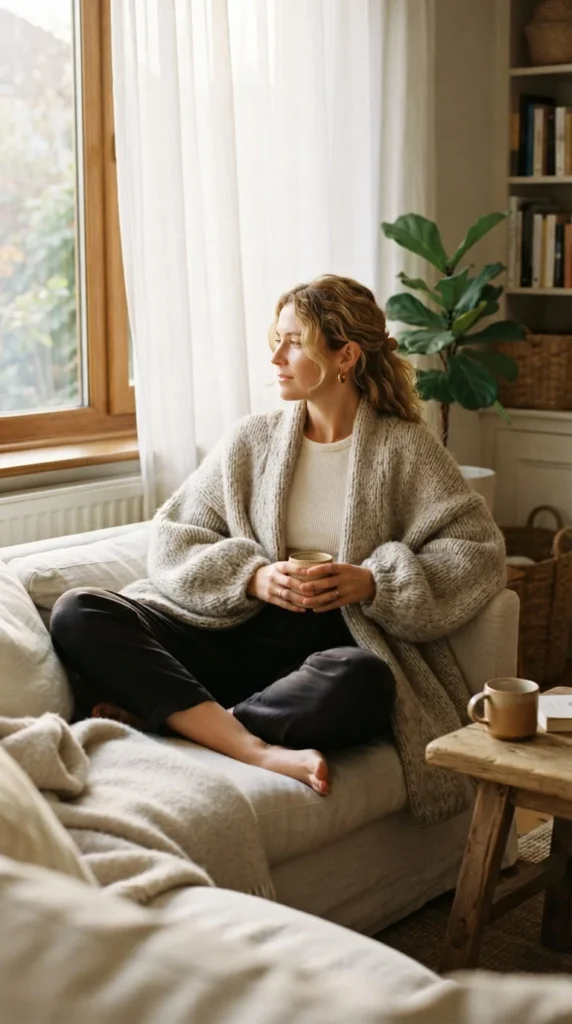
Built from larger granny squares than a standard patchwork cardigan, this cocoon wrap style favors a loose, enveloping fit over a fitted silhouette. Fewer, bigger squares mean less joining overall, which suits a reader who wants a substantial finished piece without an equally substantial number of seams.
Because the squares are oversized, each one takes longer individually, even though you’re making fewer of them total compared to a classic cardigan built from smaller motifs.
This style drapes best in a soft acrylic-wool blend or a brushed cotton, since the goal is movement and softness rather than the crisper structure a firmer cotton would give.
Ergonomic tip: working large squares in a heavier yarn over long stretches can tire your hands faster than smaller projects. Take breaks every twenty to thirty minutes, and consider an ergonomic-grip hook if you notice soreness building up during long joining sessions.
8. Cropped Granny Square Bolero
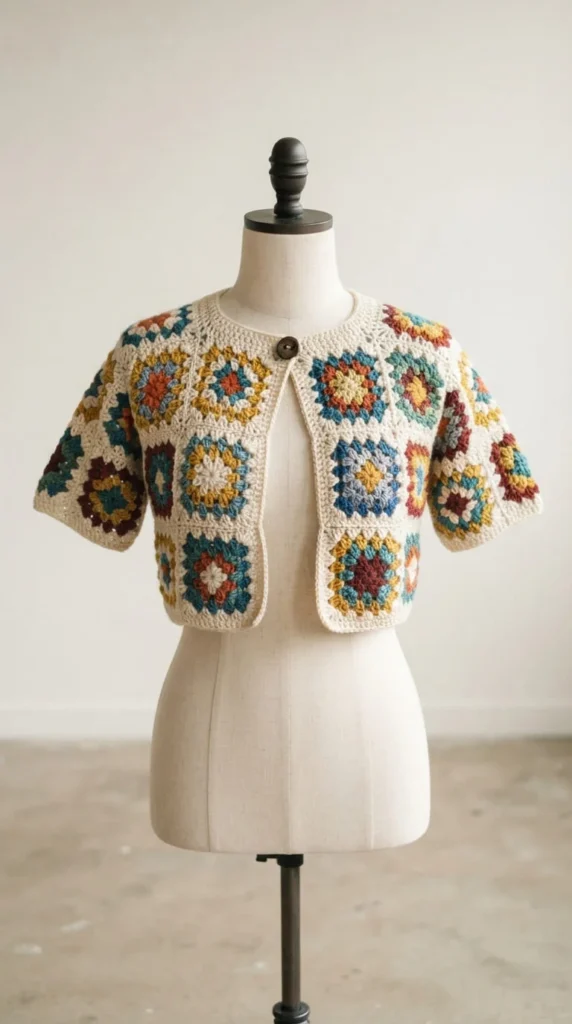
A bolero stops well above the waist, using far fewer squares than a full-length cardigan, which makes it one of the faster projects on this list despite still requiring careful joining. It’s meant to be worn open over dresses or high-waisted outfits rather than buttoned closed.
Because this style is short, fit matters more in the shoulder and upper body than in the length, so pay close attention to your square size and sleeve width rather than overall body length.
This is a good project for practicing a full square-to-garment workflow — making, blocking, and joining — on a smaller scale before committing to a longer cardigan elsewhere on this list.
Sizing note: since a bolero uses relatively few squares, sizing up or down by a single square per panel makes a noticeable difference in fit, so test your layout against your actual measurements before joining everything permanently.
9. Long-Line Duster Cardigan
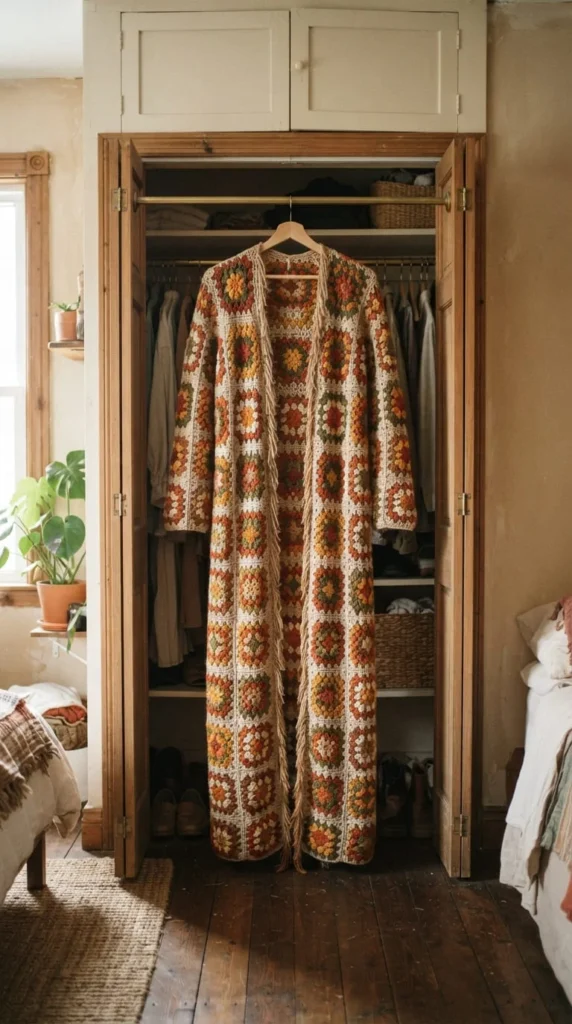
Stretching well past the hip, sometimes close to the floor, a duster cardigan uses significantly more squares than a cropped or waist-length version. The extra length changes how the piece functions in an outfit — this reads more as a layering topper than a fitted garment.
Because there’s no side seam holding the front panels together, small width inconsistencies between squares matter less here than in a fitted, fully seamed cardigan.
Plan for a considerable time investment with this style. Between the square count and the finishing details, this is a genuinely long-term project rather than a weekend make.
Cost estimate: because duster-length cardigans use noticeably more yardage than shorter styles, price out your total yarn needs before starting, especially if you’re buying new yarn rather than working from an existing stash.
10. Ribbed Cuff Button-Front Cardigan
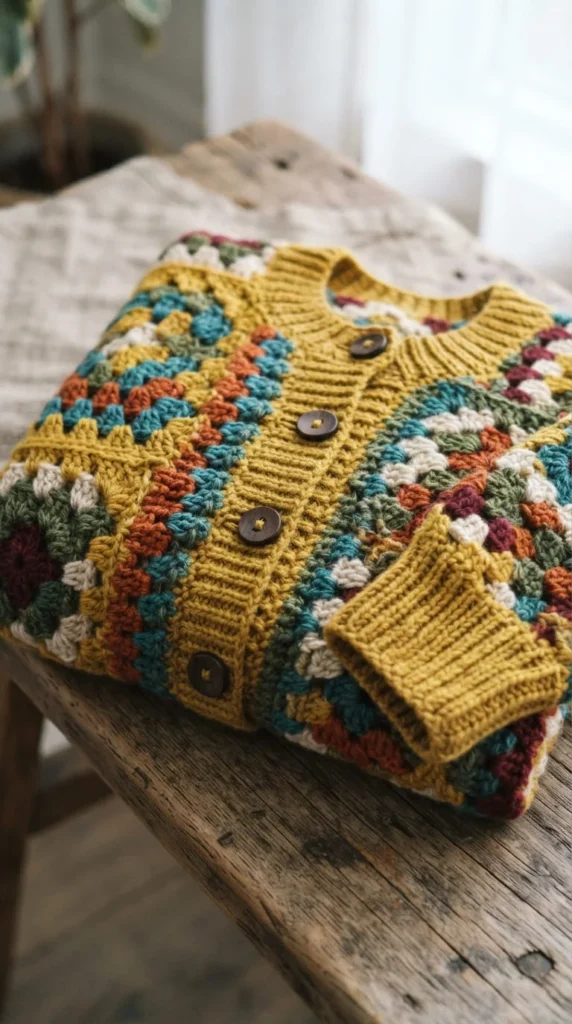
This style pairs classic granny squares with ribbed edging at the cuffs, hem, and front button band, giving the finished piece a more polished, ready-to-wear look than a plain granny edge would. The ribbing is worked in back-loop-only rows, which is what creates the stretchy, textured effect.
If your ribbing curls instead of lying flat, the fix is usually tension-related — try going down half a hook size for just the ribbed sections, since looser ribbing tends to curl more than a slightly firmer version.
The button band is a strip of single crochet worked along the front edge, with evenly spaced gaps left for buttonholes as you go.
Button spacing tip: mark your intended button positions on the finished front edge with scrap yarn before crocheting the band, then space your buttonholes to match. Adjusting spacing after the band is finished is far more difficult than planning it first.
11. Lacy Openwork Granny Cardigan
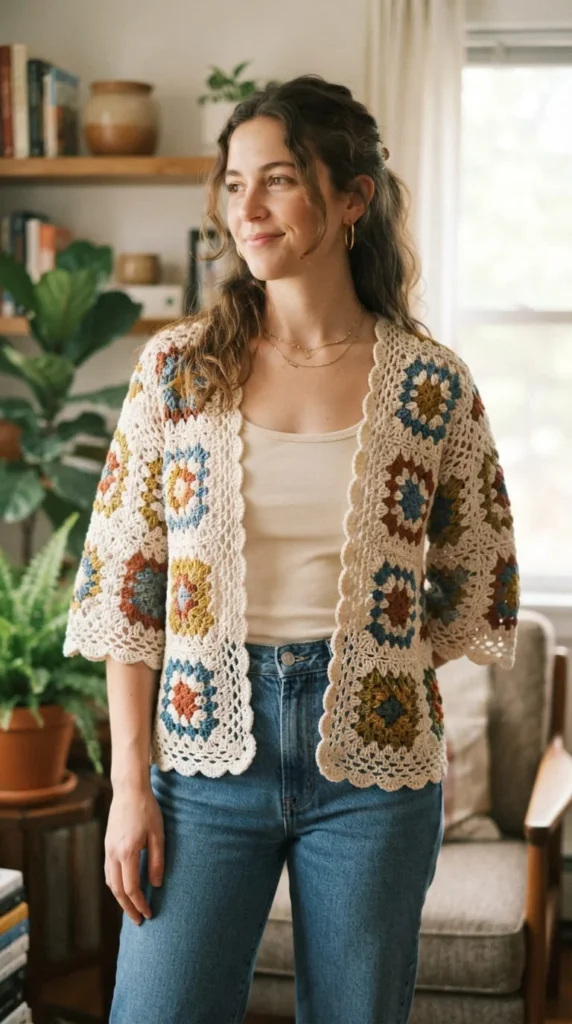
Worked in a more delicate motif with larger open spaces between stitches, this lacy cardigan trades some warmth for a lighter, airier finished piece suited to cooler summer evenings rather than deep winter. The open squares still join the same way as denser motifs, so the assembly process stays familiar even though the stitch itself looks more intricate.
Because the open spacing shows more of whatever is worn underneath, plan this cardigan as a layering piece from the start rather than a standalone garment.
A finer yarn weight suits the lacy aesthetic better than a bulky one, which tends to close up the open spaces and lose the delicate effect the pattern is going for.
Coverage tip: pair this cardigan with a solid-color cami or fitted tank in a shade that complements rather than clashes with your yarn choice, since the lace pattern will let quite a bit of the layer underneath show through.
12. Vintage 1970s-Style Revival Cardigan
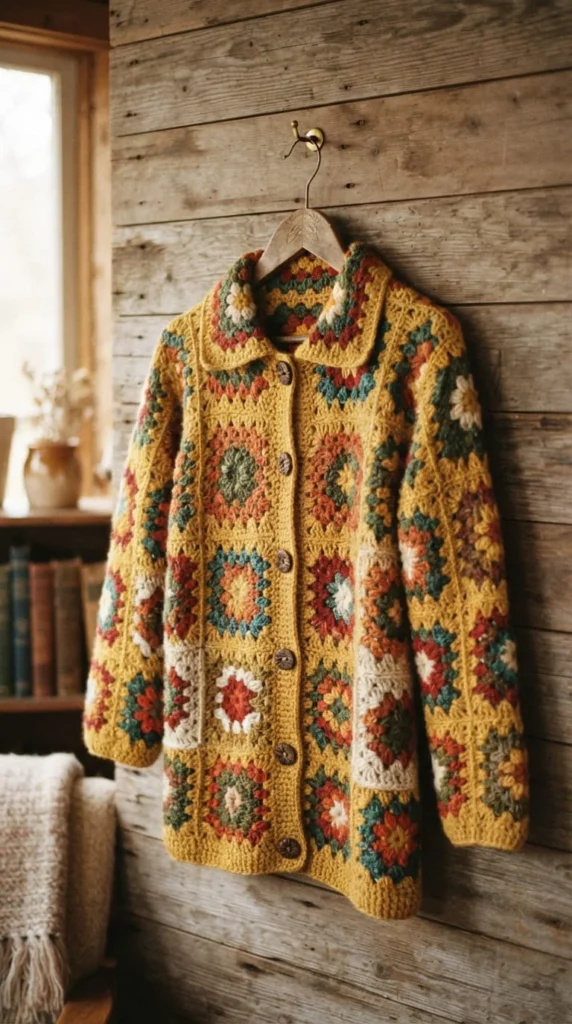
Bold, saturated colors and a classic square-by-square patchwork layout give this cardigan an intentionally retro feel, drawing on the aesthetic that made granny squares popular in the first place decades ago. Burnt orange, mustard, avocado green, and warm brown make up a period-accurate palette if you want the look to feel authentic rather than just colorful.
This is a great project for using up assorted yarn from a stash, since the vintage aesthetic actually benefits from slightly mismatched, scrappy color choices rather than a perfectly coordinated palette.
Pair the finished cardigan with modern basics — straight-leg jeans, a simple white tee — to keep the overall outfit from feeling like a costume rather than an intentional style choice.
Styling idea: this piece works especially well thrown over a slip dress or a simple midi skirt, letting the cardigan’s pattern and color do the visual work while the rest of the outfit stays understated.
13. Neutral Earth-Tone Layering Cardigan
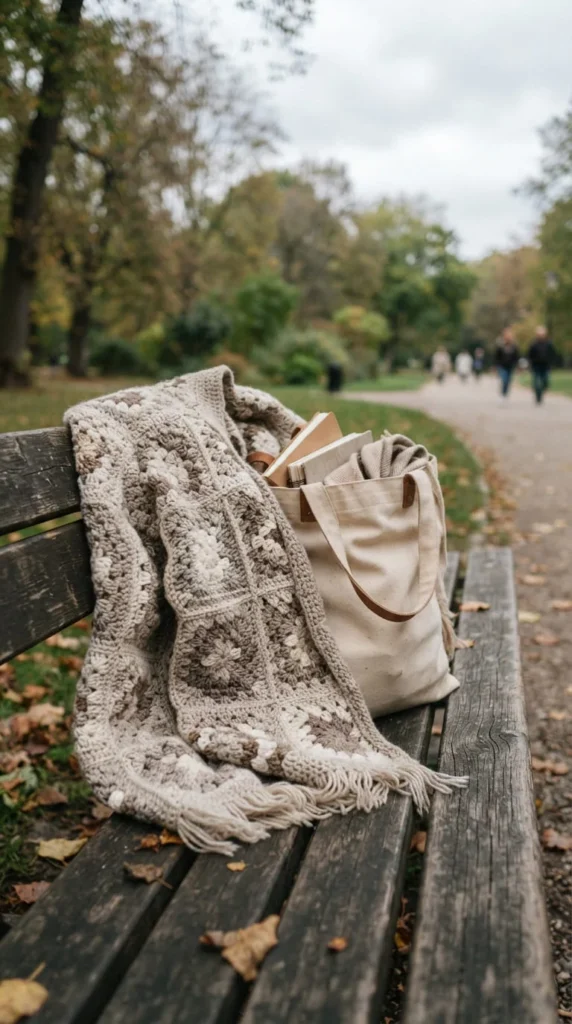
For a reader who wants the texture of granny squares without a bold, colorful statement, this cardigan sticks to a muted, neutral palette — oatmeal, taupe, soft camel, warm gray. It layers easily over almost anything already in your closet, which makes it one of the more practically wearable projects on this list.
Because neutral tones don’t compete with each other visually, tension and stitch consistency become more noticeable than they would in a busier color scheme, so treat this as a good project for tightening up your technique.
This palette also photographs well in almost any lighting, which matters if you’re documenting your handmade projects or sharing them anywhere online.
Fiber tip: a wool-acrylic blend in neutral tones tends to have a richer, more natural-looking texture than a stark white acrylic, which can sometimes look flat or synthetic in photos and in person.
14. Two-Tone Colorblock Cardigan
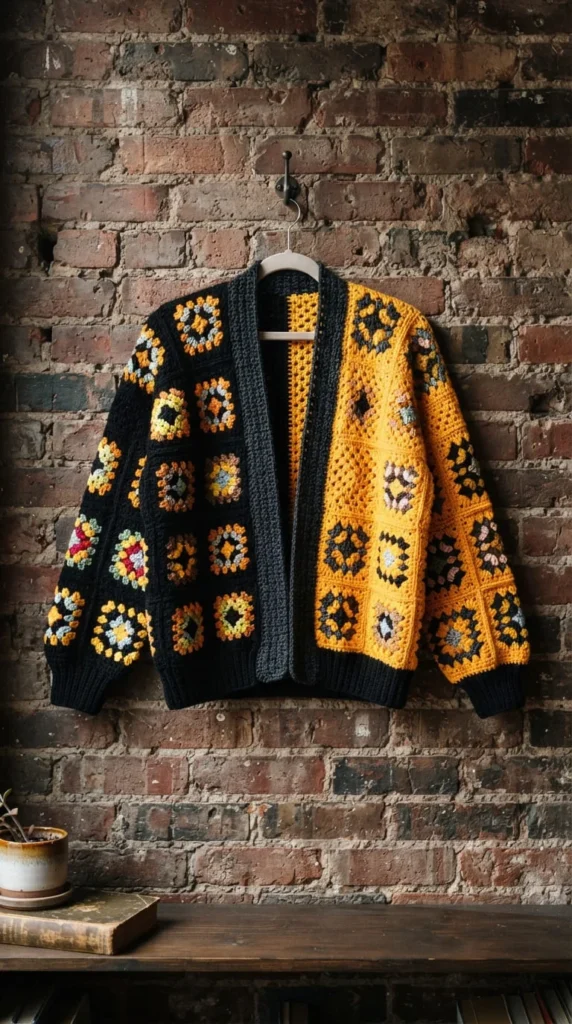
Rather than mixing many colors, this cardigan sticks to just two, arranged in large connected blocks rather than a scattered patchwork. The limited palette makes color planning dramatically simpler than a multi-color layout, while still giving the finished piece clear visual structure.
Choose two colors with enough contrast to read clearly as distinct blocks — a very close color pairing can end up looking like a mistake rather than an intentional design choice.
This is a good beginner-friendly entry point into color layout planning generally, since managing two colors is far less overwhelming than managing six or eight across a full patchwork cardigan.
Layout tip: sketch your two-color block arrangement on paper before crocheting a single square, deciding exactly how many squares of each color you need for the front panels, back, and sleeves, so you don’t run short partway through joining.
15. Mini Granny Square Textured Cardigan
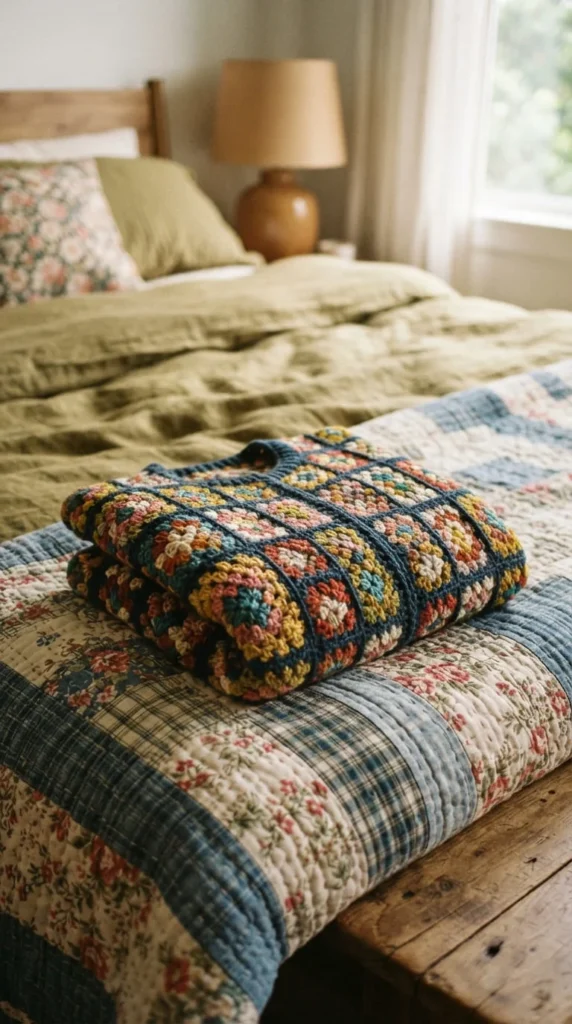
Using smaller squares than a standard cardigan pattern, this style requires more total motifs but produces a denser, more finely textured fabric once everything is joined. The smaller scale also makes color transitions and layout patterns read in finer detail than a cardigan built from larger squares.
Because you’ll be making significantly more squares than a jumbo or oversized version, batch-work this project in sessions, setting a target number of squares per sitting rather than trying to finish everything at once.
The higher square count also means more joining seams overall, so budget extra time for the assembly phase specifically, not just the square-making phase.
Hand fatigue tip: smaller squares mean more starting and stopping, which can be harder on your hands than long continuous rows. Stretch your fingers and wrists between squares, especially during longer crochet sessions.
16. Jumbo Square Chunky Cardigan
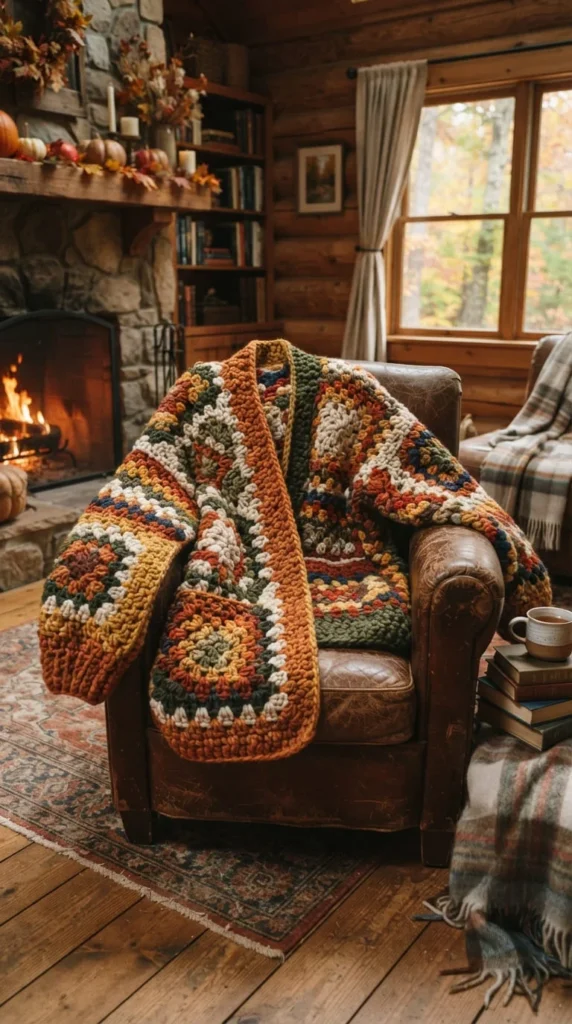
At the opposite end of the scale, this cardigan uses large squares worked in bulky or super-chunky yarn, which means far fewer total motifs and a much faster finish overall. It’s a strong option if you want a genuinely warm, substantial cardigan without months of square-making.
Because the yarn itself is heavier, a larger hook is required, which actually makes the stitches themselves easier to see and count than working with a finer weight.
This project uses a significant amount of yarn per square, so total yardage needs are higher than they’d look based on square count alone — always check the total weight or yardage required, not just the number of squares.
Time and cost estimate: a jumbo-square chunky cardigan can realistically be finished in under two weeks of casual crocheting, though the bulky yarn itself tends to cost more per skein than a standard worsted weight.
17. Scrap Yarn Stash-Buster Cardigan
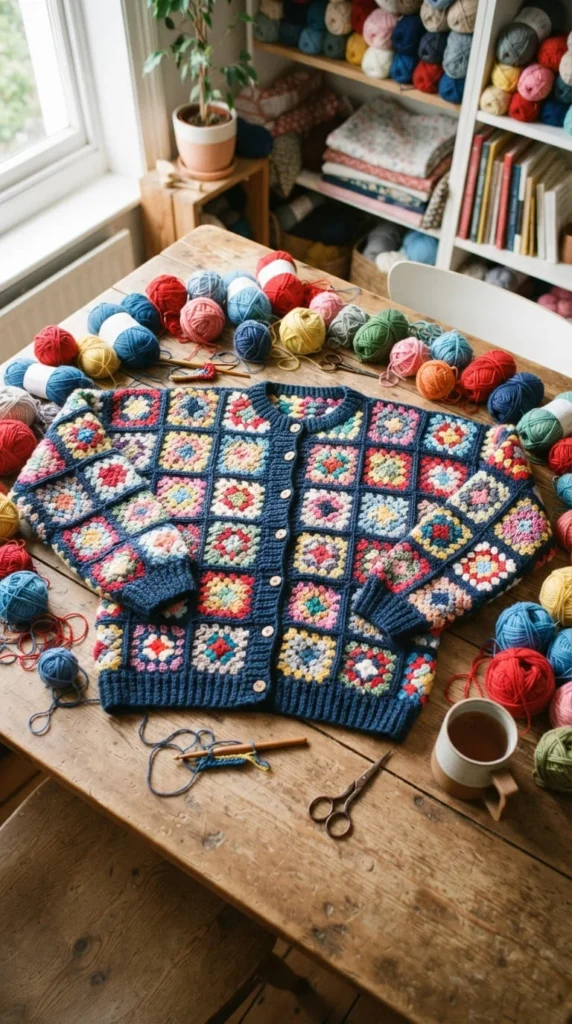
If you’ve been crocheting for a while and have a growing pile of leftover yarn, this cardigan puts it to genuine use. Each square can use a completely different color combination, since the patchwork nature of granny squares hides inconsistency far better than a garment worked in continuous rows would.
Sort your scraps by weight before you start, since mixing yarn weights within the same square can create uneven, lumpy motifs even if the colors themselves look fine together.
This is one of the most budget-friendly cardigans on this list, since you’re primarily using yarn you already own rather than buying a full new project’s worth of skeins.
Color harmony tip: even with a scrappy, mismatched approach, keeping one consistent color — like a cream or black border round — around every square ties the whole patchwork together visually, no matter how different the centers are from square to square.
18. Striped Border Granny Cardigan
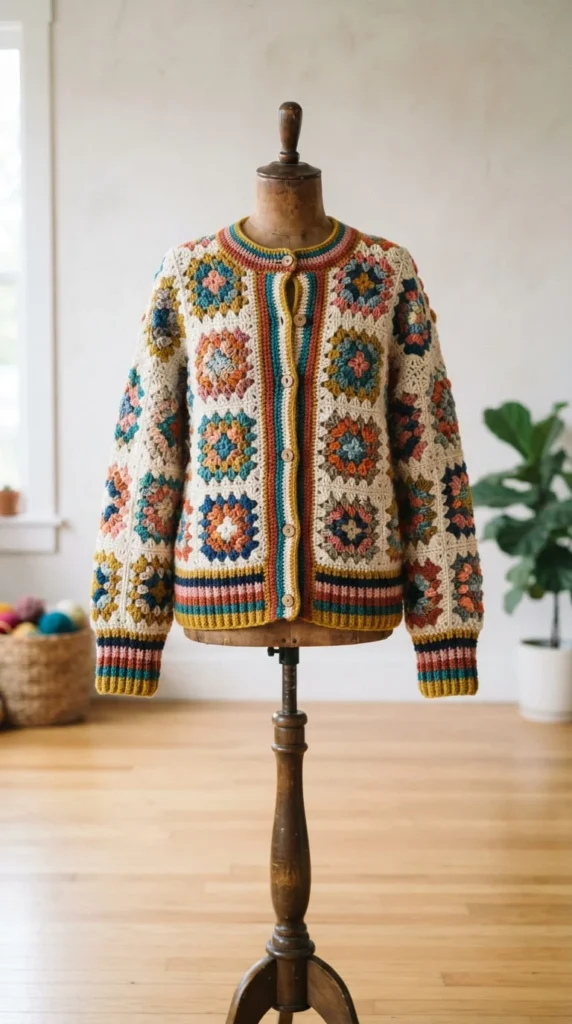
This cardigan keeps the body squares in a simple, restrained palette, then adds a bold striped border around the hem, cuffs, and front edges for contrast. The stripes are worked in straightforward single or double crochet rows, added after the main patchwork body is joined and blocked.
This is a good project for adding a decorative element without redesigning your entire color layout, since the striping is confined to the edging rather than woven throughout the whole garment.
Plan your stripe sequence and width before starting the border, working a small swatch of the stripe pattern first so you know exactly how many rows each color needs.
Finishing tip: block the border separately after attaching it, in addition to blocking your original squares, since added edging can pull the finished garment’s edges slightly out of shape if it isn’t flattened and shaped afterward.
19. Hooded Granny Square Cardigan
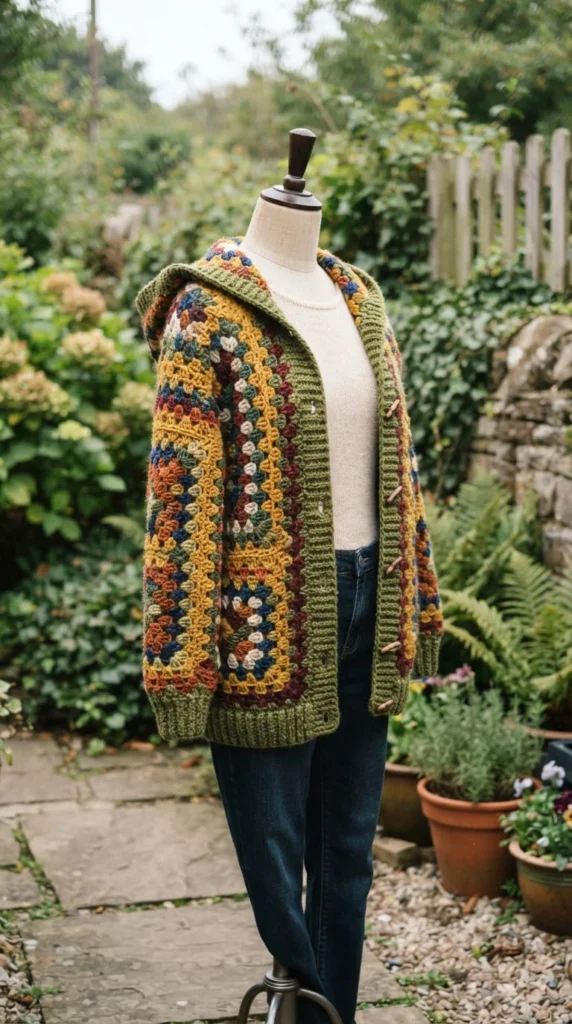
Adding a hood to a granny square cardigan changes both its function and its look, making it suited to cooler weather and more casual, outdoorsy styling than a classic buttoned version. The hood itself is usually worked separately as two mirrored panels seamed together, then attached around the neckline.
Because the hood adds an extra construction step beyond the body and sleeves, this is a good next project once you’re already comfortable with the basic square-to-garment process from an earlier pattern on this list.
Choose a slightly denser stitch or double-thickness hood if you want it to hold its shape and sit up rather than flopping flat, since a single layer of open granny squares can feel a little limp as a hood on its own.
Fit tip: try the hood on before permanently attaching it, adjusting the seam placement slightly if it sits too far forward or back, since hood positioning affects both comfort and how the cardigan looks when worn open.
20. Kimono-Sleeve Granny Cardigan
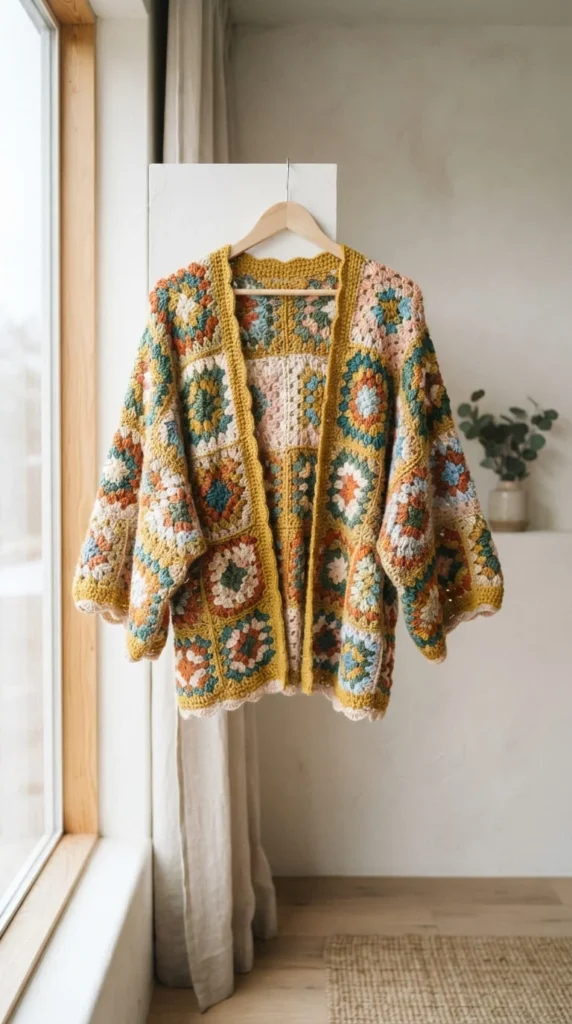
Rather than shaping fitted sleeves, this cardigan attaches wide rectangular sleeve panels at a dropped shoulder line, giving it a relaxed, kimono-inspired silhouette. This sleeve approach is considerably simpler than set-in shaping, since there’s no armhole curve to match.
Because the sleeves are rectangular, any small width differences between your squares are far less noticeable here than they would be in a fitted sleeve style, making this a forgiving choice if your gauge runs slightly inconsistent.
This style suits a drapier yarn especially well, since the wide sleeves benefit from movement rather than structure.
Sleeve fit tip: pin the sleeve panel to the body before permanently joining it, checking that it hangs evenly on both sides. Easing a slightly mismatched sleeve into place before seaming is far easier than unpicking a finished seam later.
21. Belted Wrap-Style Cardigan
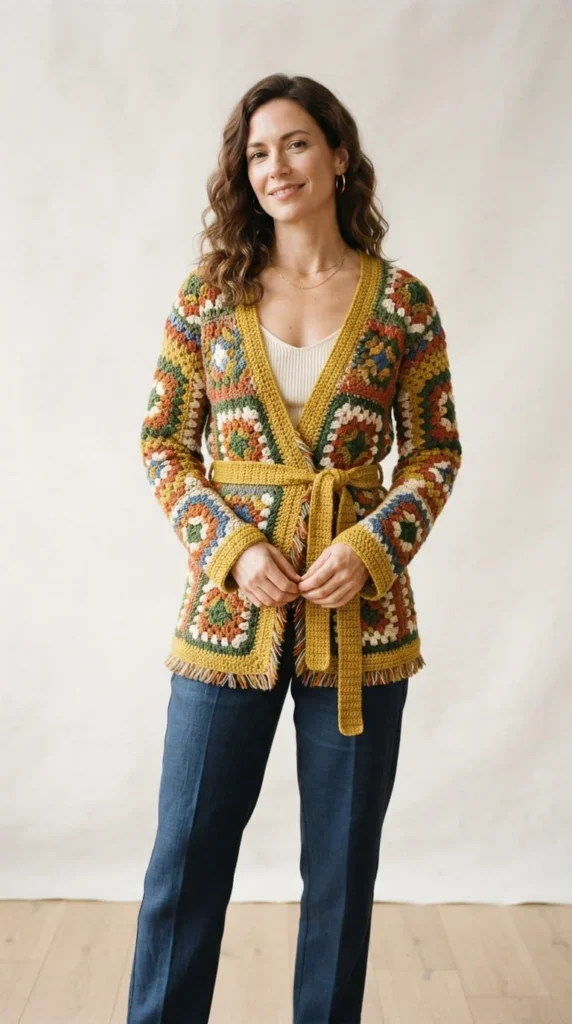
Instead of buttons, this cardigan closes with a crocheted belt or long tie, wrapping around the waist to define shape rather than relying on a fitted pattern. The belt is simply a long strip of double crochet or single crochet, worked separately and threaded through waist-level loops or simply tied over the front panels.
Because the wrap-and-tie closure is adjustable, this style is more forgiving of small fit differences than a buttoned cardigan would be, and it accommodates changes in how you want to wear it — loose and open, or cinched and fitted.
This is a good project for practicing a long, even foundation chain, since the belt itself needs to be worked at a consistent tension to lie flat rather than curling.
Styling note: try the belt at different waist heights before deciding where to attach the loops, since even a small shift in belt placement changes the overall silhouette significantly.
22. Pastel Spring Granny Cardigan
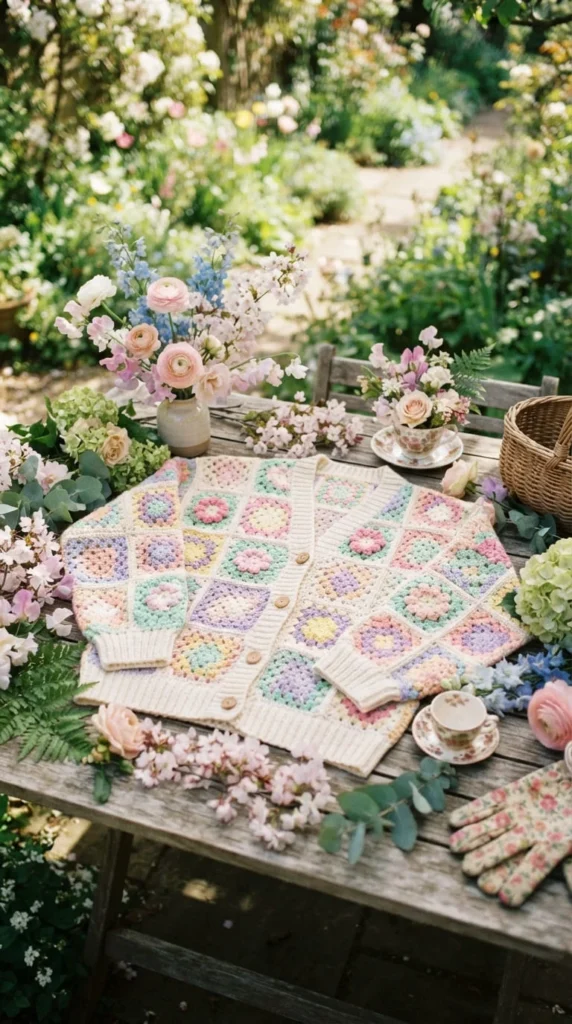
Soft pinks, mints, and light lavenders give this cardigan a gentle, seasonal feel suited to spring wardrobes rather than the bolder tones common in vintage-style versions. The pastel palette also tends to photograph particularly well against greenery and natural light.
Because pastel yarns show tension inconsistencies and color bleeding more readily than darker shades, work a wash-test swatch before starting, especially if you’re combining several different yarn brands within the same project.
This is a nice cardigan for a beginner who wants a colorful project without committing to the higher-contrast planning a rainbow gradient or colorblock cardigan requires.
Care tip: wash pastel-colored squares separately the first time, in case any color transfers, before combining them with other pieces in a single wash load once the cardigan is finished.
23. Autumn Harvest Color Cardigan
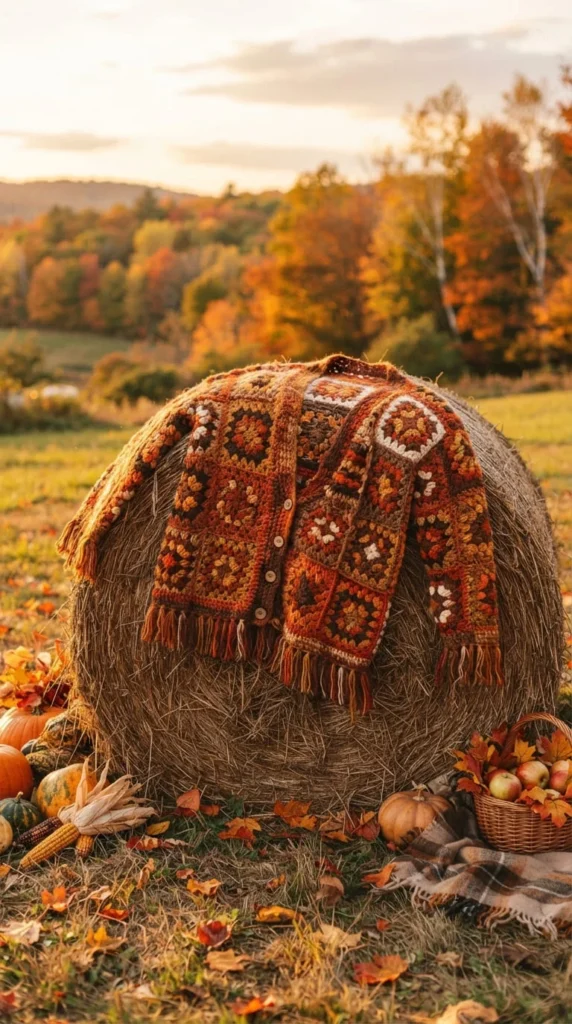
Deep rust, burnt sienna, olive, and warm brown give this cardigan a cozy, seasonal palette that pairs naturally with denim and boots once the weather turns. The color scheme reads as intentional and coordinated without requiring the more complex gradient planning a rainbow layout would need.
A worsted or heavier weight yarn suits this cardigan’s autumn styling better than a lightweight cotton, adding a bit more warmth and substance appropriate for cooler-weather wear.
This palette also works well as a stash-buster if your existing yarn collection leans toward warm, earthy tones from other fall or winter projects.
Mending tip: reinforce high-wear areas like cuffs and buttonholes with a few extra stitches in matching yarn once the cardigan starts seeing regular wear, since these spots tend to loosen and fray before the rest of the garment does.
24. Toddler-and-Me Matching Cardigan Set
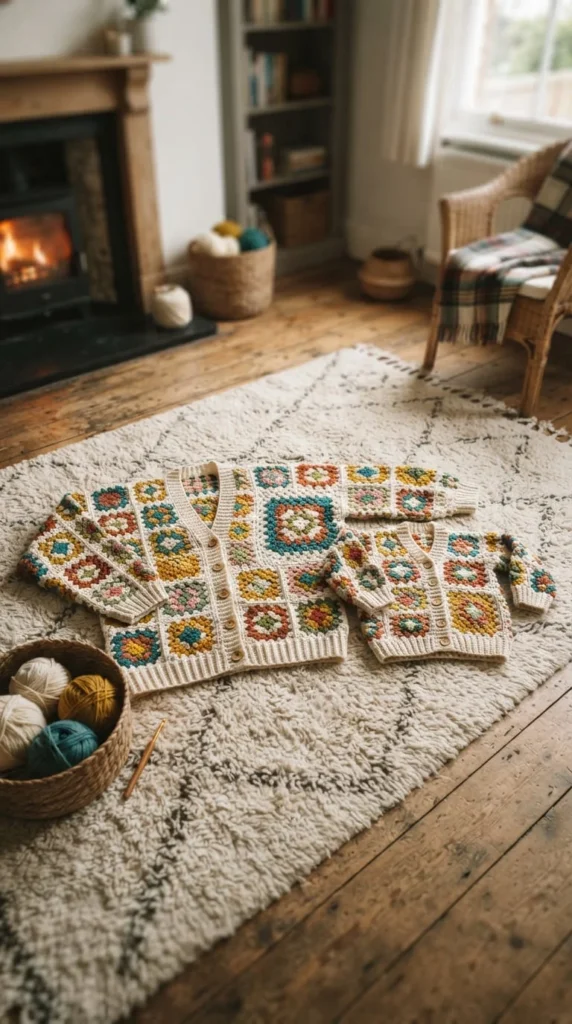
Scaling a granny square cardigan down for a toddler uses the exact same construction as the adult version, just with far fewer total squares, which makes this an approachable way to create a matching set without learning any new techniques.
Because children’s cardigans use significantly less yarn, this is also a good low-pressure way to test out a new color palette or motif style before committing to the full adult-sized version.
Keep in mind that a child’s cardigan will need replacing as they grow, so this project works best with an affordable, easy-to-source yarn rather than a special splurge skein you’d want to save for a longer-lasting piece.
Sizing tip: measure an existing well-fitting cardigan or sweater the child already owns, and use those dimensions to determine your square count and layout, rather than relying only on generic size charts.
Conclusion
A granny square cardigan rewards patience more than raw skill, and the projects on this list are proof that the format flexes to fit almost any style, from a fast six-square shrug to a long-line duster you’ll work on for weeks. Start with whichever version matches how much time and yarn you actually have on hand right now, block your squares before joining no matter which pattern you pick, and keep a simple layout sketch nearby so color planning doesn’t turn into guesswork halfway through. Small habits — batching your squares, testing join methods on spares, pinning sleeves before seaming — make the difference between a cardigan that hangs well and one that ends up back in the yarn stash. Pick your favorite style from this list, gather your squares, and start building a cardigan you’ll actually want to wear for years.