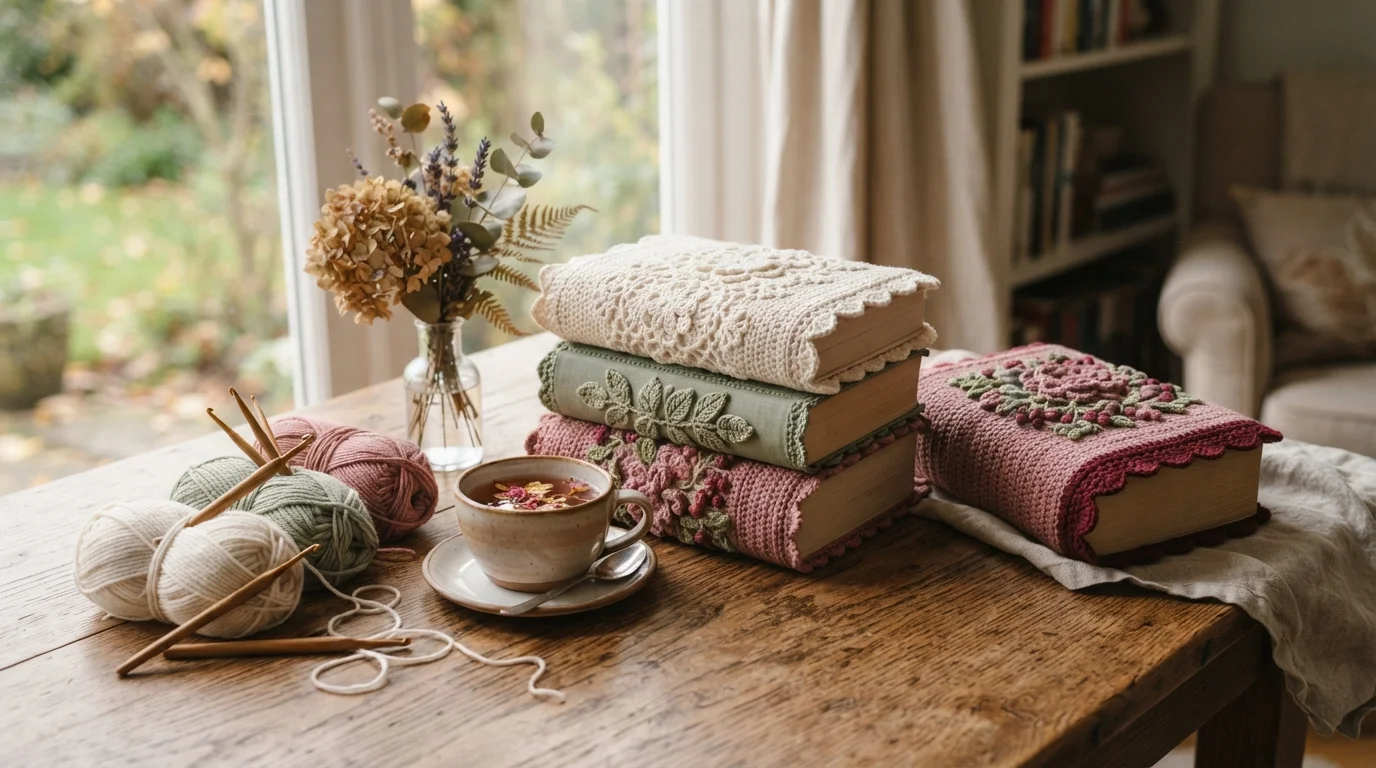
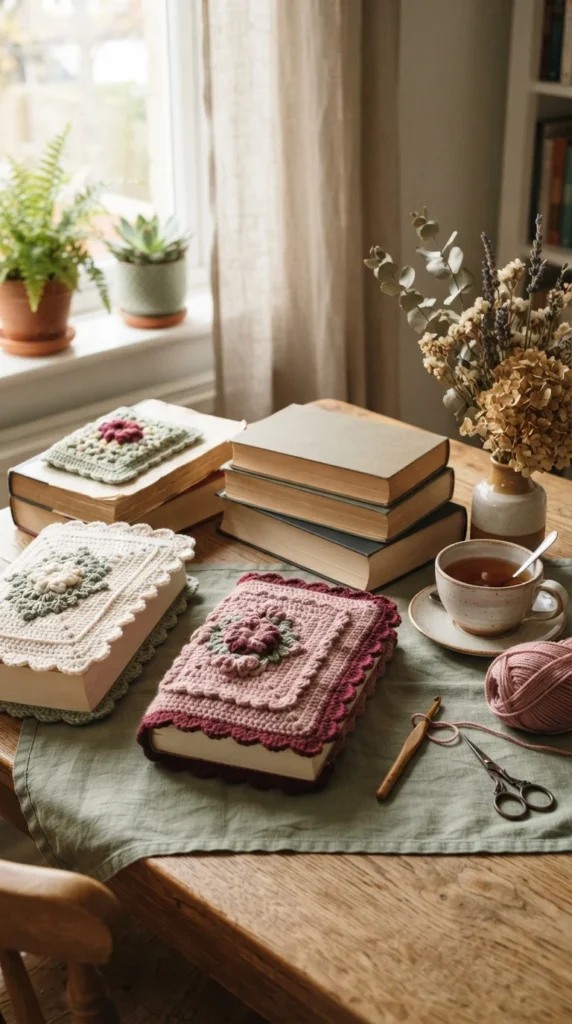
A beautiful book deserves more than a plain place on the shelf. Aesthetic crochet book covers turn everyday reading accessories into soft, decorative pieces that can protect paperbacks, journals, hardcovers, and e-readers while showing off your crochet style. From cottagecore roses and floral granny squares to dark academia colors, textured stitches, bows, and simple neutral designs, there are many ways to create a cover that feels personal. The ideas below include decorative wraps, protective sleeves, Kindle cases, matching bookmarks, and practical DIY details so you can choose a design that suits your yarn stash, crochet level, favorite books, and reading routine.
1. Cottagecore Rose Appliqué Book Cover
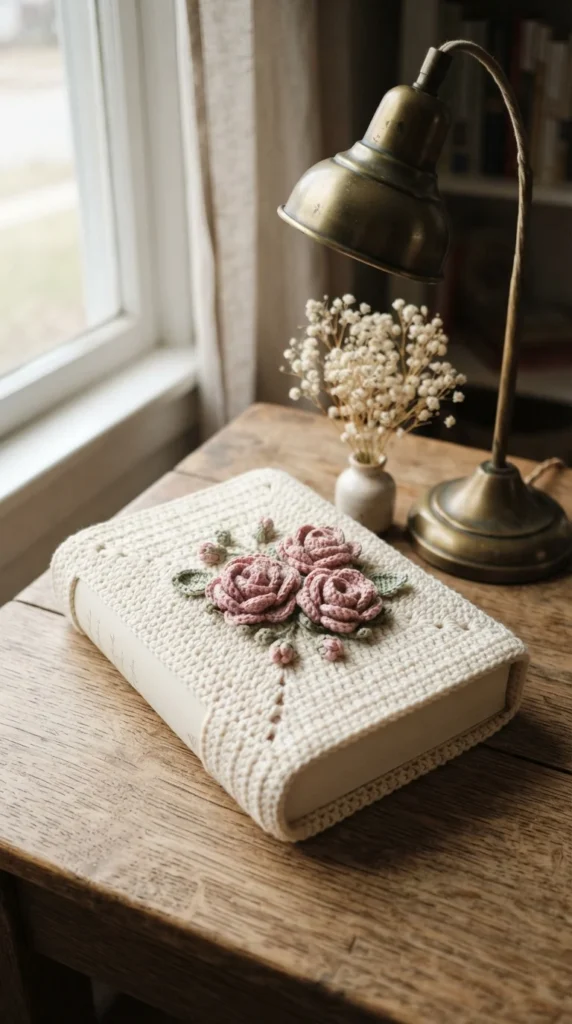
A cream crochet cover decorated with small raised roses is a lovely choice when you want something romantic without making the design overly busy. The neutral background keeps the piece calm, while dusty pink, muted peach, or soft burgundy flowers add just enough detail.
Start with a simple rectangular base worked in single crochet, half double crochet, or moss stitch. A dense stitch works well because it creates a firmer surface for the book. Crochet the rectangle long enough to wrap around the front cover, spine, and back cover, then form pockets at both ends for the book covers to slide into.
The decorative part comes afterward. Make two or three small spiral roses and sew them near one lower corner rather than covering the entire front. Add tiny green leaves for contrast.
For a more polished finish:
- Use cotton or cotton-acrylic yarn for good stitch definition.
- Keep appliqués away from the spine so the book opens comfortably.
- Sew flowers down through several points so they do not flop outward.
- Finish the outer edge with a narrow scallop.
This design works especially well for poetry books, journals, romance novels, or a handmade gift for someone who loves soft cottage-inspired decor.
2. Burgundy Dark Academia Crochet Sleeve
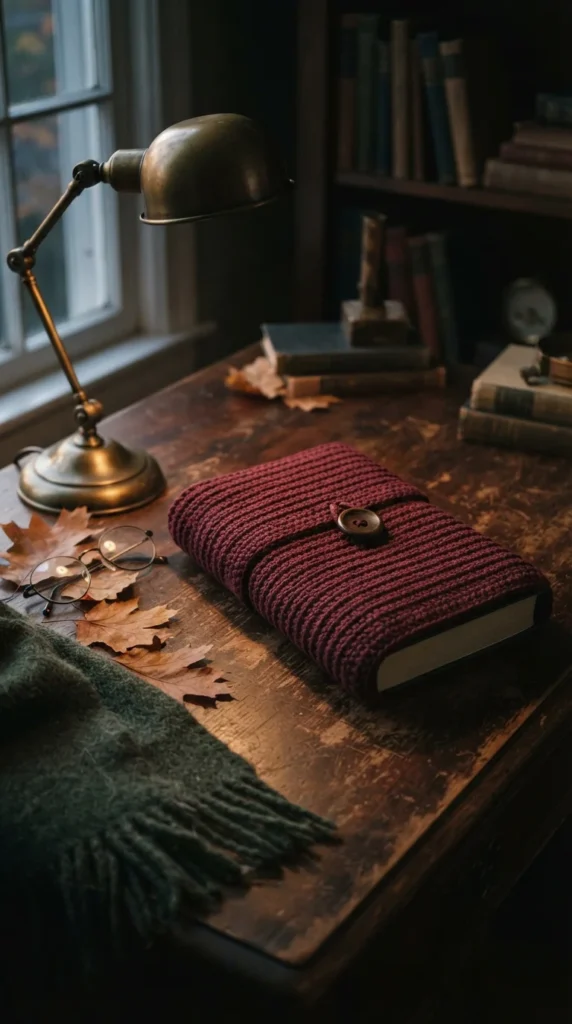
For a moodier reading accessory, try a burgundy sleeve with strong texture and minimal decoration. Deep wine, espresso brown, charcoal, forest green, and muted navy all work well for a dark academia crochet book cover.
Rather than relying on flowers or colorful appliqués, let the stitch pattern create the character. Front-post and back-post stitches, simple ribbing, or a compact basket texture can give the sleeve an old-library feel.
Make the sleeve slightly roomy so a paperback can slide inside without catching on the stitches. If you carry books in a tote bag, add a flap across the top. A single wooden button or crocheted loop can keep the book from slipping out.
A lining can also help when the crochet texture has larger gaps. Choose plain cotton fabric in brown, cream, black, or muted plaid. Hand stitching the lining around the upper edge is usually enough for a small sleeve.
Avoid adding too many decorative pieces. This style looks strongest when the color, texture, and closure carry the design.
Pair the finished sleeve with a thin crochet bookmark in the same yarn. The result feels coordinated without becoming overly decorative, making it suitable for classics, history books, journals, and everyday reading.
3. Patchwork Granny Square Book Cover
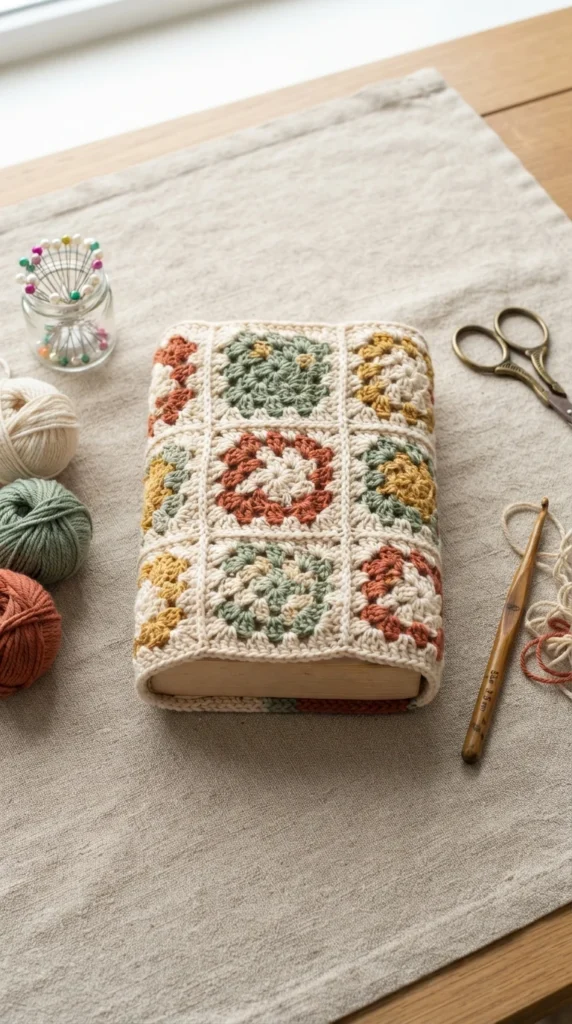
Small granny squares can turn a simple cover into something that resembles a tiny handmade quilt. This approach is especially useful when you have several coordinating yarn leftovers that are too small for a larger project.
Choose three or four colors rather than using every shade in your stash. Cream, sage, rust, and mustard create a warm look, while blush, ivory, lavender, and pale green feel softer.
Crochet enough small squares to cover the front and back of your book. Before joining them, block every square to the same dimensions. Uneven motifs can cause the finished cover to twist or pull along the seams.
Join the squares with slip stitches for visible definition or whip stitch them from the back for a flatter surface. You can then crochet a plain panel for the spine or continue the patchwork around the whole book.
A solid-color inner flap helps keep the project practical. It also prevents the inside from looking too busy.
For easier sizing, place the joined panel around the closed book before attaching the final edges. Adjust the border if the fit feels too tight.
The modular construction also makes this design easy to personalize. Change only the square colors and the same basic layout can suit spring reading, autumn bookshelves, children’s books, or handmade gifts.
4. Sage Botanical Vine Cover
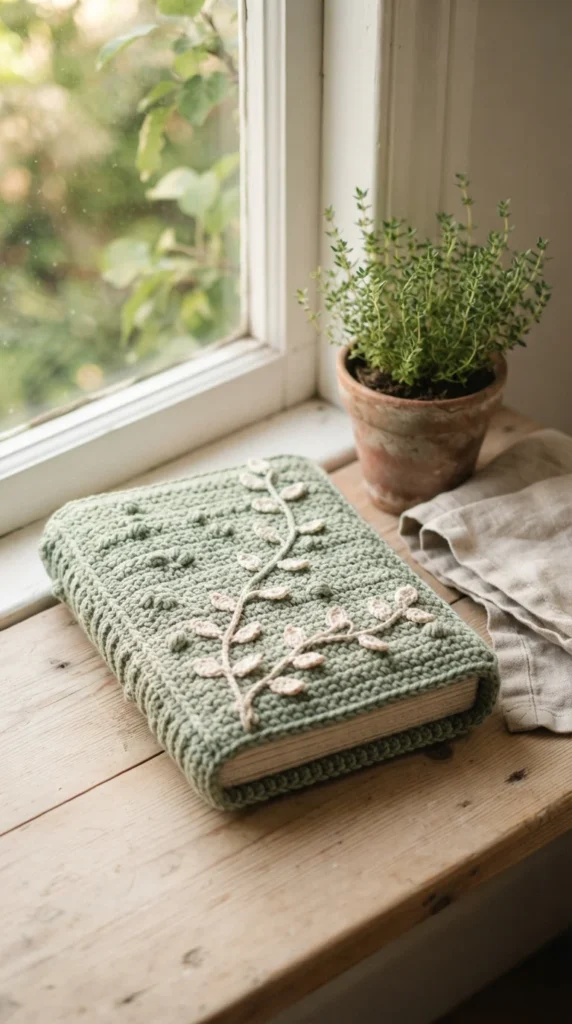
A sage green base with crochet vines gives a book cover a botanical look without requiring large flowers or complicated motifs. It is a good middle ground between a plain cover and a heavily decorated piece.
Work the main cover in a smooth stitch so the vine remains visible. Half double crochet or tight single crochet creates a clean background. Once the cover is assembled, crochet a thin chain in a darker green and sew it across the front in a gentle curve.
Add tiny leaves along the chain. Keep them small and slightly spaced apart so the front remains comfortable to hold.
You can also make the vine travel from one bottom corner toward the opposite side. This asymmetrical placement gives the design movement while leaving plenty of open space.
Try combinations such as:
- Sage with cream leaves
- Olive with dusty pink buds
- Moss green with beige accents
- Soft eucalyptus green with pale yellow details
If your book spends time inside a backpack, flatten each appliqué firmly before sewing it down. Raised leaves look lovely, but oversized pieces may catch on other objects.
A narrow cream border around the outer edge can finish the piece without competing with the botanical detail. This style suits nature writing, garden journals, poetry collections, and calm reading-corner decor.
5. Dusty Rose Scalloped Book Wrap
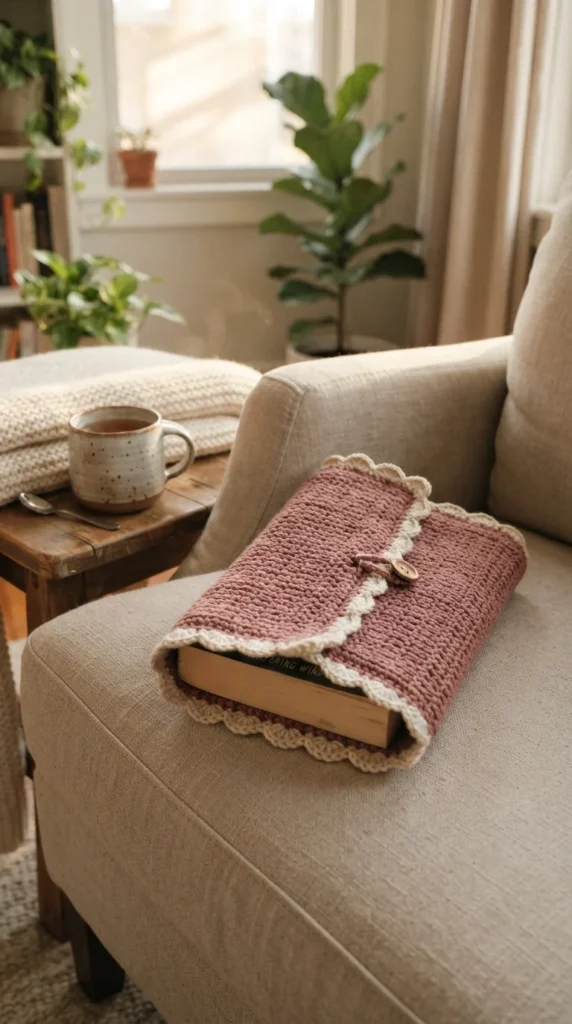
A crochet wrap is useful when you want the decorative look of a cover without making fitted pockets for one exact book. Instead of attaching permanently, the piece wraps around the closed book and fastens with a tie, loop, or button.
Dusty rose yarn works particularly well with a cream scalloped edge. The colors feel soft, while the border adds a handmade finish.
Make the central rectangle long enough to travel around the front, spine, and back. Leave a little room for the book to open rather than crocheting the wrap tightly around it.
Add narrow ties to each end for the simplest closure. Another option is a crocheted loop that stretches over a flat button.
The scalloped border can be added after the main rectangle is complete. Keep it narrow. Large shells around every side may fold under the book or make the cover awkward to hold.
This format is also practical for people who switch between books of similar sizes. One wrap may fit several paperbacks rather than staying attached to a single volume.
For a quieter appearance, use only two colors. Dusty rose and warm cream already provide enough contrast, so additional decorations are optional.
It makes a sweet handmade gift when paired with a matching bookmark or small crochet page marker.
6. Textured Waffle-Stitch E-Reader Sleeve

Not every crochet book cover has to wrap around a printed book. A waffle-stitch sleeve gives an e-reader the same handmade, bookish character while adding a padded-feeling outer layer.
Waffle stitch creates deep recessed squares that look rich even in a single yarn color. Oatmeal, camel, muted brown, sage, charcoal, or dusty pink all suit this texture.
Because the stitch can create a thicker fabric than basic single crochet, measure the device before starting and make a small swatch. Compare the swatch width to the e-reader rather than relying only on a written stitch count.
Work a long rectangle, fold it, and seam the sides. Another option is crocheting two matching panels and joining them around three edges.
For the closure, keep things simple. A crochet loop and flat button add little bulk. If the sleeve will stay mostly at home, an open top may be enough.
Consider adding a smooth fabric lining when using loosely spun yarn. It creates a cleaner interior and keeps small fibers away from the screen.
The main attraction here is texture rather than decoration. That makes waffle stitch a good choice for readers who like handmade accessories but prefer neutral, uncluttered designs.
7. Woodland Cottage Crochet Cover
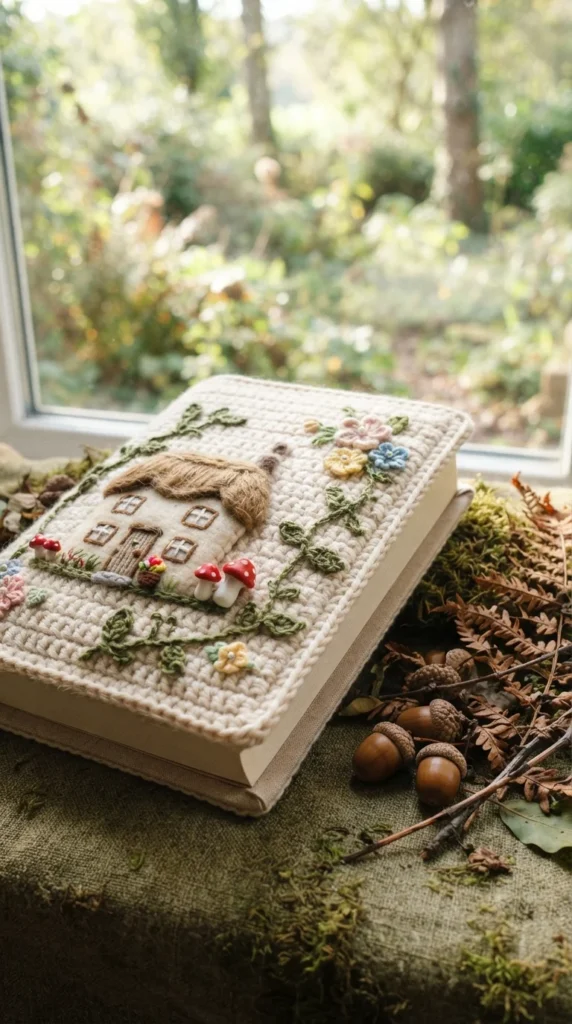
A tiny crochet cottage surrounded by mushrooms, leaves, and flowers can turn the front of a book cover into a miniature woodland scene. This design works best when the background stays simple and the decorative pieces remain small.
Begin with a cream, oatmeal, pale moss, or muted brown base. Crochet it with a close stitch so there is a stable surface for attaching the appliqués.
Make the cottage from basic shapes rather than trying to crochet one complicated piece. A small rectangle can become the house, a triangle can form the roof, and a tiny stitched square can suggest a window without adding actual lettering.
Place one or two mushrooms beside the cottage and run a thin vine around part of the design. Leave open space around the edges.
The key is controlling bulk. Large stuffed pieces may make the book difficult to stack or hold. Flat appliqués sewn closely against the base are much more practical.
Use scraps for the decorative pieces since they require very little yarn.
You can also simplify the idea by using only a cottage and one mushroom. A smaller scene often looks more intentional than filling every available area.
This cover suits fairy-tale collections, nature journals, children’s classics, or anyone building a woodland-inspired reading nook.
8. Daisy Checkerboard Crochet Sleeve
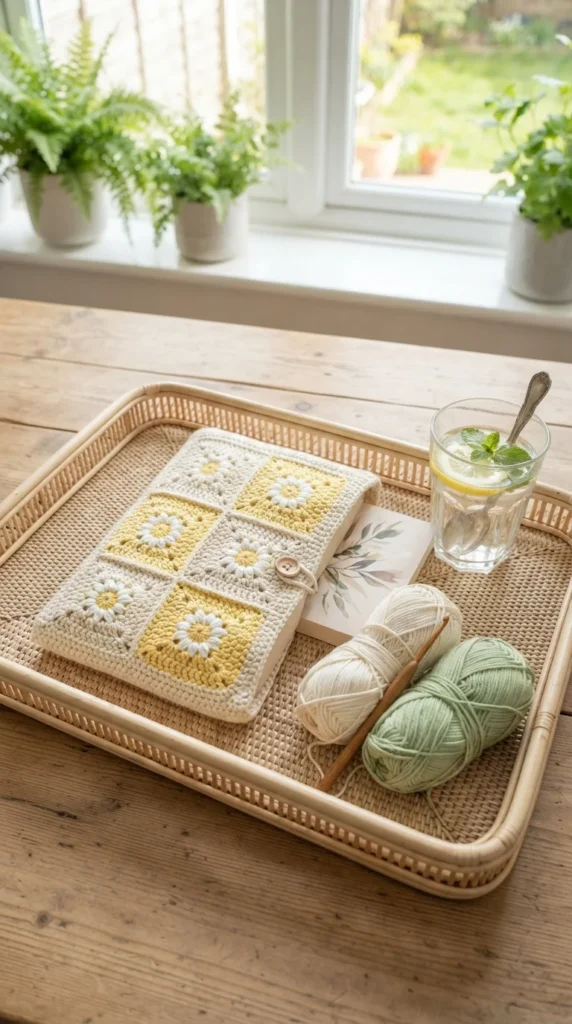
Checkerboard layouts have a graphic quality that works beautifully with crochet, especially when tiny daisies soften the pattern.
Instead of making one large panel, crochet small squares in two coordinating colors. Cream and pale yellow feel sunny, while cream with sage, lilac, or dusty blue gives the same structure a quieter appearance.
Add a small daisy to every second square rather than decorating all of them. The empty squares give the eye somewhere to rest.
Once the pieces are finished, block them before joining. Matching dimensions matter because even a small difference can pull the checkerboard out of line.
Lay the squares around the book before sewing anything together. This lets you move colors around until the pattern feels balanced.
For the back panel, you have two choices. Continue the checkerboard for a fully decorated sleeve, or crochet the back in one solid color to save time.
A simple top edge works better than another decorative border because the squares already provide plenty of detail.
This is also a good design for yarn scraps. Each motif uses a small amount, making it possible to create a coordinated project without buying several full skeins.
The finished sleeve feels playful and works well for spring reading, book club gifts, journals, or cheerful desk accessories.
9. Fabric-Lined Crochet Cover With Bow Ties
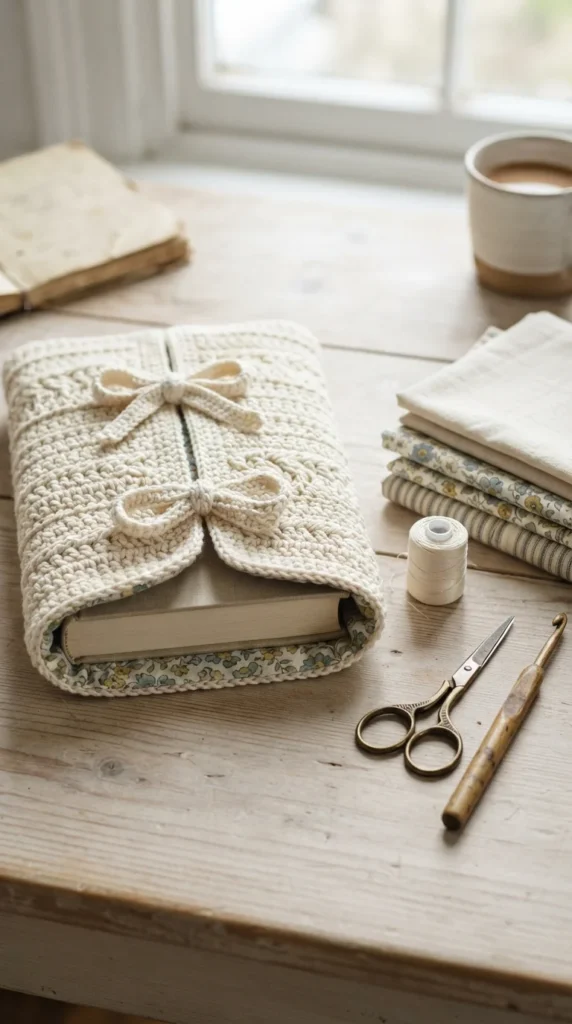
Adding fabric inside a crochet sleeve can make the project feel more finished while keeping small items from catching through open stitches. It is especially useful for lace patterns, granny stitches, or covers made from softer yarn.
Crochet the outer sleeve first. Once you know its finished dimensions, cut two pieces of lightweight cotton fabric slightly larger than the interior.
Sew the fabric pieces together along the sides and bottom, then fold the top edge inward. Slip the lining into the crochet shell and hand stitch around the opening with small stitches.
For the closure, attach two narrow crochet ties near the upper edge. Tie them into a bow after inserting the book.
The bow adds decoration without requiring buttons, snaps, or hardware. It is also easy to replace if the tie becomes stretched over time.
Choose lining fabric that supports the crochet color rather than competing with it. A cream crochet shell might pair with tiny florals, gingham, muted dots, or plain dusty pink cotton.
Keep the lining smooth and avoid heavy fabric that could make the sleeve stiff.
This construction works well for paperbacks, journals, planners, and e-readers, especially when the outer stitch pattern has decorative holes that would otherwise expose the item inside.
10. Minimal Oatmeal Ribbed Book Cover
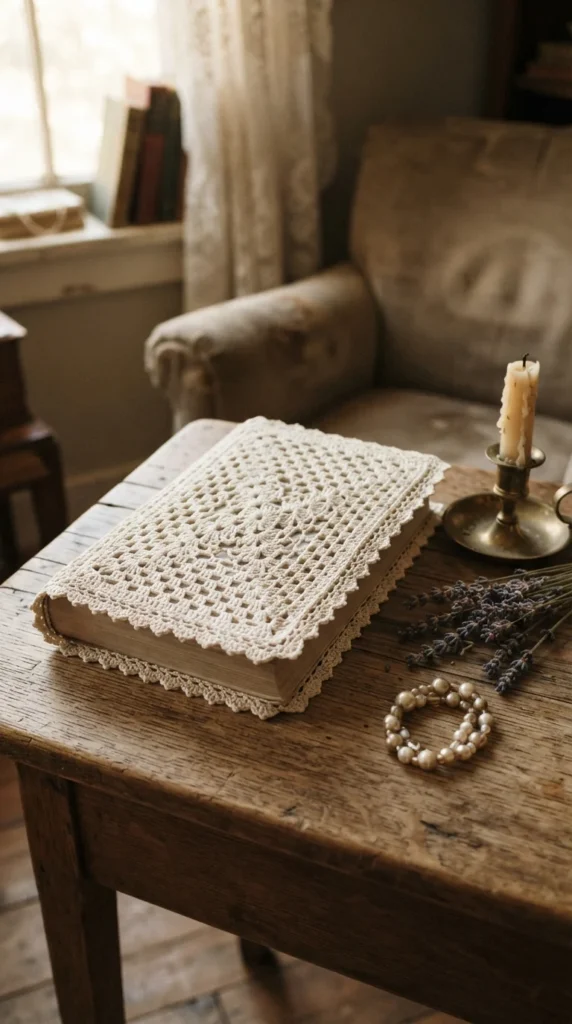
Aesthetic does not always mean highly decorated. A plain ribbed book cover in oatmeal, stone, taupe, or warm gray can look just as beautiful when the stitching is neat and the proportions are clean.
Ribbing is usually created by working into one loop of each stitch or by using post stitches. Either method creates repeated raised lines across the fabric.
For a book cover, keep the ribs running vertically if you want the book to appear taller and more structured. Horizontal ribs create a softer sweater-like appearance.
Use a yarn with good stitch definition. Smooth cotton, cotton-acrylic, or tightly spun acrylic shows the lines more clearly than fuzzy yarn.
Since this design has no appliqués, spend extra time on the finishing:
- Keep both side pockets the same depth.
- Check that the spine area is not stretched.
- Weave yarn ends into the inside.
- Block gently if the edges curl.
A matching border is optional. One row of single crochet around the perimeter is usually enough.
The simplicity also makes this one of the easier aesthetic crochet book covers to adapt to many book sizes. Measure the book, make a rectangle, test the wrap, and adjust before attaching the inner pockets.
It is ideal for readers who prefer neutral home decor and understated handmade accessories.
11. Vintage Lace Granny Book Cover
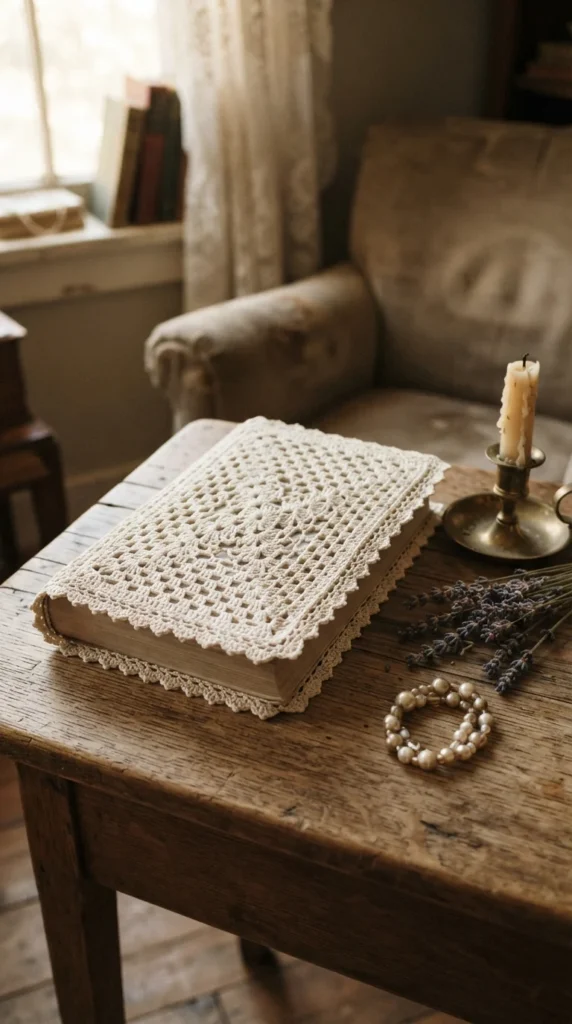
A lace-style granny stitch gives a book cover a lighter appearance than dense crochet while still creating plenty of visual detail.
This design works particularly well in ivory, antique cream, dusty pink, muted lavender, or faded blue. Using one color keeps the open stitch pattern from becoming visually crowded.
Because granny stitches contain gaps, treat this style more like a decorative cover than a rugged protective case. If you plan to carry the book around often, add a lining or place the crochet over a fitted fabric cover.
Work the main rectangle in repeated granny clusters. Check the width against the closed book every few rows because open stitches may stretch more than expected.
Once the base fits properly, add narrow interior pockets using a denser stitch. The difference in texture can help the cover grip the book.
Finish the perimeter with a small shell or picot-inspired edge. Avoid a very wide lace border near the spine, where extra fabric could interfere with opening the book.
For decoration, one tiny flower near a corner is enough. The stitch pattern already provides most of the visual interest.
This style works beautifully for classic novels, poetry books, journals, heirloom-style gifts, or books displayed on an open shelf between reading sessions.
12. Strawberry Gingham Crochet Cover

A strawberry-themed cover can feel playful without becoming childish when the colors stay muted and the motifs are used sparingly.
Start with a gingham-inspired base using cream, blush pink, and a slightly deeper rose shade. The checked effect can be created with color blocks, tapestry crochet, or joined squares.
After finishing the main panel, add two or three tiny strawberries. Crochet each berry as a flat red or dusty coral shape, then attach small green leaves at the top.
Place the berries near one corner instead of spacing them evenly across the whole cover. This keeps the design decorative while leaving comfortable areas for your hands.
For a simpler version, skip the full gingham pattern and make a cream sleeve with one checked pocket across the front.
Cotton yarn is particularly useful here because it shows small color changes clearly and creates a sturdy fabric.
If you carry the sleeve outdoors, avoid thick bobbles for the strawberry seeds. Small embroidered yarn stitches lie flatter and are less likely to catch.
A cream scalloped border can finish the piece, but keep the edge narrow.
This design is ideal for spring and summer reading, recipe journals, gardening books, romance novels, or handmade gifts paired with a strawberry-shaped crochet bookmark.
13. Midnight Moon and Stars Book Sleeve
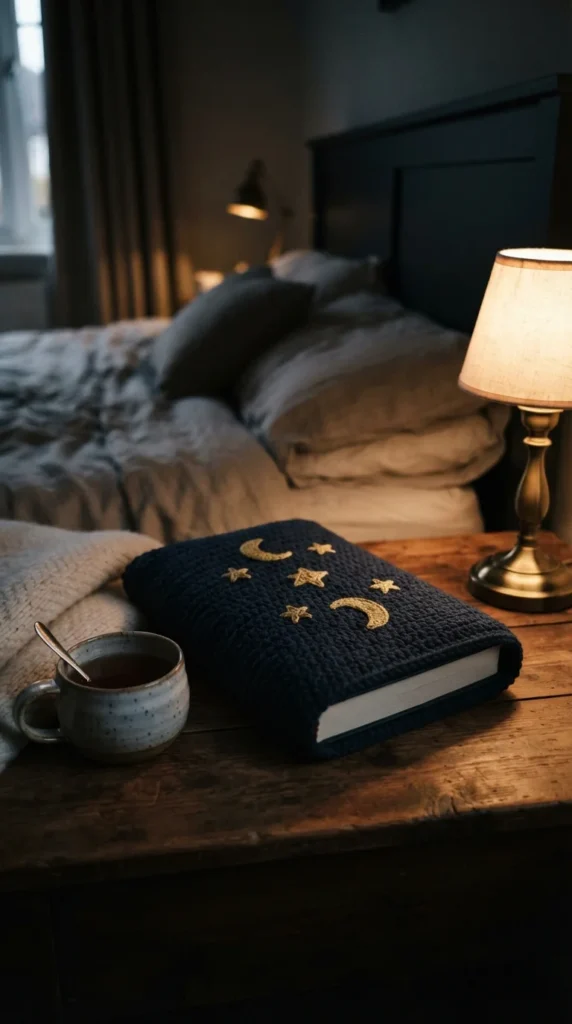
A navy or deep charcoal crochet sleeve with small celestial motifs creates a completely different mood from floral cottage designs.
Choose a dense stitch for the main body. Dark yarn can hide stitch definition, so simple single crochet or half double crochet often works better than a complicated texture.
Create a small crescent moon from muted gold, cream, or pale gray yarn. Add two or three tiny stars around it. Keep every motif flat against the surface.
Rather than centering the moon, position it toward the upper corner. A slightly off-center arrangement can make the sleeve feel more relaxed and modern.
If dark yarn is difficult to see while crocheting, work under a bright task lamp and use a lighter-colored hook or stitch marker to help track rows.
A contrasting inner lining can also make the sleeve easier to use. Cream, warm gray, or mustard fabric creates visibility when placing a book inside.
For the closure, try a simple loop over a matching crochet button.
Avoid metallic threads if the sleeve will be handled frequently. Standard yarn in a muted gold shade gives the same color effect without scratchy fibers.
This celestial idea suits fantasy novels, astronomy books, bedtime reading, dark bedroom decor, or readers who prefer something imaginative without using flowers.
14. Autumn Pumpkin and Leaf Cover
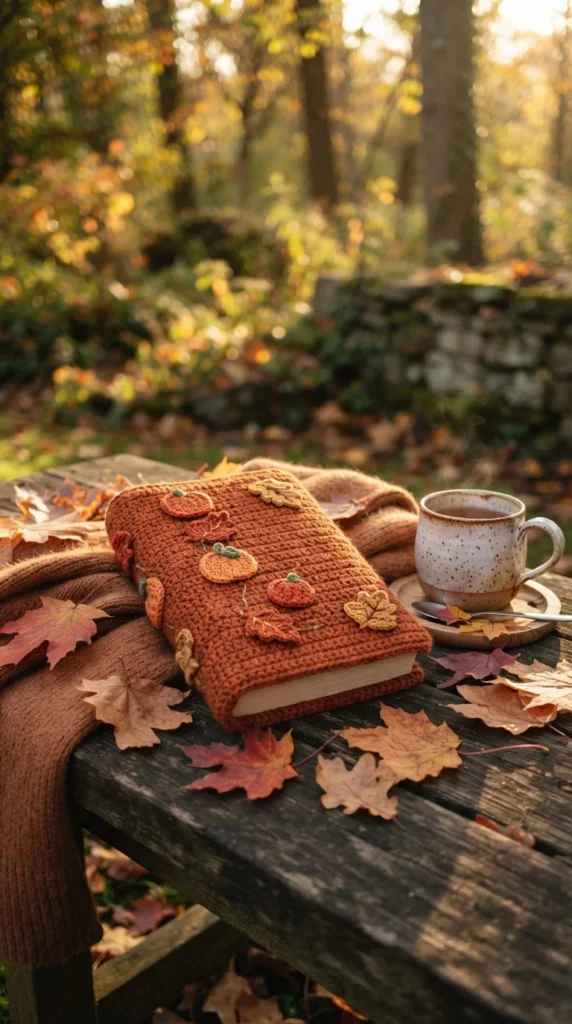
Seasonal crochet works especially well for book accessories because the project is small enough to change throughout the year.
For an autumn cover, use rust, burnt orange, caramel, olive, brown, and cream. You do not have to use every shade. Two or three coordinated colors are usually enough.
Make the base in a warm neutral such as camel or oatmeal. Crochet one flat pumpkin and two small leaves, then arrange them near the lower edge.
A pumpkin appliqué can be made from a small oval with stitched vertical lines. Add a short brown stem rather than making a bulky three-dimensional pumpkin.
Another approach is to crochet the whole cover in rust and use only an olive border. The color alone can create a strong autumn mood.
If you plan to use the cover beyond the season, choose removable decoration. Sew the appliqués onto a small detachable flap or tie-on panel instead of stitching them permanently to the base.
Texture can also support the theme. Ribbed stitches resemble the lines of a pumpkin and give the cover more character without extra pieces.
Pair the cover with a leaf-shaped bookmark in leftover yarn.
The finished set works well for mystery novels, cozy fiction, journals, or reading baskets arranged for cooler weather.
15. Crochet Book Sleeve With a Reading Glasses Pocket
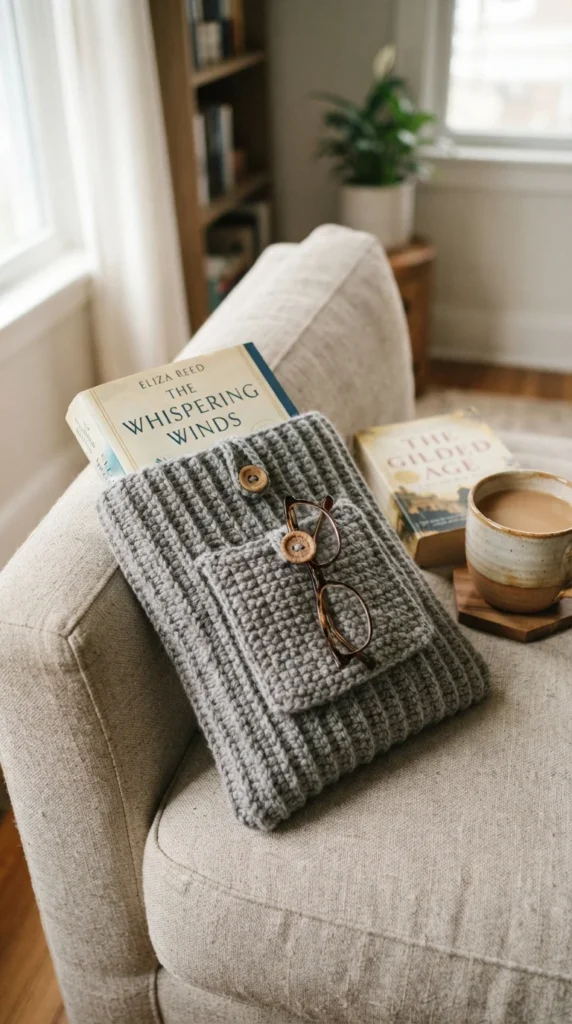
A decorative sleeve becomes even more practical when it carries one small reading accessory. Adding a front pocket gives you a place for reading glasses, sticky tabs, or a slim bookmark.
Crochet the main sleeve first using a sturdy stitch. Then make a separate rectangle for the pocket.
The pocket should be wide enough for your intended item without covering the entire front. Position it slightly below the center so the upper opening remains easy to reach.
Attach the pocket along the sides and bottom, leaving the top open. Reinforce the upper corners with several extra stitches because those points receive the most pulling.
For glasses, use a soft yarn and avoid rough decorative buttons inside the pocket area. A fabric lining can also help protect lenses.
If you plan to store pens, make the pocket narrower and deeper so they cannot fall sideways.
Keep the rest of the sleeve fairly simple. Gray, oatmeal, sage, navy, or dusty rose lets the functional pocket become part of the visual design.
You can also make the pocket in a contrasting color. A cream sleeve with a moss-green pocket looks deliberate without requiring appliqués.
This idea is particularly useful for commuters, students, book club members, or anyone who likes keeping their reading items together in one place.
16. Wearable Crochet Book Pouch With Strap
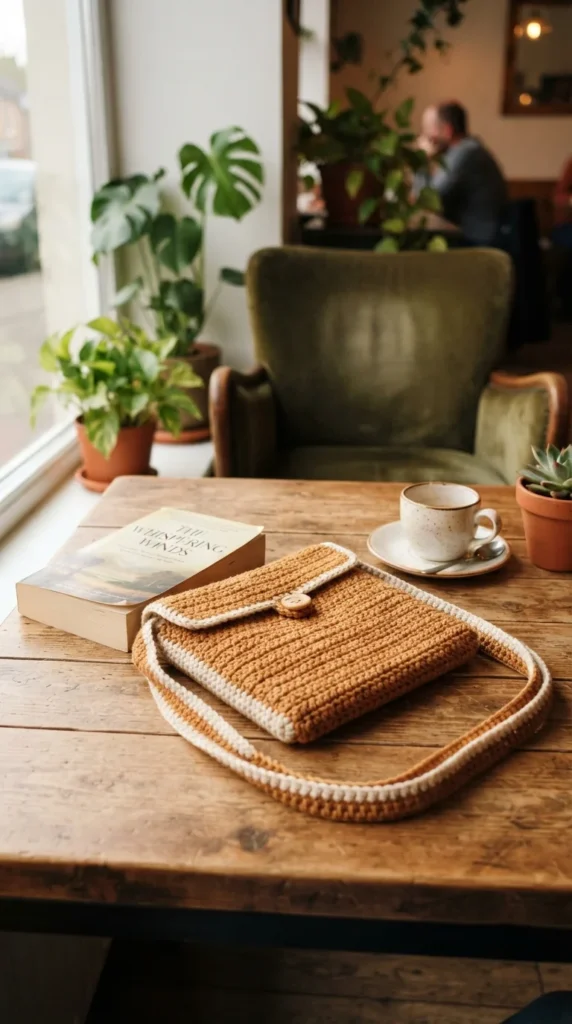
If you often carry one paperback from room to room, to a café, or outside, you can turn a book sleeve into a small wearable pouch.
Start with a standard crochet sleeve, but use a firm stitch and sturdy yarn. Cotton or a durable cotton-acrylic yarn works well because the strap places extra pressure on the upper corners.
After assembling the body, crochet a long strap separately. Test the length before sewing it on. A short strap creates a shoulder bag, while a longer strap allows crossbody wear.
Attach each end across several stitches rather than sewing through one narrow point. Wider attachment areas distribute the weight better.
Add a flap or secure top closure so the book cannot slide out while walking.
Keep the design light. One paperback can already add weight, so thick appliqués, heavy buttons, and multiple layers are unnecessary.
A small interior divider can hold a bookmark, but avoid turning the pouch into a general bag unless you reinforce the base.
Try warm caramel with cream edging, deep green with tan details, or dusty blue with gray.
This idea combines book storage and a wearable reading accessory, making it particularly handy for park reading, cafés, study sessions, or slow weekend walks.
17. Raised Heart Granny Square Cover
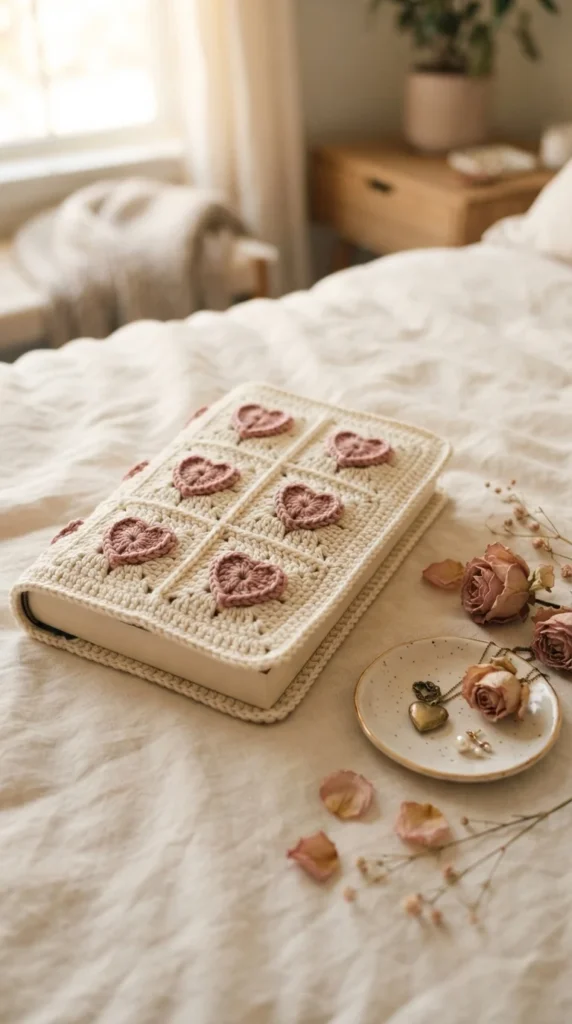
Heart motifs work beautifully on book covers when they are treated as texture rather than oversized decoration.
One approach is creating several small granny squares with a raised heart in the center. Join them into a front panel, then crochet a simpler back panel in one solid color.
Cream squares with dusty rose hearts create a soft romantic style. Burgundy hearts on oatmeal feel warmer, while pale lavender hearts on gray create a cooler palette.
Before joining the squares, check each motif for equal dimensions. Raised centers can alter tension, causing some squares to become slightly wider than others.
Blocking can help flatten the outer edges while keeping the heart texture raised.
If a full panel of hearts feels too busy, use only two heart squares as accents and combine them with plain granny squares.
For the inner pockets, choose a dense stitch. This gives the book better support than repeating the open granny construction inside.
Avoid placing thick raised motifs along the spine. Keep that area flat so the book remains comfortable to hold and open.
A narrow border around the finished panel can hide slight differences between joined squares.
This design makes a thoughtful handmade cover for romance readers, anniversary gifts, friendship gifts, or anyone who enjoys soft decorative crochet with a nostalgic feel.
18. Scrap-Yarn Color-Block Book Sleeve
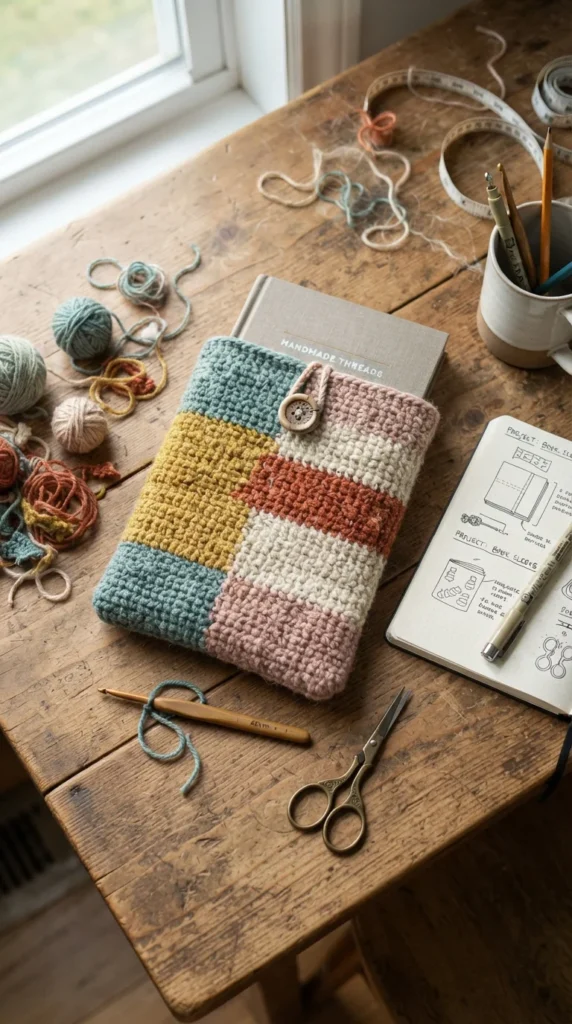
A book sleeve is an excellent small project for using yarn left from larger crochet pieces. Instead of creating random stripes, plan the scraps as intentional color blocks.
Choose yarns with similar thickness. Combining very thin and very bulky strands can make the sleeve uneven even when the colors work well together.
Sort your scraps into three to five colors that feel related. Terracotta, mustard, cream, dusty teal, and brown create an earthy palette. Pink, lilac, gray, and ivory feel softer.
Work each color for several rows rather than changing yarn constantly. Larger blocks look cleaner and reduce the number of ends you must weave in.
Try placing the darkest shade near the bottom and lighter colors toward the opening. Another option is repeating one neutral shade between brighter blocks.
When switching colors, carry yarn only when the gap is short. For larger sections, cut the yarn and weave the ends securely into the inside.
The sleeve shape can remain extremely simple. A rectangle folded and seamed at the sides lets the color arrangement carry the entire design.
Add a plain border using whichever neutral appears most often.
This approach keeps leftover yarn useful while producing a one-of-a-kind reading accessory. No two scrap collections are identical, so every finished sleeve naturally has its own color story.
19. Wooden Button Closure Book Cover
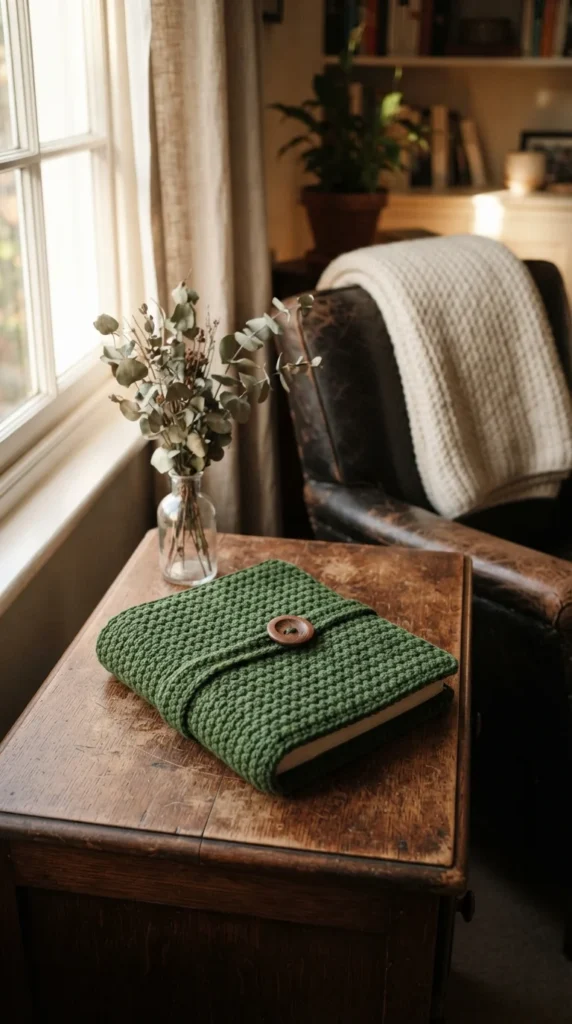
A single wooden button can change the character of a plain crochet cover without adding much work.
Start with a simple sleeve or wrap in forest green, cream, rust, burgundy, oatmeal, or navy. Crochet a flap extending from the back panel, then add a short chain loop at the end.
Position the button only after the book is inside the finished cover. This allows you to find the point where the flap closes comfortably without squeezing the book.
Choose a smooth button with rounded edges. Rough wood may catch yarn fibers over time.
If your button has large holes, sew it on with the same yarn used for the cover. For smaller holes, strong sewing thread may sit more neatly.
Reinforce the area behind the button by stitching through several crochet rows. Repeated opening and closing places pressure on this spot.
You can also crochet a tiny circular backing piece and place it inside the sleeve behind the button attachment.
The closure works particularly well with textured stitches because both materials have a natural handmade appearance.
For extra detail, add a narrow contrasting border rather than another appliqué.
This is one of the simplest ways to give a basic crochet book sleeve a finished, gift-ready appearance while keeping the design practical for everyday use.
20. Matching Crochet Book Cover and Bookmark Set
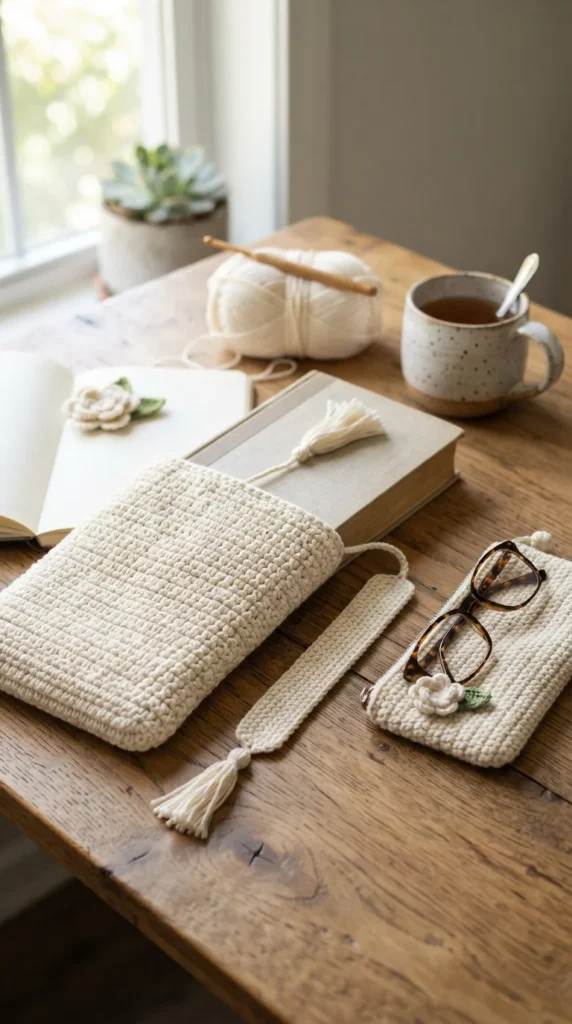
Instead of stopping after the cover, use the remaining yarn to create a coordinated reading set.
A matching bookmark takes very little material and makes the finished project feel more intentional. Crochet a narrow chain-based strip, small lace rectangle, leaf, flower, heart, or tassel-style marker.
Keep the bookmark thin. Thick bobbles or stuffed motifs can place unnecessary pressure between pages when the book is closed.
Use the main cover color for most of the bookmark and repeat one accent color from the cover. If the sleeve is sage with cream flowers, for example, make a cream bookmark with one small sage leaf.
You can also add a tiny page marker that loops around a corner, although it should fit loosely enough that it does not bend the paper.
For a larger gift set, pair the cover with:
- A thin crochet bookmark
- A small glasses sleeve
- A crochet mug coaster
- A tiny yarn tassel
- A simple book charm
Keep the colors consistent across all pieces rather than adding new shades to every accessory.
This approach works particularly well when making gifts for teachers, librarians, book club friends, students, or readers who enjoy coordinated handmade items.
Among all the aesthetic crochet book covers in this list, a matching set offers one of the easiest ways to turn a small crochet project into a complete bookish gift.
Conclusion
Crochet book covers can be as simple as a neutral ribbed rectangle or as decorative as a floral granny-square sleeve filled with roses, leaves, hearts, or woodland details. The best design is the one that matches how the book will actually be used.
Start by measuring your book or e-reader, choose a yarn that suits the amount of handling the cover will receive, and test the fit before closing the seams. After that, let color, texture, edging, closures, pockets, linings, and small appliqués shape the style.
You do not have to make the most complicated option to create something beautiful. A carefully finished border, coordinated button, thoughtful color palette, or matching bookmark can give even a beginner project plenty of character.
Choose one idea from this collection, check your yarn stash, and make a cover around a book you already love. Once the basic construction makes sense, changing the colors and decorative details can give you an entirely different reading accessory for the next book on your shelf.