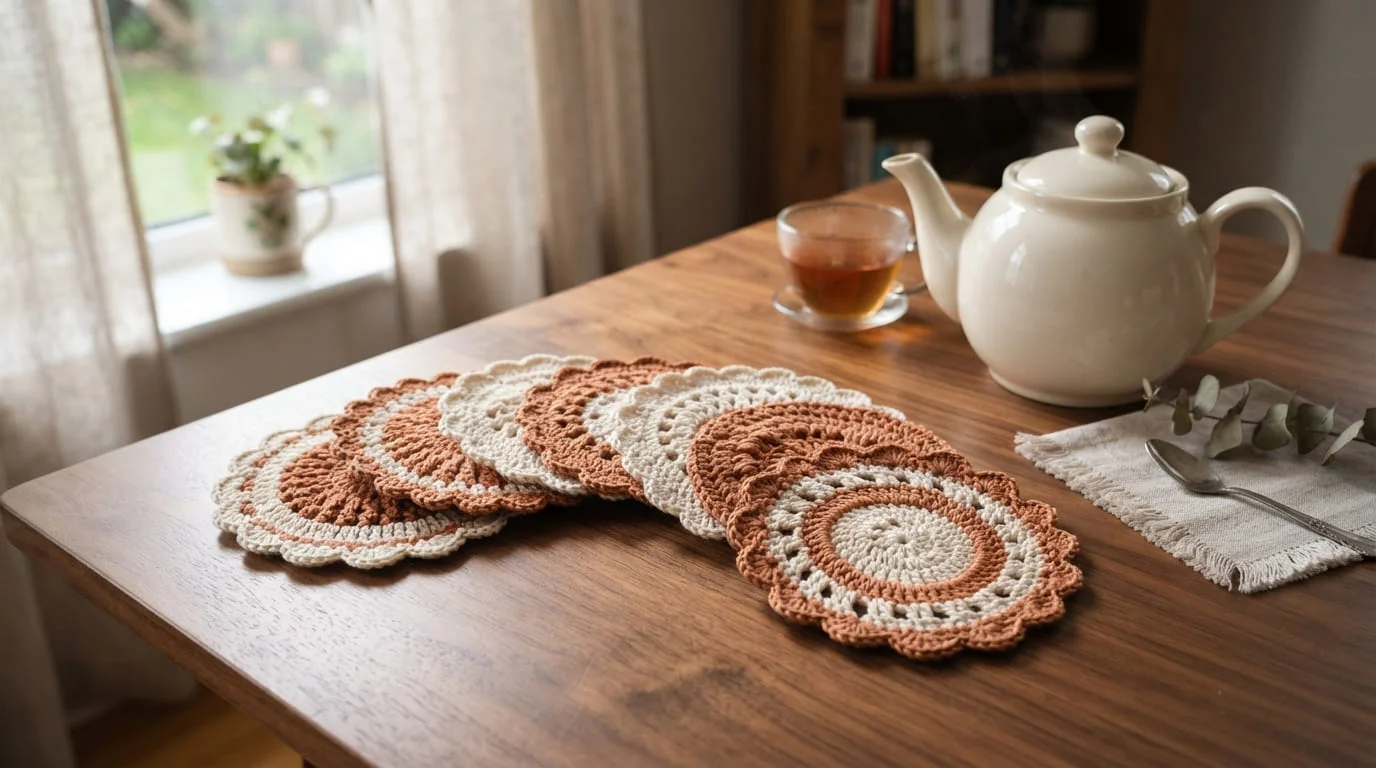
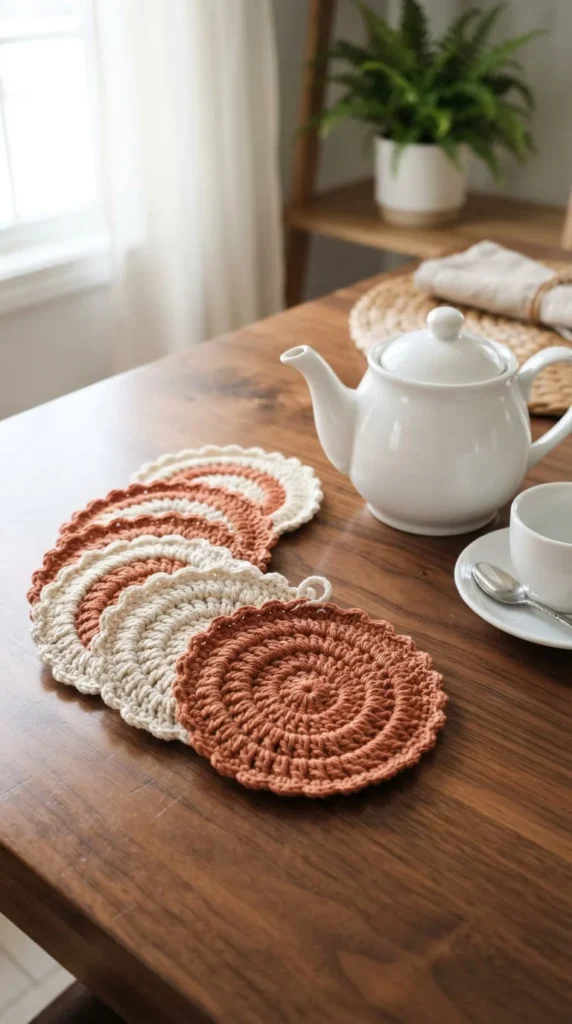
Buying a single coaster rarely solves the problem — most tables need at least four, and a matching set looks far more finished than a pile of mismatched pieces. Crochet coaster sets solve that in one project, and they scale easily from a simple set of four rounds worked in an evening to a coordinated set with a matching trivet, holder, or table runner. This list covers 21 different approaches to building a set rather than a single coaster: how to plan colors so pieces feel coordinated instead of repetitive, which stitches hold up best to years of daily coffee and tea, how to bundle in a bonus trivet or storage holder, and a handful of seasonal and gift-ready ideas you can start today. Whether you’re stocking your own kitchen or building something to sell at a craft fair, these ideas focus on what actually makes a set of crochet coasters feel complete.
1. Classic Set of Six in Mercerized Cotton
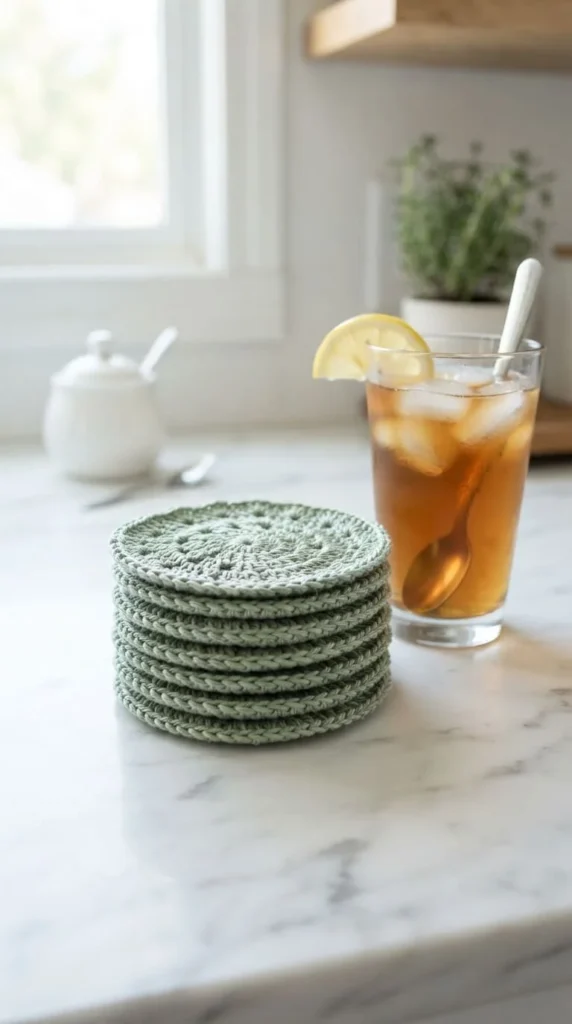
A set of six identical rounds worked in mercerized cotton is the most dependable place to start, and it’s the version most people picture when they hear “coaster set.” Mercerized cotton has a slight sheen and a smoother hand than standard cotton, which gives even a plain single crochet round a slightly more polished look.
Why six instead of four:
- Covers a full dinner table setting without running short
- Leaves two spares for a coffee table or guest overflow
- Divides evenly if you want to gift half the set later
Working all six in the same yarn and stitch keeps the project simple, but it doesn’t have to be boring. Alternating two closely related shades — like sage and moss, or oatmeal and taupe — every other coaster gives the set gentle variation without looking mismatched.
Once the rounds are finished, block each one individually rather than all together. Pin them to the same size and shape while damp, and let them dry completely before stacking. This single step is what keeps a full set looking uniform rather than having a few pieces that sit slightly differently than the rest.
2. Coaster and Trivet Duo Set
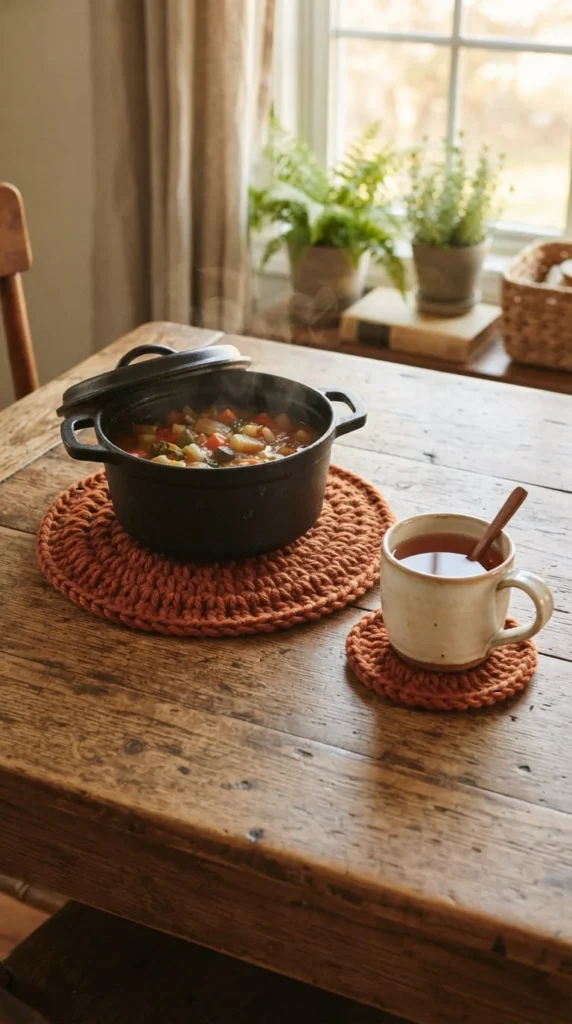
Pairing coasters with a matching trivet turns a small project into something that solves two real problems at once. The trivet uses the same stitch and color as the coasters, just worked several rounds further out, so the whole set reads as one coordinated design rather than two separate projects.
Sizing the two pieces correctly:
- Coasters finished at 4 to 4.5 inches
- Trivet finished at 7 to 8 inches for hot pots and pans
- Use a firmer stitch like single crochet for the trivet, since it takes more heat exposure than a coaster
Because the trivet holds actual cookware rather than just a mug, it benefits from being worked in a double strand of yarn or with a thicker cotton than the coasters. This adds bulk and heat resistance without changing the stitch pattern itself, so the two pieces still look like they belong together.
This kind of set makes a genuinely useful gift for anyone setting up a new kitchen, since it solves two small daily annoyances — hot pans and mug rings — in one coordinated package rather than two separate purchases.
3. Boho Mandala Coaster Set with Scalloped Edges
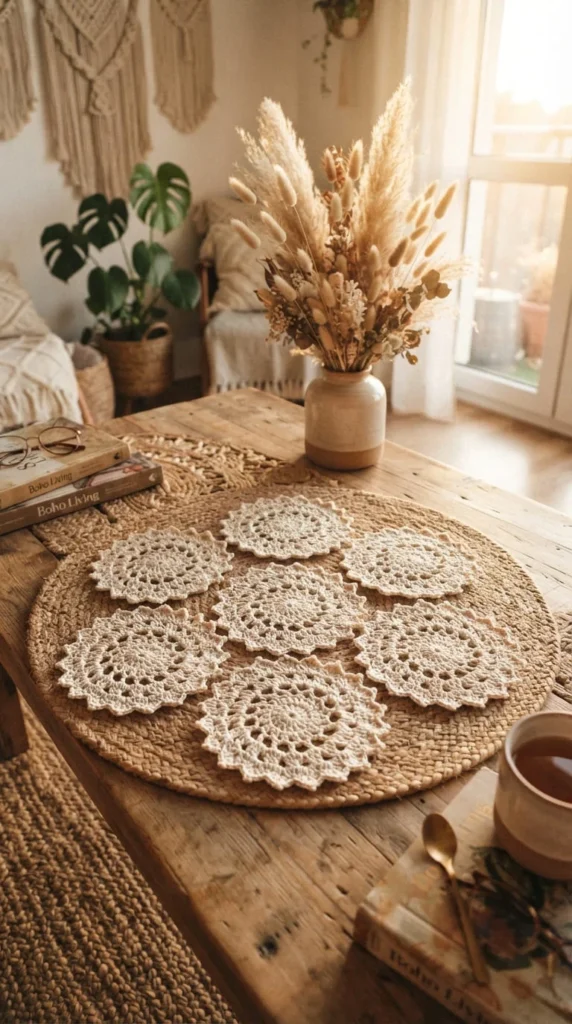
A mandala-style coaster starts with an open, lacy center worked in a contrasting color, then builds outward through a few solid rounds before finishing with a scalloped shell-stitch border. The combination of open lace and a solid outer edge is what gives this style its distinctive boho look.
Building the set with variety:
- Keep the center lace pattern identical across all pieces for cohesion
- Vary the outer solid rounds in two or three related earthy tones
- Finish every coaster with the same scallop count for a matched border
This style takes longer per coaster than a plain round, since the open lace center requires more careful stitch counting than solid crochet. It’s worth the extra time for anyone drawn to a warmer, more textured table setting, since the finished set has real visual depth compared to flat single-color coasters.
Because the open center leaves gaps, mandala coasters work best under mugs and glasses rather than very hot pans, where a solid trivet is still the better choice. Displayed loose in a small bowl or basket, this set doubles as a small piece of table decor even when it’s not actively under a drink.
4. Granny Cluster Coaster Set for Textural Contrast
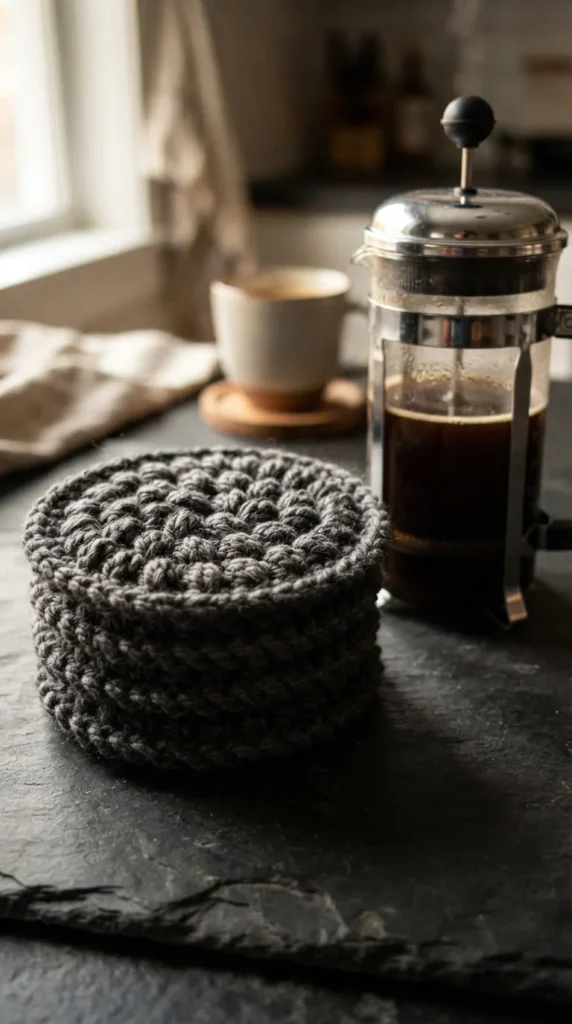
Granny cluster stitch groups several double crochet stitches into small raised bundles, separated by chain spaces, which gives the surface a bumpy, dimensional look without needing any color changes. It’s the classic granny square texture condensed into a round or square coaster shape.
What makes this a strong set option:
- The raised texture hides small tension inconsistencies between pieces
- Works well in a single bold color without looking plain
- Naturally dense fabric that resists curling over time
A set worked entirely in one deep color — charcoal, navy, or forest green — lets the texture itself carry the visual interest instead of relying on stripes or motifs. This makes it a good match for a kitchen that already has a lot of pattern elsewhere, like tile or wallpaper, where a busier coaster design would compete rather than complement.
Because the clusters use more yarn per round than plain stitches, this set takes slightly longer to finish than a basic single crochet set, but the texture holds up visibly better to years of daily use, since the raised bumps disguise wear far better than a flat surface does.
5. Moss Stitch Coaster Set for Everyday Durability
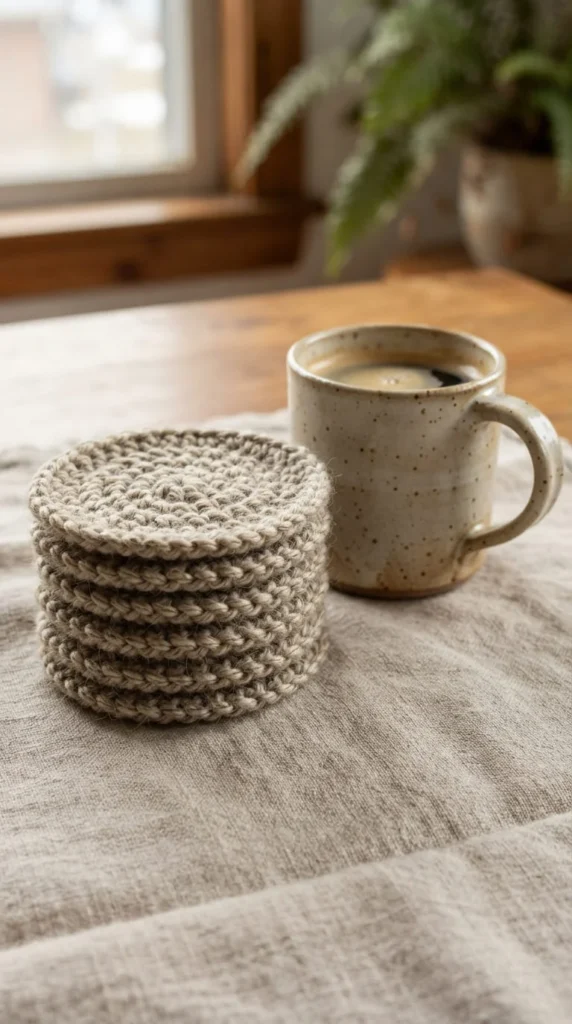
Moss stitch, also called seed stitch, alternates single crochet and chain-one spaces to build a dense, slightly bumpy fabric that behaves more like woven cloth than typical crochet. Among the stitches commonly used for coasters, it holds up especially well to repeated washing without losing its shape.
Practical reasons to choose this stitch for a full set:
- Very little stretch, so coasters stay a consistent size across the set
- Textured surface manages condensation better than smooth stitches
- Reversible pattern, so there’s no wrong side to worry about when placing them
Because the pattern repeats every two stitches, it’s easy to keep six or eight pieces perfectly consistent, which matters more for a full set than for a single coaster. Small counting mistakes are also less visible in this stitch than in a flat single-color round, since the texture itself hides minor irregularities.
A set like this works best in a solid neutral — oatmeal, stone, or soft gray — since the goal here is everyday function rather than decoration. These are the coasters worth making first if you want a set that gets used daily rather than saved for guests.
6. Ombré Gradient Coaster Set
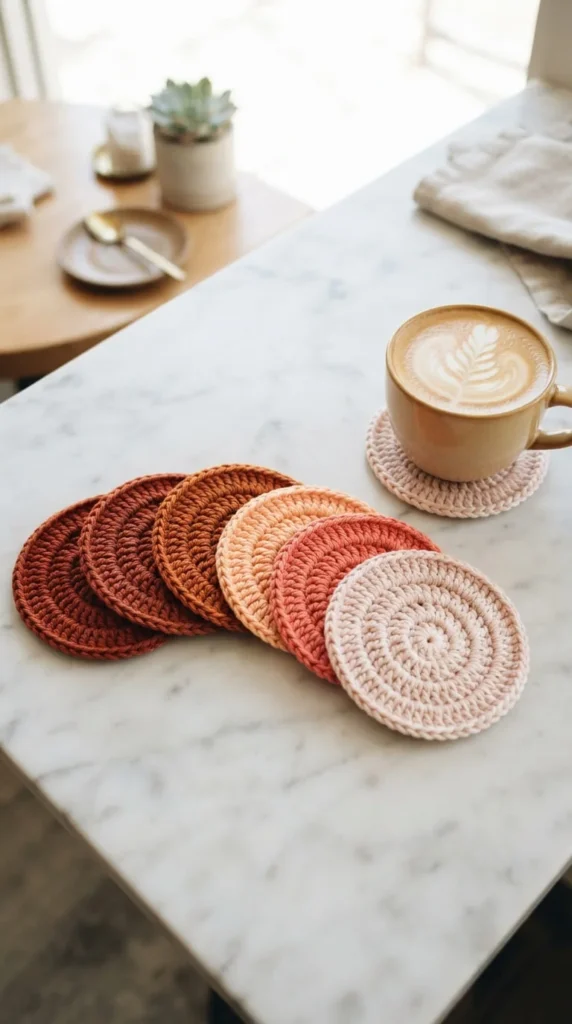
An ombré set uses the same stitch and size across every coaster, but shifts the color gradually from one end of the set to the other — deep terracotta fading to pale blush, or navy fading to sky blue, for example. Each individual coaster is a solid color, and the gradient effect only becomes visible once the whole set is laid out together.
Planning the color shift:
- Choose four to six shades of the same yarn line for consistent fiber content
- Order shades from darkest to lightest, or lightest to darkest
- Keep the stitch pattern completely plain so the color does the work
This idea is a good option for anyone who already owns several coordinating shades of the same yarn but hasn’t found a project that uses them together. Rather than mixing colors within a single piece, the gradient happens across the set as a whole, which is a much simpler technique than gradient crochet within one motif.
Displayed in a fan shape or a small stack, the color shift becomes the main visual feature of the set, so this style works particularly well as a centerpiece-adjacent accent rather than something tucked away in a drawer.
7. Floral Tulip Coaster Set with Petal Edging
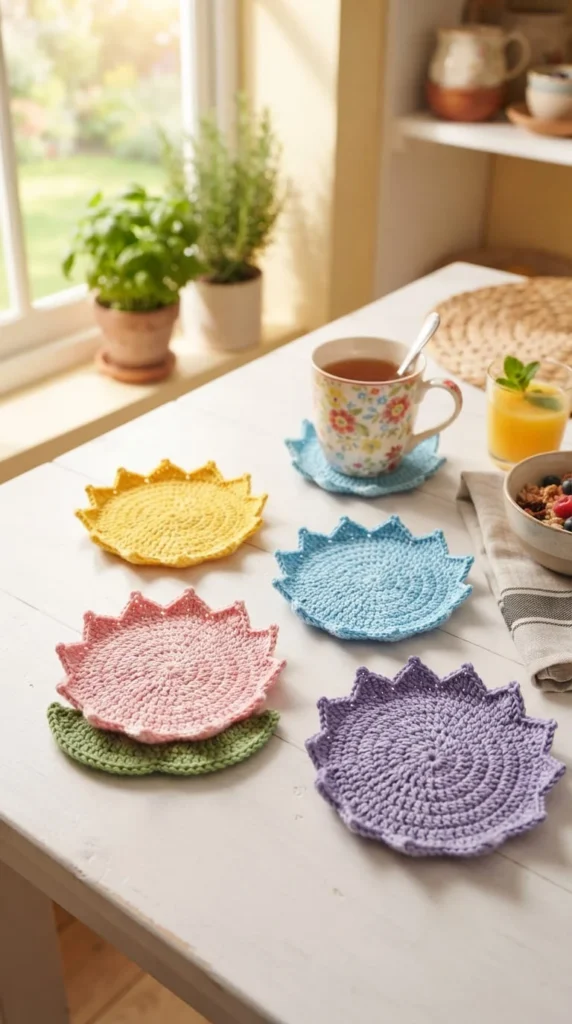
A tulip-shaped coaster is worked from the center outward with a final round of pointed shell stitches that create the petal silhouette. Rather than a plain circle, the petal edging gives the coaster an obvious floral shape while still using standard round-crochet construction underneath.
Coordinating a full floral set:
- Keep the petal shape and stitch count identical across every coaster
- Vary only the petal color: pink, coral, lavender, and pale yellow work well together
- Use the same green for the small leaf accent on each piece if you add one
This style suits a kitchen that already leans toward a softer, cottage-inspired look, especially paired with real or dried flowers on the same table. A set of four or five tulip coasters in different colors, rather than all matching, tends to look more like a garden than a uniform product line.
Because the petal points extend past the main body of the coaster, this shape calls for slightly firmer tension than a plain round to keep the points from curling upward once dry. Blocking each petal flat individually while pinning solves this reliably.
8. Sunflower Coaster Set for a Sunny Kitchen
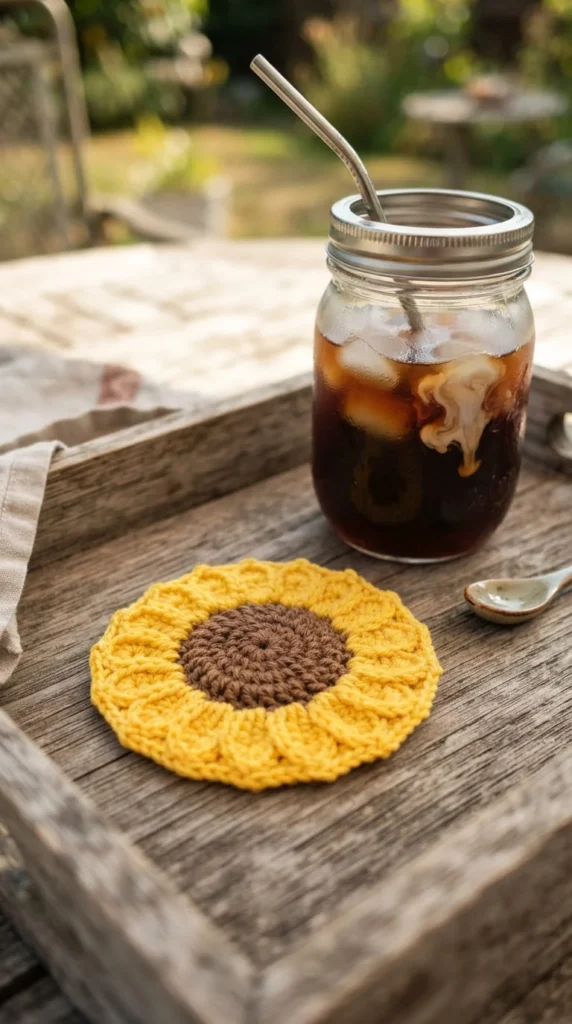
Sunflower coasters combine a dark brown or black textured center — usually worked in bobble or loop stitch to mimic seeds — with a surrounding ring of bright yellow petals. It’s a more advanced design than a plain floral coaster, since it involves at least two color changes and two different stitch textures in one small piece.
Building the center texture:
- Bobble stitch gives a raised, dimensional seed-head look
- Loop stitch creates a fuzzier, more textured center
- Either technique works; choose based on which stitch you already know
A set of four sunflower coasters, all identical, makes a strong visual statement on its own without needing other floral pieces to feel complete. Unlike the softer tulip set above, this design tends to suit a bolder, more graphic kitchen style rather than a delicate cottage look.
Because the yellow petals and dark center create high contrast, small mistakes in the color-change rounds are more visible here than in a single-color coaster. Working slowly through the color-change rounds and checking stitch counts before moving on keeps the finished set looking clean and consistent.
9. Autumn Leaf Table Cover and Coaster Set
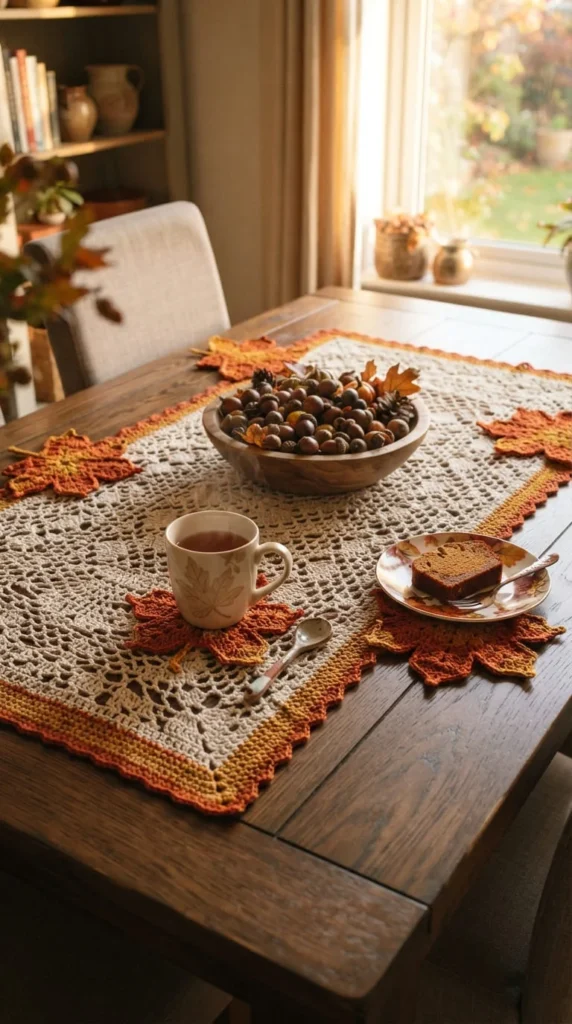
This idea scales a leaf-shaped coaster pattern up into a small round or oval table cover, using the same shape and color logic at a larger size. The coasters and the cover share the same pointed-lobe construction, just worked with far more rounds for the centerpiece.
Planning yarn for the full set:
- Four to six leaf coasters use roughly 30 to 50 yards each
- A coordinating table cover typically takes six to eight times that amount
- Buy all yarn in one purchase to avoid dye-lot differences across the set
Because the leaf shape isn’t naturally flat, both the cover and the coasters need firm blocking while damp to prevent curling at the points. Pin the largest piece first, since it takes longest to dry, and work down to the smaller coasters afterward.
A set like this is a substantial project compared to most others on this list, but it transforms a plain table into a clear seasonal display for the two or three months it’s out. Storing the full set flat in a drawer between seasons, rather than folded, helps it keep its blocked shape year after year.
10. Christmas Tree Coaster Set with Star Toppers
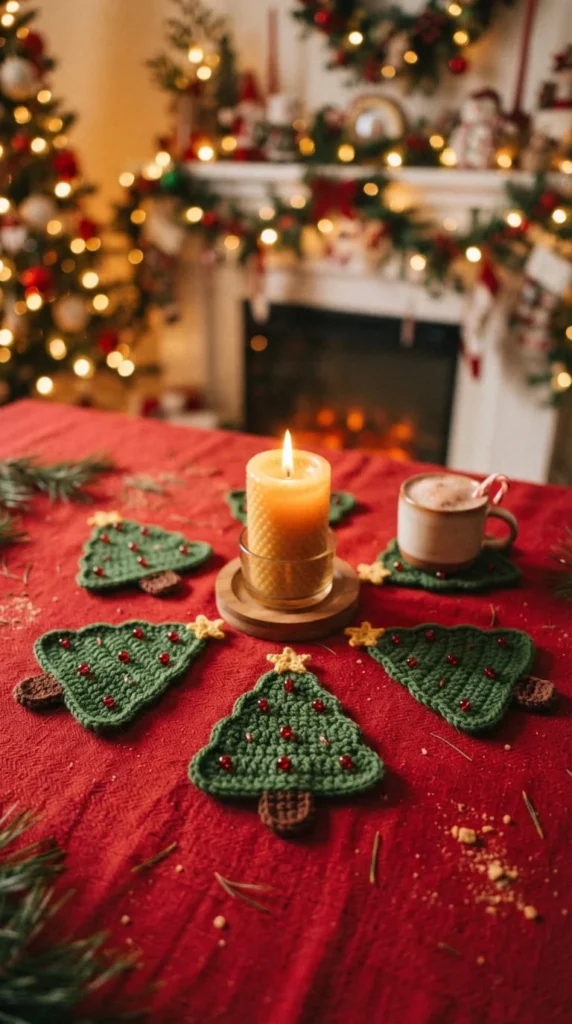
Each coaster in this set is worked as a triangle from the top down, widening with each row to form the tree shape, with a small crocheted or beaded star sewn onto the point at the top. Tiny seed beads or French knots scattered across the green rows stand in for ornaments.
Assembling one tree coaster:
- Work the green triangle base first, increasing at both edges every row
- Attach a small brown rectangle at the bottom as the trunk
- Sew on a tiny star or bead cluster at the top point
- Add three or four bead “ornaments” with a needle and matching thread
Because the triangle shape doesn’t sit flush against a mug base the way a round coaster does, this style works best as a decorative set displayed near the coffee station rather than an everyday-use set. A small basket or shallow tray keeps six or eight tree coasters organized and visible between uses.
A matching set like this, boxed with a ribbon, makes a stronger gift than a single ornament, since it’s both decorative and genuinely usable once the holidays wrap up and the trees come off display.
11. Snowflake Coaster Set for a Winter Table
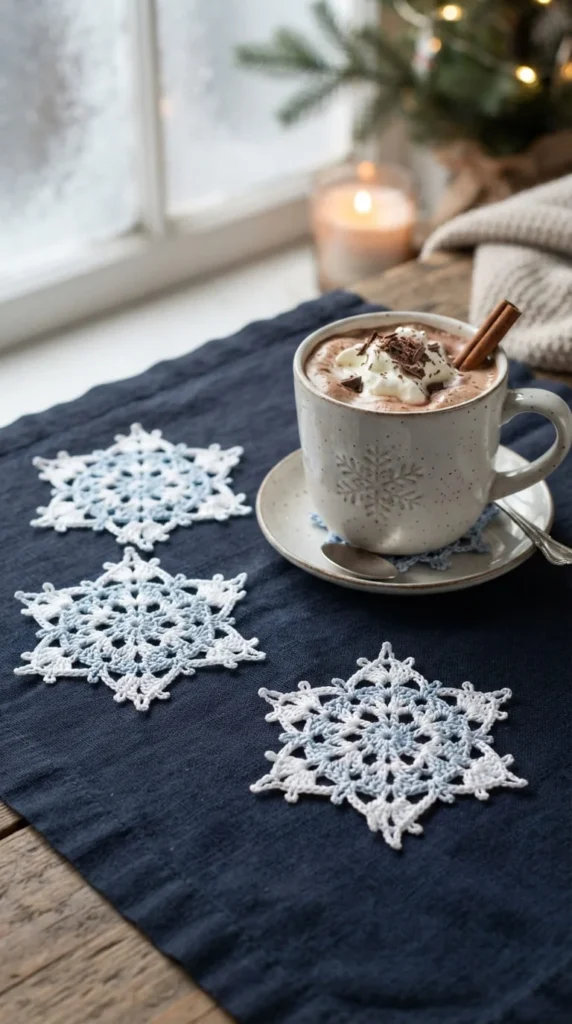
Snowflake coasters are worked from a center ring outward, using chain spaces and picot stitches to build six symmetrical points. The open, lacy structure is similar to filet or mandala work, but the six-point symmetry is what makes the shape read clearly as a snowflake rather than a generic round motif.
Keeping the six points even:
- Count stitches carefully after every point round before starting the next
- Use a stitch marker to flag the start of each new point
- Block firmly, pinning each point to the same length
White or icy blue yarn is the obvious choice, but a set that mixes both — three white and three pale blue — adds subtle variety without breaking the winter theme. Because the open lace leaves gaps between the points, this style is best suited to mugs and glasses rather than very hot cookware.
This set pairs naturally with the Christmas tree idea above if you want a broader winter collection rather than a strictly Christmas-only one, since snowflakes work as decor through the entire season rather than just during the holidays themselves.
12. Halloween Pumpkin Coaster Set with Shell Border
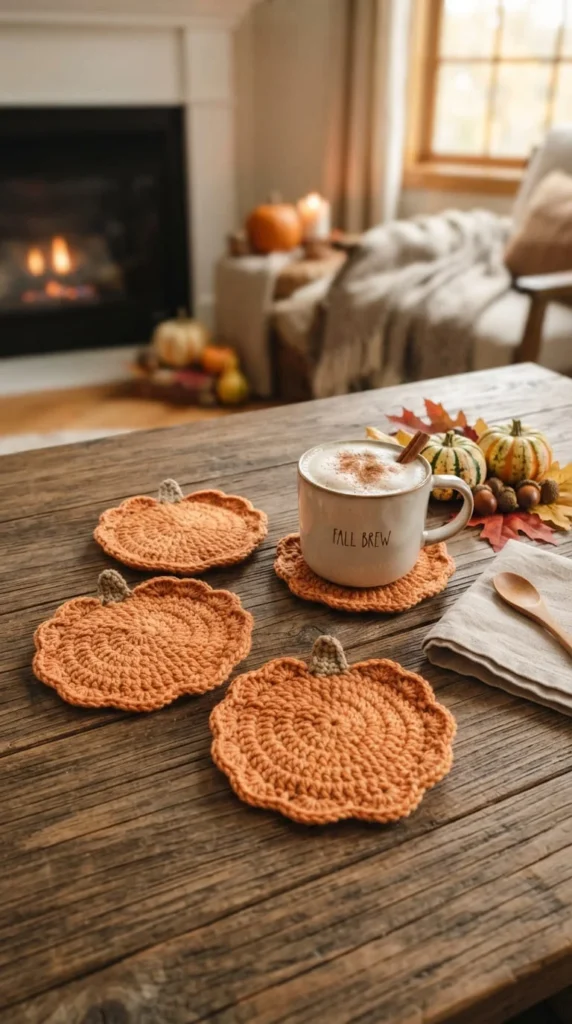
This set builds on the classic pumpkin shape with a decorative shell-stitch border added as the final round, which gives the coaster a slightly ruffled, more finished edge than a plain round of single crochet. The ribbing that creates the pumpkin’s grooves comes from working through the front loop only on select rounds.
Sizing a full pumpkin set:
- Work four to six coasters in slightly different orange shades
- Keep every piece the same finished diameter for a clean stack
- Add a short brown stem to each with a few chain stitches and a slip stitch back
The shell border takes a little more counting than a plain edge, since each shell relies on the same number of stitches worked into the same base stitch to stay even. Practicing the border on a scrap swatch first, before starting the final round on an actual coaster, saves time if the count is off.
A pumpkin set like this fits comfortably into a Halloween or general autumn table setting, and unlike costume-specific decor, it stays appropriate to use straight through Thanksgiving without needing to be swapped out.
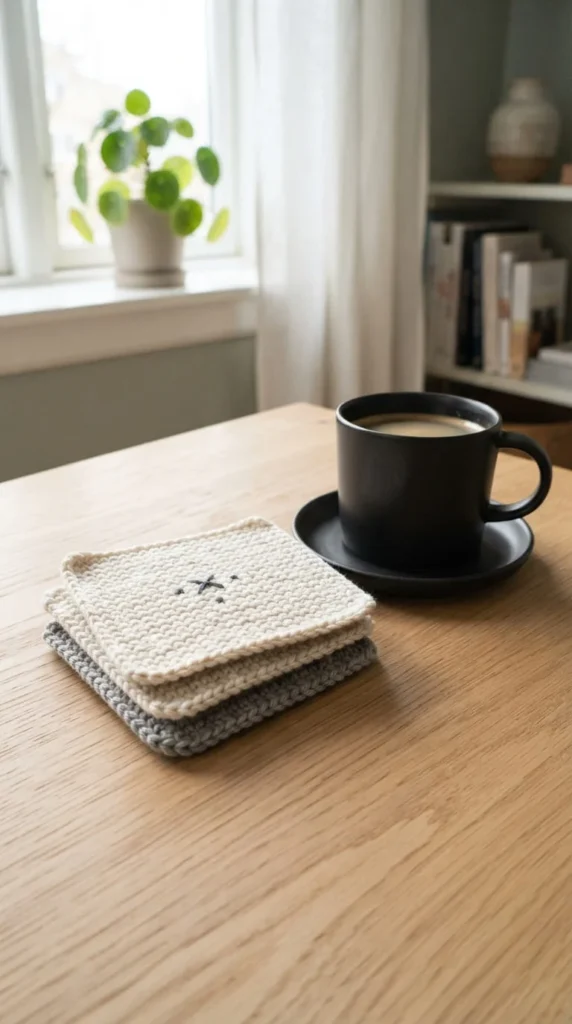
13. Tunisian Minimalist Coaster Set with Cross-Stitch Accents
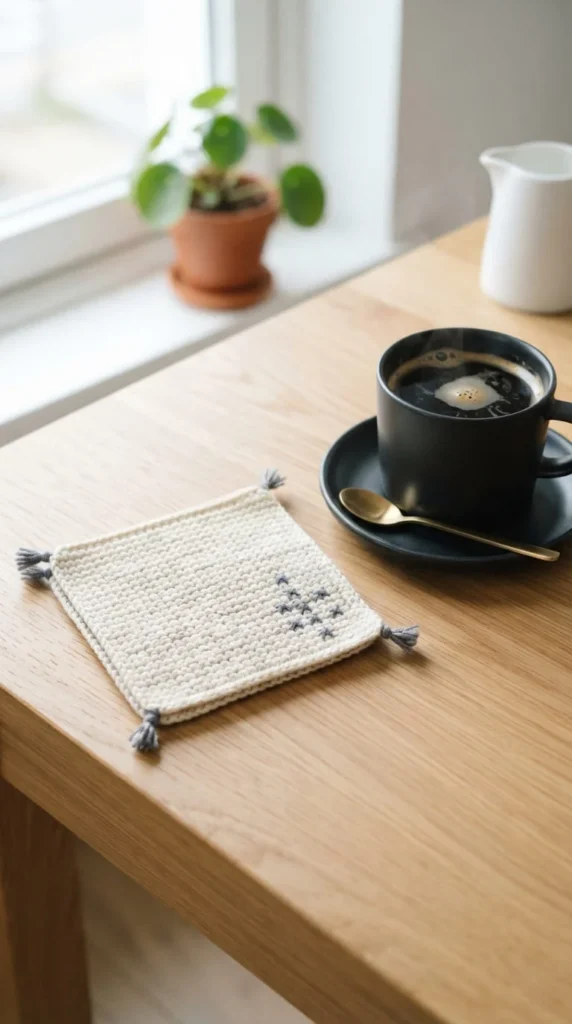
Tunisian crochet uses a longer hook that holds multiple loops at once, producing a flatter, more woven-looking fabric than standard crochet. For a coaster set, the Tunisian simple stitch creates a grid-like surface that happens to be an ideal base for adding small cross-stitch embroidery afterward.
Adding the cross-stitch detail:
- Work the coaster base fully in Tunisian simple stitch first
- Use a blunt tapestry needle and contrasting thread for the cross-stitch
- Keep the embroidered motif small — a single X, a tiny heart, or one initial
This combination suits a more contemporary, understated kitchen better than the textured or floral sets earlier in this list. A set of four in cream, gray, and soft charcoal, each with the same small embroidered accent, reads as considered rather than plain.
Tunisian crochet does take practice if you haven’t worked with the technique before, since managing the extra loops on the hook feels different from standard crochet at first. A coaster is a genuinely useful-sized project to learn on, since mistakes are cheap and quick to redo compared to a full Tunisian blanket panel.
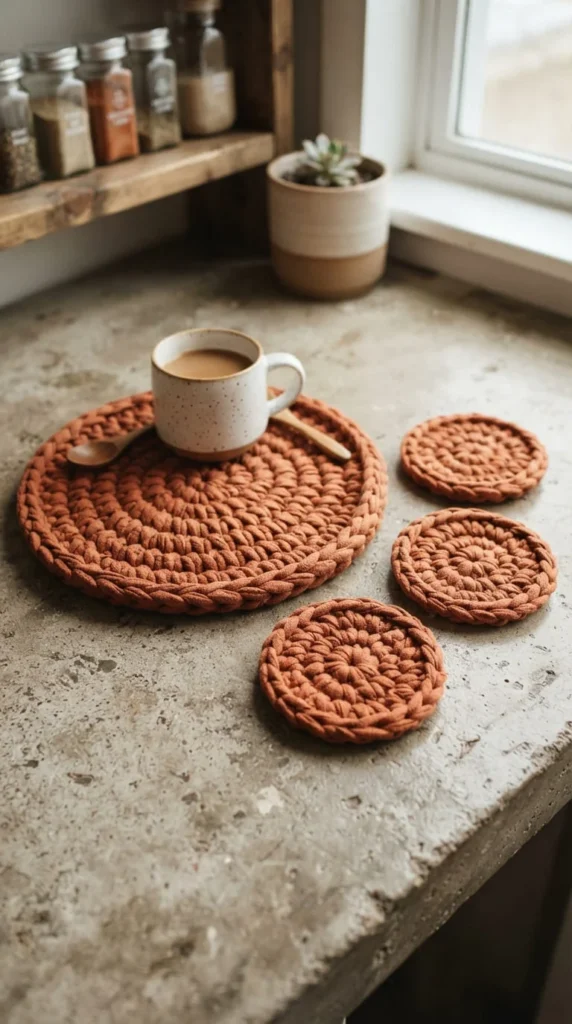
14. Chunky T-Shirt Yarn Coaster and Trivet Set
T-shirt yarn, made from strips of recycled cotton jersey, works up quickly on a large hook — usually 9mm or bigger — producing thick, substantial coasters in a fraction of the time standard yarn takes. A matching oversized trivet from the same yarn rounds out a set with real heft and texture.
Working with t-shirt yarn successfully:
- Use a larger hook than you’d expect for the yarn’s visual thickness
- Work fewer rounds than a standard pattern calls for, since each round covers more area
- Expect a looser, more relaxed fabric than fine cotton produces
Because this yarn is thick and absorbent, a single coaster from t-shirt yarn does the job of several standard cotton coasters when it comes to protecting a table from condensation. The trade-off is that the finished pieces take up noticeably more storage space than a standard set.
This is a fast option for anyone who wants a finished set in an afternoon rather than over several evenings, and it’s also a practical way to repurpose old t-shirts that are too worn to donate but too soft to throw away.
15. Cotton Rope Coiled Coaster Set
This technique wraps cotton clothesline or rope in a flat spiral, securing each wrap to the last with a line of single crochet stitches worked directly through the coils. The rope itself provides the bulk and structure, while the crochet stitching holds everything together and adds a bit of color.
Working the spiral evenly:
- Start with a small coiled center and stitch outward in a continuous spiral
- Keep tension consistent so the rope doesn’t bunch or gap between rounds
- Use a contrasting thread color for the stitching if you want it to show
Because the rope core is naturally thick and dense, these coasters resist curling almost completely without any blocking, which makes this one of the lowest-maintenance styles on this list. They also tend to be heavier than yarn-only coasters, which keeps them from sliding around on a smooth table.
A set of four or five in undyed natural rope, stitched with a single accent color of thread, fits well into a coastal, farmhouse, or industrial-leaning kitchen where a soft yarn coaster might look out of place.
16. Monogram Coaster Set for Personalized Gifting
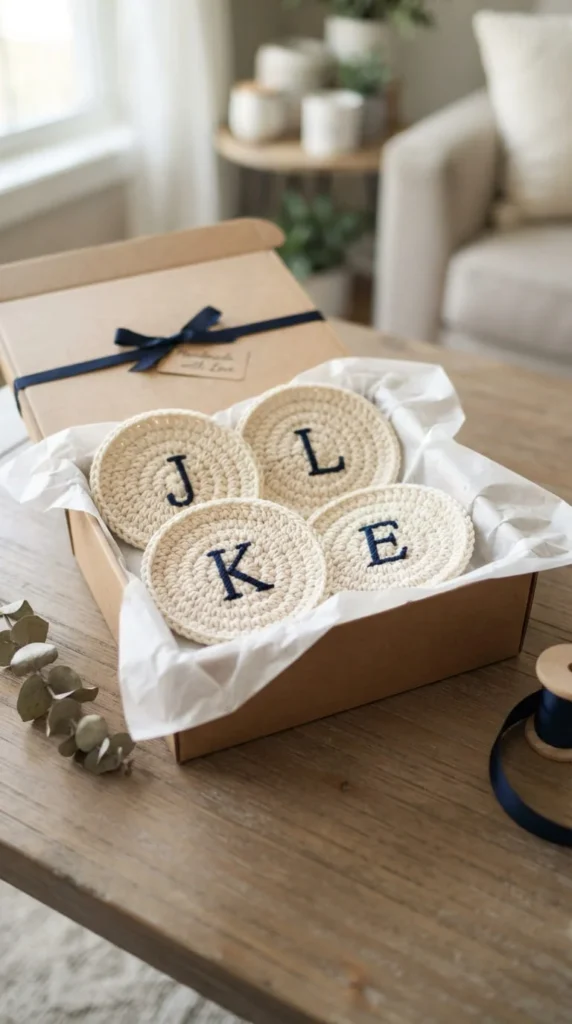
This idea takes a plain round coaster in a neutral color and adds a single embroidered initial to the center of each piece, using simple backstitch or satin stitch in a contrasting thread. The crochet base stays deliberately simple so the monogram has room to stand out.
Keeping the embroidery legible at small scale:
- Choose a simple block letter rather than an ornate script font
- Work the letter in backstitch first, then fill with satin stitch if desired
- Center the letter carefully before stitching, using a fabric pen to mark placement
A set of four with the same initial makes a strong personal gift for a housewarming, wedding, or new home, while a set with four different initials works well for a shared household or as a hostess gift where the recipient’s whole family gets represented.
Because the embroidery is added after the crochet base is finished and blocked, this is a good way to use up plain coasters that already exist in your stash but never got a distinct identity. A single monogrammed coaster also makes a low-cost, high-impact gift on its own if a full set isn’t needed.
17. Two-Tone Striped Coaster Set for Modern Kitchens
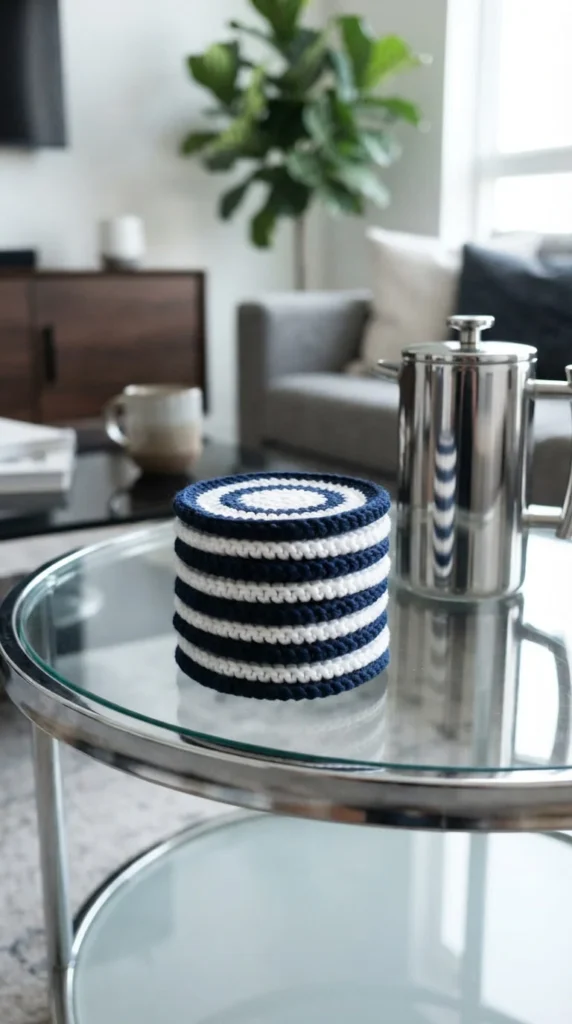
Striped coasters alternate two colors every one or two rounds, using a stitch like single crochet or half double crochet that keeps the color changes crisp rather than soft-edged. The simplicity of the stripe pattern is what makes it read as modern rather than busy.
Getting clean stripe changes:
- Change colors on the last pull-through of the final stitch in a round
- Carry the unused color loosely up the inside if it will be needed again soon
- Weave in ends as you go rather than leaving a pile to finish at the end
High-contrast pairs like navy and white or black and cream give the cleanest graphic look, while two similar tones — like two shades of gray — produce a subtler, more tonal stripe that still reads as intentional rather than accidental.
Because every coaster in the set uses the exact same stripe sequence, consistency matters more here than in more organic or textured designs. Keeping a written note of exactly how many rounds of each color you worked on the first coaster makes it far easier to replicate precisely across the rest of the set.
18. Nesting Coaster Set in Graduated Sizes
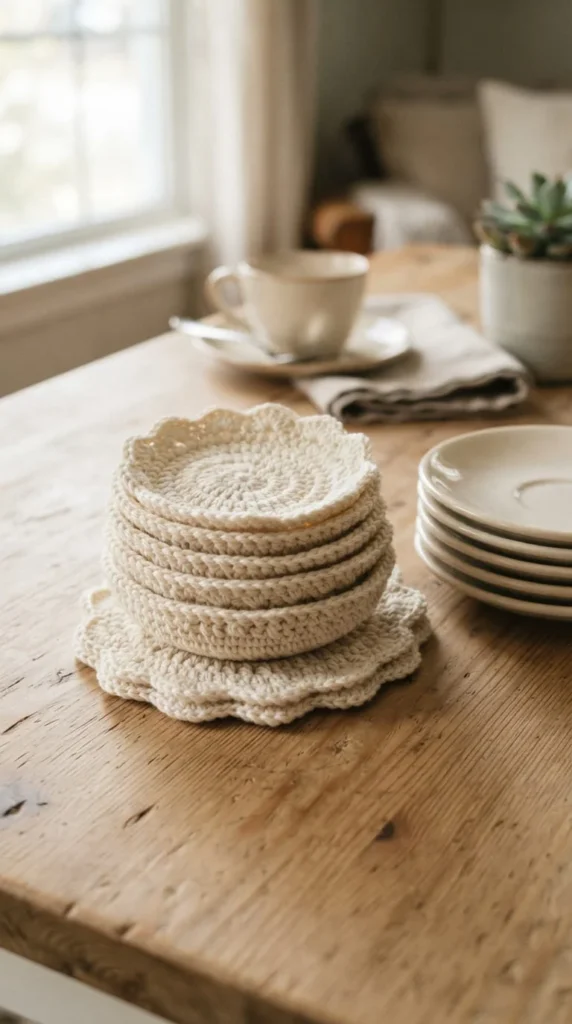
Instead of making every coaster the same size, this set works the same pattern at five different diameters, from a small 3-inch piece up to a 5.5-inch round. The graduated sizing means the set can handle everything from a small espresso cup to a wide latte bowl without needing separate designs.
Planning the size progression:
- Increase the diameter by about half an inch between each piece
- Keep the stitch and color identical across all sizes for a cohesive set
- Stack them largest to smallest for storage, the same way you’d nest bowls
This idea solves a real practical gap most standard sets miss, since a single coaster size rarely suits every cup and glass in a household. A larger piece from the set can also double as a small trivet for a teapot or French press without needing to make a separate matching trivet.
Because each size uses a different total stitch count, this set takes a bit more planning than a standard identical set, but working from smallest to largest lets you fine-tune the increase rate on the first couple of pieces before committing to the largest ones.
19. Coaster Set with Matching Storage Basket
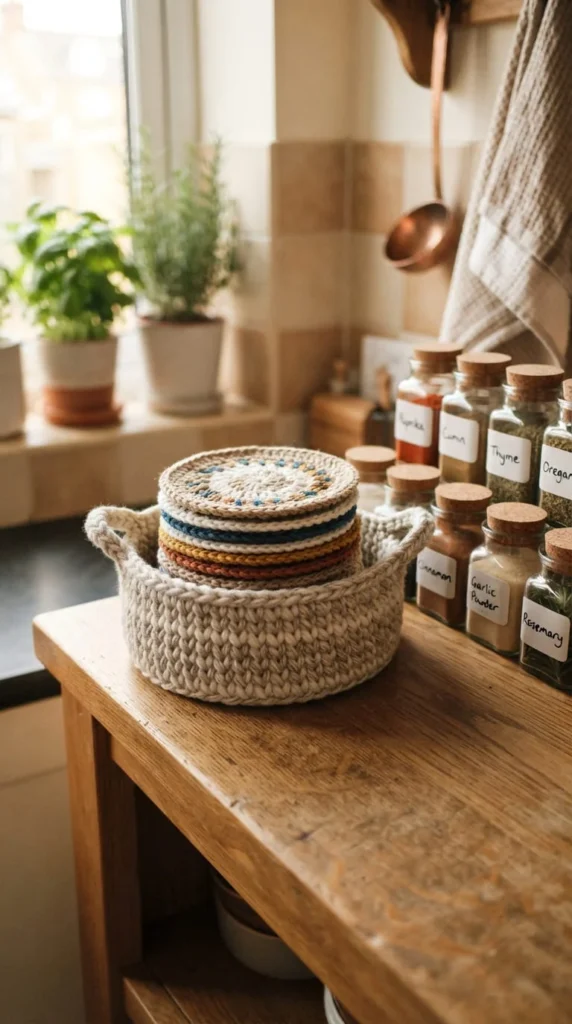
This idea pairs a standard coaster set with a small crocheted basket sized to hold the whole stack upright, using the same yarn and color scheme as the coasters themselves. The basket is worked in the round from the base up, usually in a firm stitch like single crochet to hold its shape without a fabric liner.
Building a basket that holds its shape:
- Use a smaller hook than usual for a tighter, sturdier fabric
- Work the base flat, then increase into the walls without further shaping
- Add two short handles at the top for easy lifting off a shelf
A set like this solves the common problem of loose coasters sliding around a drawer or catching on other items. Kept upright in its own basket on a counter or shelf, the set stays visible and accessible rather than buried.
This combination also makes a complete, ready-to-give gift without any extra packaging, since the basket itself functions as the presentation. A ribbon tied around the basket handles is the only additional touch needed before handing it over.
20. Vintage Doily-Style Lace Coaster Set
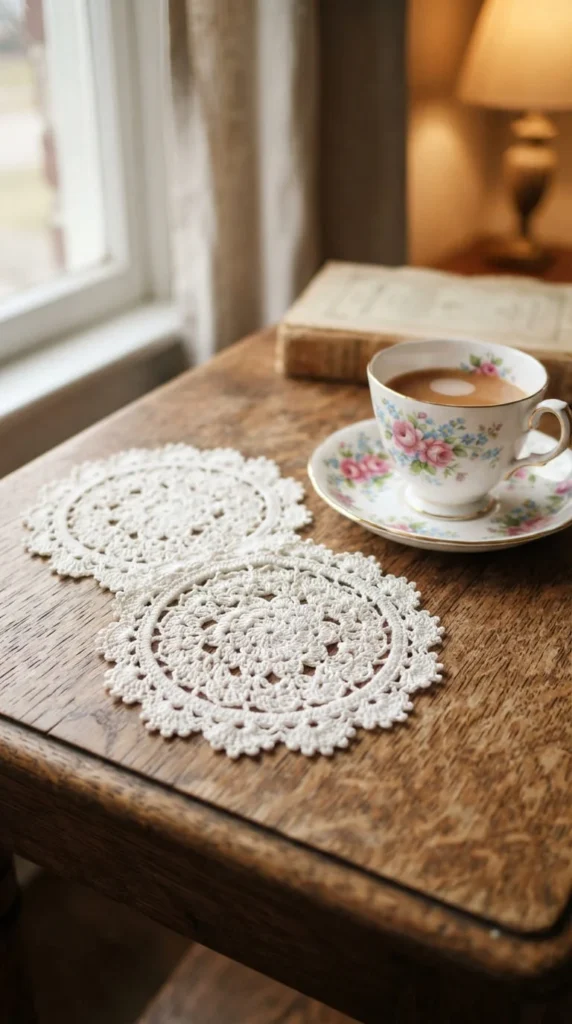
This set shrinks the classic doily pattern down to coaster scale, working outward from a center ring through several rounds of chain-space lace before finishing with a scalloped picot border. The lace structure and scalloped edge together give the set an obviously vintage, heirloom character.
Keeping a lace set consistent:
- Use the same fine cotton thread and hook size across every piece
- Block each coaster with the same pin count on the scallops for uniform edges
- Starch very lightly if the set leans more decorative than everyday-use
Because this style takes longer per piece than a solid coaster, a set of four is usually more realistic than a full set of six or eight, unless the maker already has significant thread crochet experience. The extra time is part of what makes the finished set feel special rather than routine.
A set like this suits a table that already includes vintage or inherited pieces — an antique teapot, patterned china, or lace linens — since the doily coasters sit naturally alongside them rather than looking out of place next to more modern tableware.
21. No-Magic-Ring Beginner Coaster Set
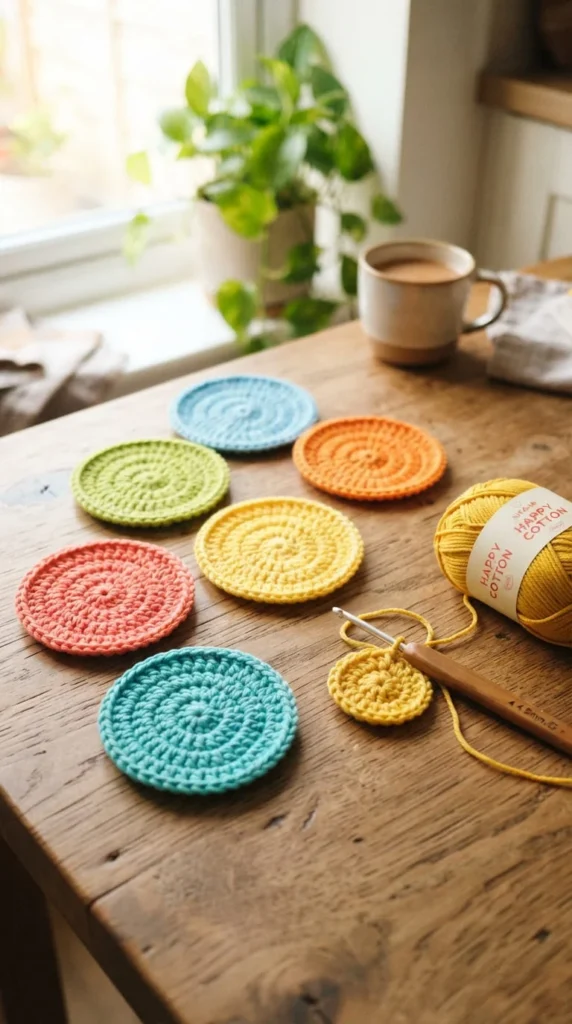
This set is built specifically around a starting method that skips the magic ring, using a simple chain-and-join ring instead. It’s a small technical difference, but for a beginner still building confidence, avoiding the magic ring removes one common source of frustration from an otherwise quick project.
Starting a round without a magic ring:
- Chain four to six stitches depending on the pattern
- Join the chain into a ring with a slip stitch into the first chain
- Work your first round of stitches into the center of that ring as usual
- Accept a slightly more visible center hole as a fair trade for an easier start
The small hole this method leaves at the center closes up naturally once a couple of rounds are worked and the piece is blocked, so the visual difference between this and a magic-ring coaster is minimal in the finished set.
A set of four made this way is a genuinely good first crochet project for someone brand new to the craft, since it teaches rounds, increases, and finishing without requiring a technique that even experienced crocheters sometimes find fiddly.
Conclusion
A coordinated set does more for a table than any single coaster ever could, whether that coordination comes from matching stitches, a shared color story, or a bonus trivet that solves a second problem at the same time. Start with whichever idea on this list fits the skill level you’re at right now, then treat the leftover yarn from that first set as the starting point for the next one. Pick up a hook, choose a set size that actually matches how many people sit at your table, and get the first round started today.