
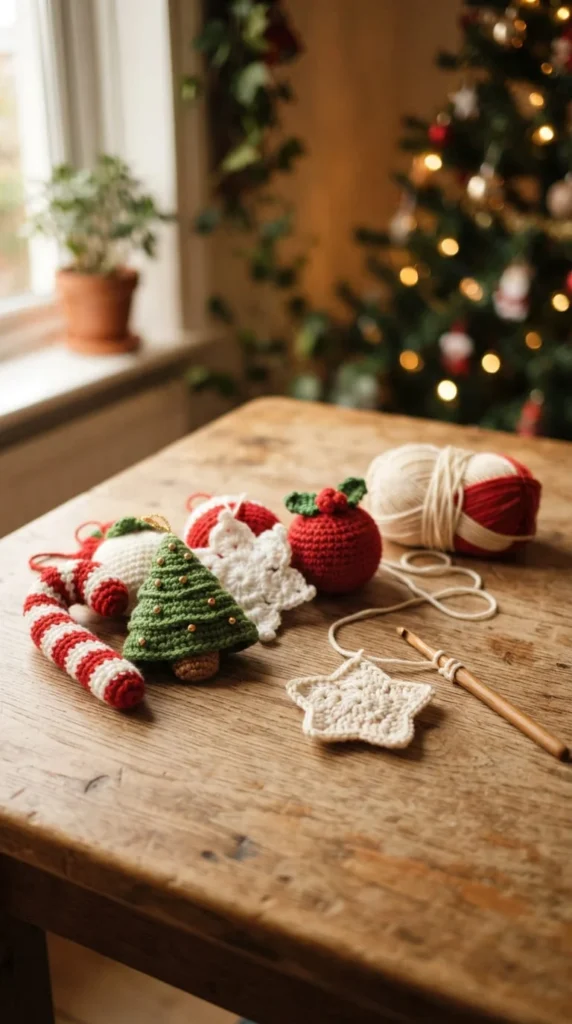
Christmas crochet ideas cover a lot more ground than the usual snowflake garland, and once you start looking, there are dozens of small, satisfying projects that fit into a busy December schedule. Whether you’re a beginner who wants a first holiday project that won’t end in frustration, or someone who sells at craft markets and needs bestsellers that come together fast, this list mixes ornaments, gifts, wearables, and home decor at every skill level. Along the way you’ll find notes on yarn choice, common mistakes to sidestep, and a few less obvious ideas — like tech cozies and advent countdowns — that don’t show up in every roundup. Grab a hook, pick a project that matches your available time, and let’s get into it.
1. Mini Amigurumi Trees for a Tabletop Forest
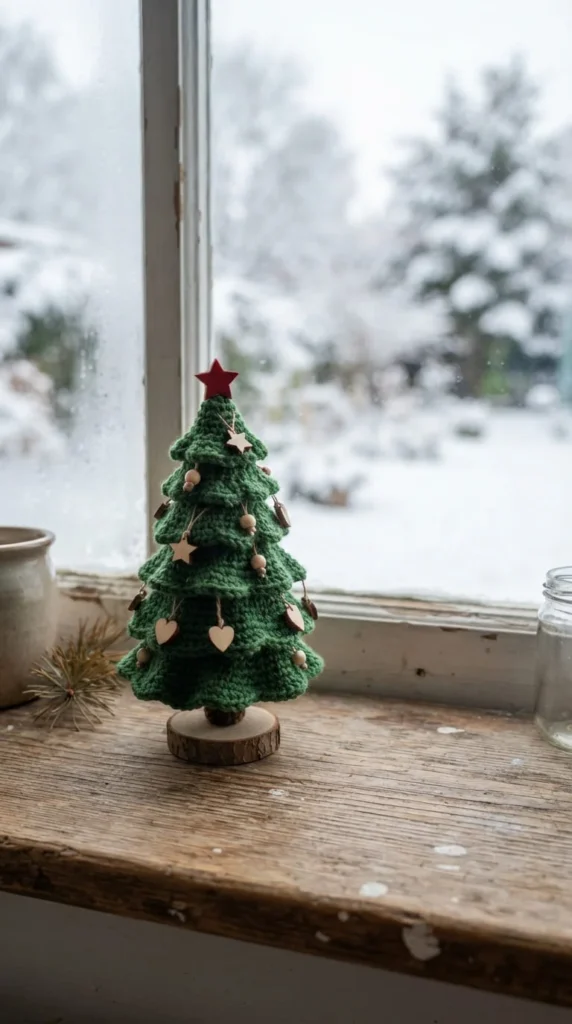
A cluster of small crocheted trees makes one of the fastest, most flexible Christmas projects you can start today. Each tree usually takes under an hour once you know the pattern, which means you can build a whole “forest” over a weekend.
Why it works: mismatched sizes and shades of green look intentional rather than sloppy, so there’s no pressure for perfect uniformity. Stuff them firmly so they stand upright without a base, or glue a wooden disc underneath for stability on a mantel.
A few practical notes:
- Use worsted weight yarn for trees under 4 inches tall — anything bulkier gets hard to shape
- Vary your green shades across the set (forest, sage, pine) so they read as a collection, not duplicates
- Add a single bead or French knot instead of a full garland for a cleaner look
These trees also make excellent stocking stuffers or place-card holders if you tuck a small tag into the top loop. Because the pattern repeats a simple stitch count, it’s a good project to memorize and then crochet while watching a holiday movie without needing to check instructions every row.
2. Chunky Yarn Stockings That Skip the Sewing
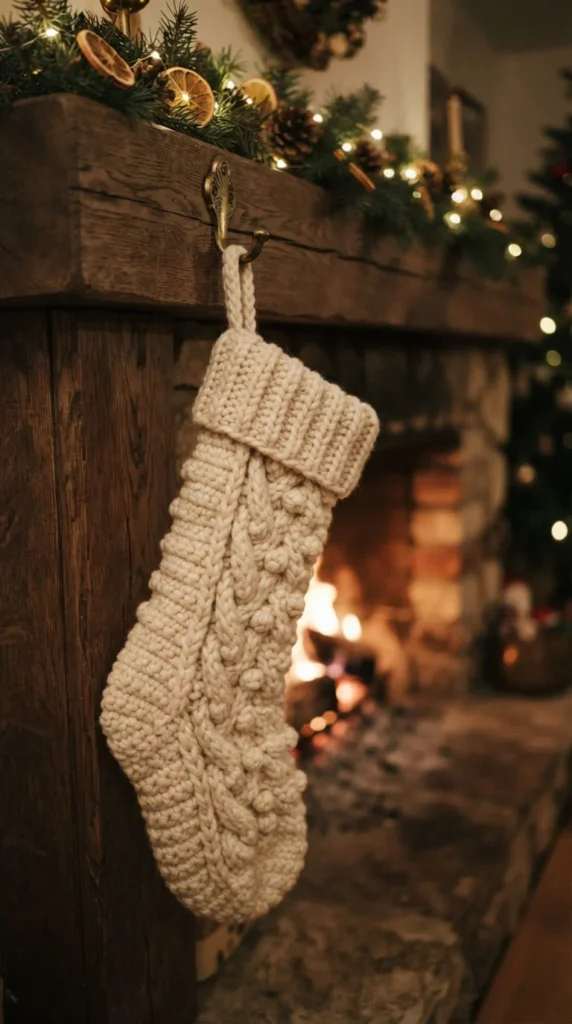
If a full stocking pattern feels intimidating, working it in super bulky yarn changes the math completely. A stocking that would take a week in worsted weight can be finished in two or three evenings using a 6mm or 7mm hook.
The trick is picking a simple single crochet or half double crochet body rather than anything with cables or color changes. Bulky yarn already gives visual texture on its own, so the stitch pattern doesn’t need to compete for attention.
To avoid the sewing step entirely:
- Crochet the stocking in one continuous piece, working in the round from the cuff down
- Close the toe with a simple decrease instead of stitching two flat pieces together
- Add the hanging loop as you go, rather than attaching it afterward
This approach also solves a common complaint about handmade stockings — that they stretch out of shape after a season of use. Bulky yarn holds its structure better under the weight of stocking stuffers, especially if you use an acrylic blend rather than pure wool. A name tag crocheted separately and sewn onto the cuff turns this into a personalized gift without much extra effort.
3. A Patchwork Granny Square Throw With a Modern Twist
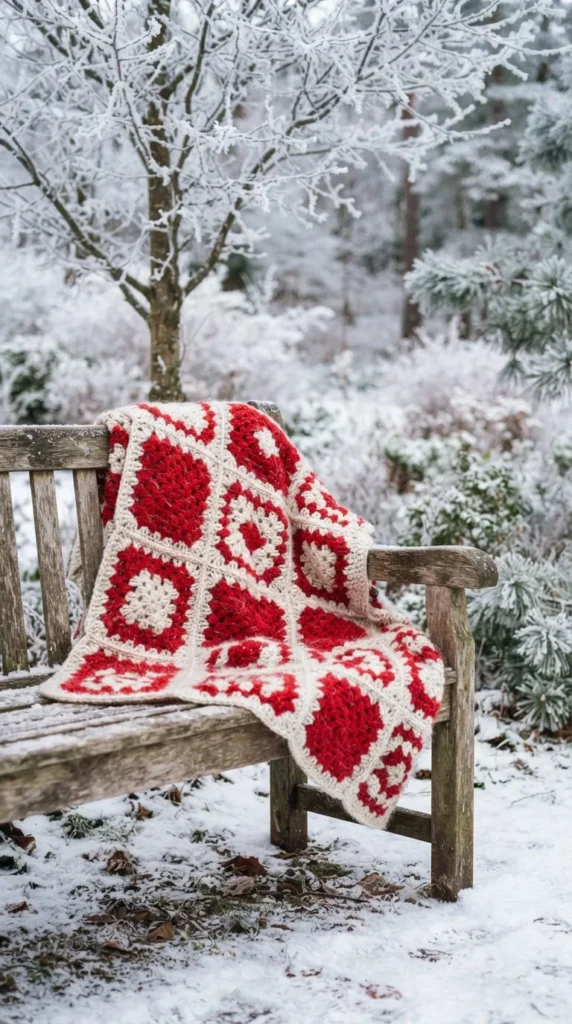
Granny squares are having a real comeback, but a full traditional afghan can take months. A smaller lap-sized throw built from a limited color palette gives you the retro charm without the long-term commitment.
Instead of mixing every holiday color at once, pick three tones total — say, a deep red, a warm cream, and one metallic or fleck yarn for accent rounds. This keeps the finished piece looking curated rather than scrappy, which matters if the throw is meant as a gift rather than a stash-buster.
Assembly tips that actually save time:
- Join as you go instead of sewing squares together at the end — it removes an entire finishing step
- Keep every square the same stitch count so blocking isn’t necessary before joining
- Use a contrasting border round to frame the whole piece and hide any uneven edges
A throw built from 30–40 squares is a realistic weekend-to-two-weeks project depending on your pace, and it scales easily — add more squares for a full-size blanket or fewer for a car-seat-sized version. It also travels well as a portable project since each square is a small, self-contained piece of work.
4. Scandinavian Gnomes With a Neutral Color Palette
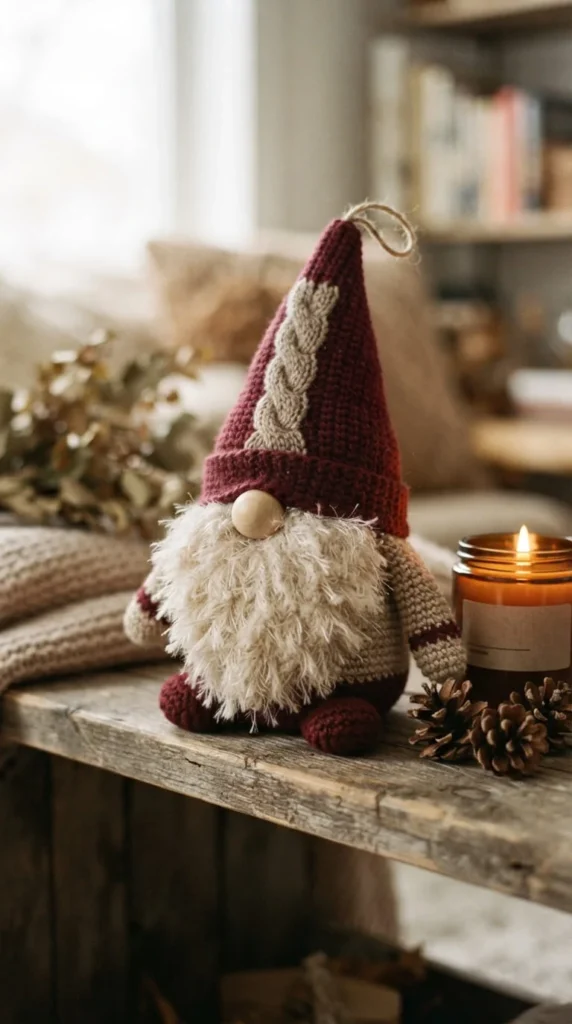
The Nordic gnome trend has stuck around because the shape is genuinely simple to crochet — a cone body, a rounded hat, and a fabric or yarn beard. What changes the whole feel is the color choice.
Swapping the usual bright red and green for oatmeal, rust, sage, and charcoal turns a novelty ornament into something that fits year-round farmhouse or Scandinavian-style decor, not just a Christmas box that comes out once a year.
A few ways to make each gnome distinct:
- Vary hat length — a floppy, oversized hat reads differently than a short, structured one
- Use roving wool or faux fur for the beard instead of yarn for extra texture contrast
- Add a small wooden bead nose or leave the face blank for a more minimalist look
Because the body is essentially a cone, this pattern is forgiving for anyone still learning to read stitch counts — mistakes in shaping are much less visible than they would be on a rounded amigurumi animal. A set of three gnomes in graduated sizes makes a strong tabletop display and works well as a gift set for someone who prefers muted decor over traditional bright colors.
5. Lace Snowflakes Blocked for a Crisp, Professional Finish
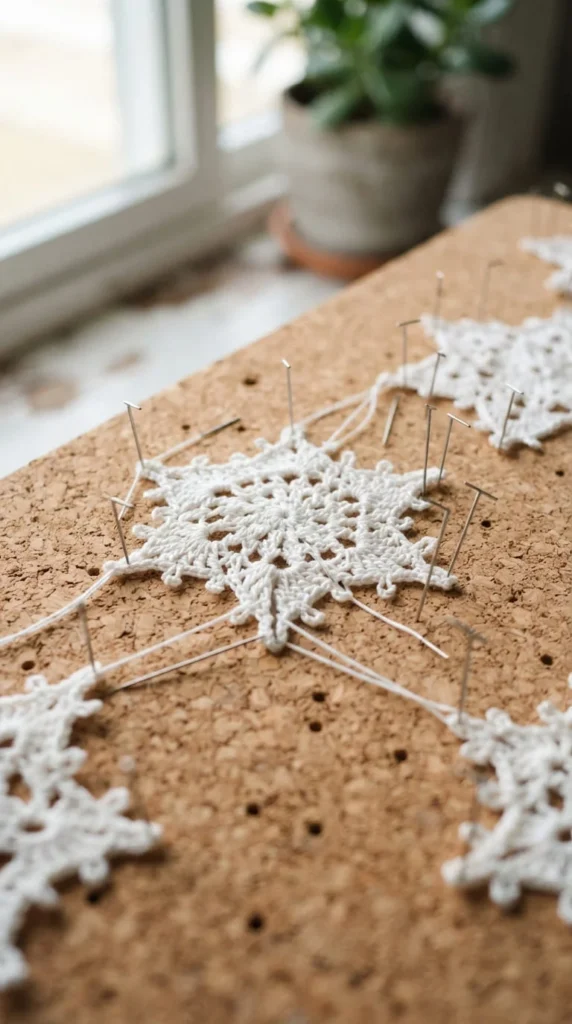
Thread-weight snowflakes look delicate and complicated, but the stitches themselves are usually just chains, double crochets, and picots repeated in a circle. What separates an amateur-looking snowflake from a polished one is almost always the blocking step.
Blocking stiffens the lace into a flat, symmetrical shape instead of the curled, floppy state it comes off the hook in. Skipping this step is one of the most common reasons a finished snowflake looks messy even when the stitch work itself was done correctly.
A simple blocking method for beginners:
- Mix a stiffening spray or a light sugar-water solution and lightly saturate the piece
- Pin each point outward on a foam board or corkboard, checking symmetry as you go
- Let it dry completely, ideally overnight, before removing the pins
Once blocked, snowflakes hold their shape for years and can be reused each season without reblocking unless they get crushed in storage. Hang them individually on a tree, string several together for a window garland, or frame a single large one as wall art — the blocked stiffness means it won’t sag or droop over time.
6. A 24-Pocket Advent Calendar You Build Over a Month
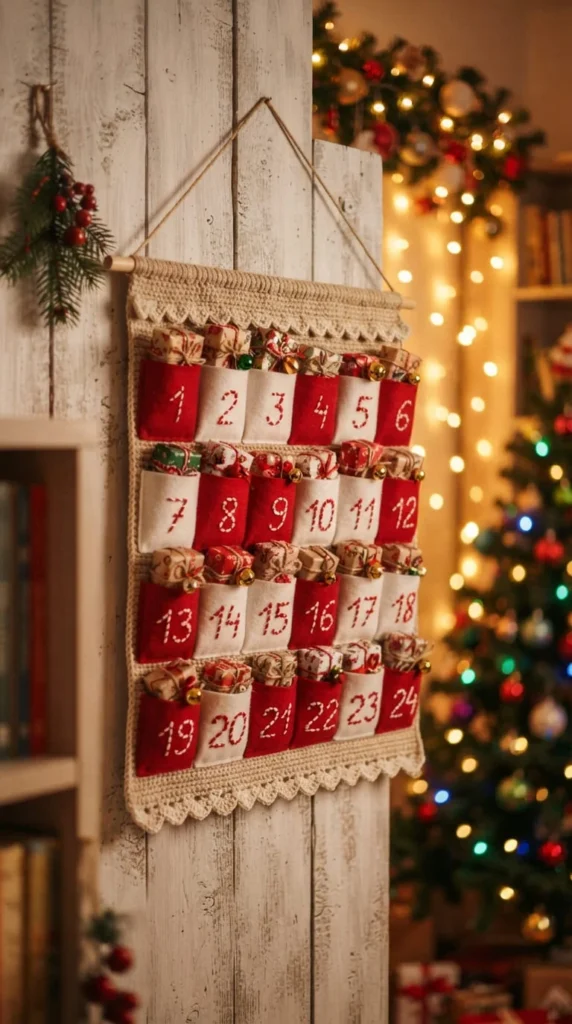
Rather than crocheting an entire advent calendar in one sitting, this idea spreads the work out — you make one small pocket per day starting in early November, so by December 1st the whole thing is ready without a single rushed weekend.
Each pocket can be a simple flat rectangle folded and stitched into a small envelope shape, or a tiny drawstring pouch if you want something reusable in future years. Numbering them doesn’t require embroidery — small wooden number tags or fabric ribbon labels tied on with yarn work just as well.
Ways to keep the project manageable:
- Batch-cut or pre-measure yarn lengths for all 24 pockets before you start
- Use a single stitch pattern throughout so you’re not relearning a technique each day
- Hang finished pockets on a length of twine or a wooden dowel as you complete them, so progress is visible
This project doubles as a countdown activity for kids if you fill each pocket with a small trinket, a chocolate, or a slip of paper with a family activity written on it. Because it’s built incrementally, it never feels like a large undertaking — just a few quiet minutes each evening.
7. Tech Cozies That Make Practical Holiday Gifts
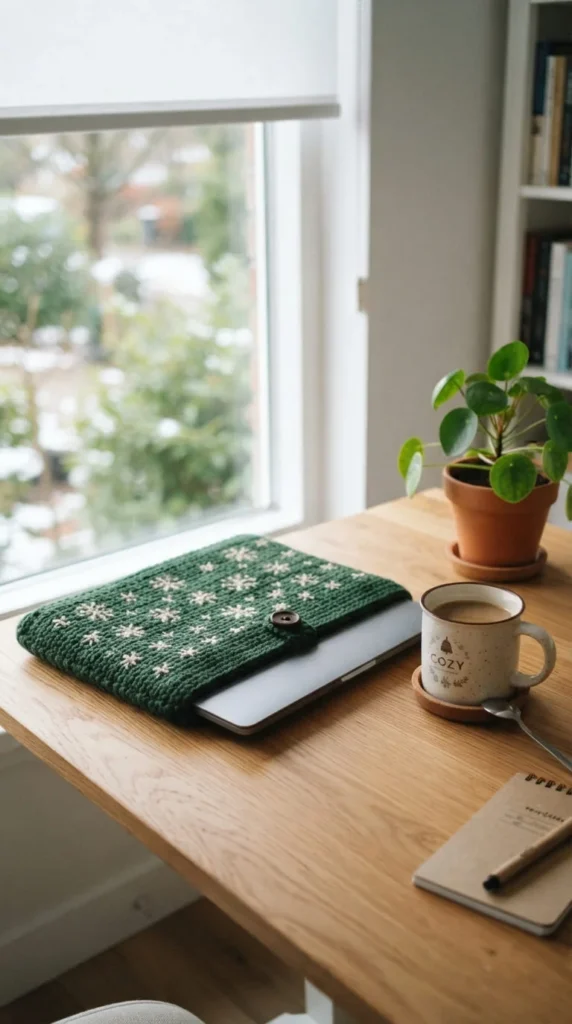
Ornaments and stockings get most of the attention, but crocheted tech accessories solve a real gift-giving problem: they’re useful year-round, not just decorative for one season. A padded laptop sleeve, a phone cozy, or an AirPod case takes a fraction of the yarn a sweater would need.
The key to a tech cozy that actually protects a device is structure, not just softness. A single layer of standard double crochet won’t cushion a laptop from bumps, so these projects usually need either a lining or a denser stitch.
Practical construction tips:
- Work in half double crochet through the back loop only for a tighter, more padded fabric
- Add a thin foam or felt lining inside larger sleeves for real impact protection
- Use a simple button or drawstring closure rather than a zipper, which is harder to install neatly
Because these items skip typical Christmas imagery like snowmen or reindeer, they read as genuinely wearable-tech accessories rather than seasonal novelties, which makes them a safer gift for someone with minimalist taste. A deep green, burgundy, or cream color is festive enough for the season without looking like a costume piece the rest of the year.
8. Wine and Bottle Cozies for Last-Minute Hostess Gifts
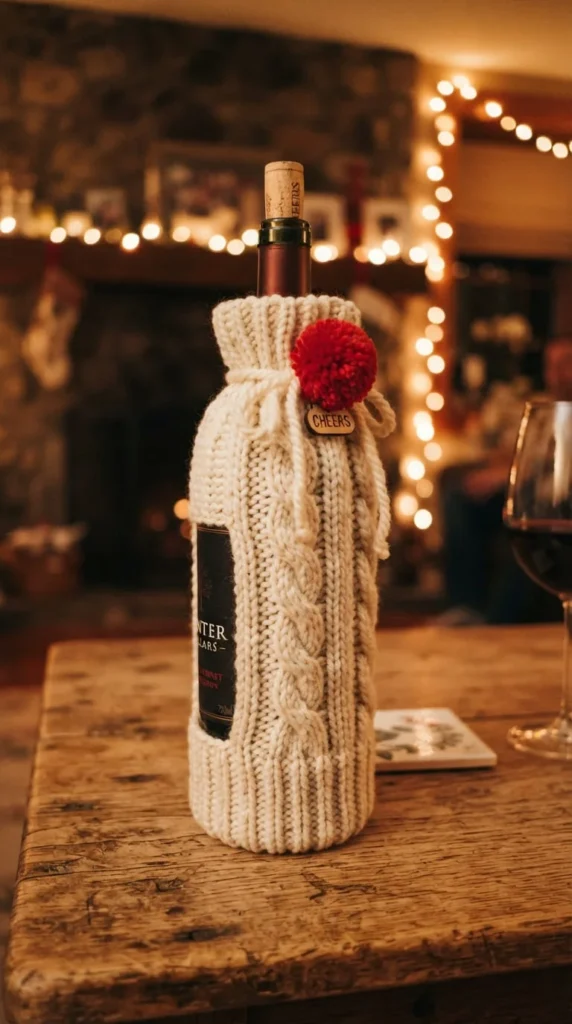
When you need a gift with almost no lead time, a bottle cozy is one of the fastest crochet projects that still feels thoughtful. Most patterns work up in under 30 minutes once you’re comfortable with basic single or double crochet in the round.
The shape is forgiving — it’s essentially a tube with a slightly gathered top — so tension mistakes that would show clearly on a garment are barely noticeable here. This makes it a good practice project for someone still building confidence with circular crochet.
A few small touches that elevate a basic tube:
- Add a contrasting cuff in a different stitch or color at the top opening
- Finish with a pom-pom, tassel, or small wooden bead for visual interest
- Size it slightly larger than the bottle so it slides on and off easily for reuse
Because bottle cozies are reusable, the recipient tends to keep using it long after the holiday, which gives the gift more staying power than something purely decorative. They also work for olive oil bottles, sparkling cider, or any gift bottle shape, so the pattern isn’t limited to wine specifically.
9. Star-Pattern Coasters That Sell Well as Sets
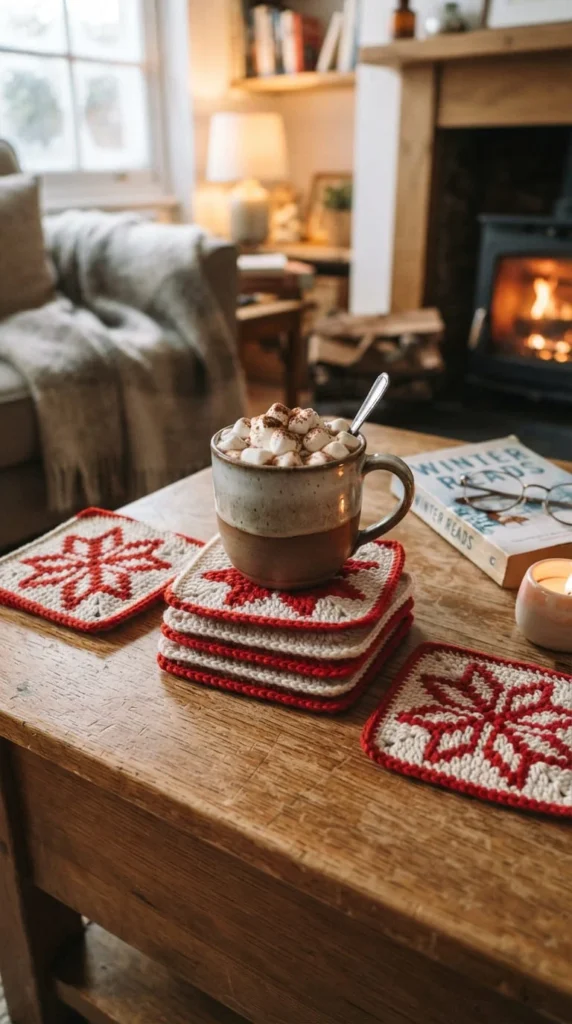
Coasters are one of the most underrated market items because they solve a practical need and use very little yarn per piece, which keeps material costs low for anyone selling handmade goods.
A simple star or snowflake motif crocheted flat, then stiffened slightly with a light starch spray, holds up better under a warm mug than a plain single crochet circle. Cotton yarn is worth the extra cost here since it absorbs condensation better than acrylic and won’t pill as quickly with regular use.
Building a sellable set:
- Make coasters in sets of four or six, since buyers rarely want a single piece
- Keep a consistent motif across the set but vary the color slightly for visual interest
- Add a simple crocheted holder or basket so the set can be gifted as one complete package
Because each coaster only takes 15–20 minutes, this is a strong project for using up leftover cotton yarn from other projects, and a full set can realistically be finished in a single evening. For craft fair sellers, bundling coasters with a matching trivet or pot holder increases the average sale size without much extra design work.
10. A Reindeer Amigurumi With Safety-First Details
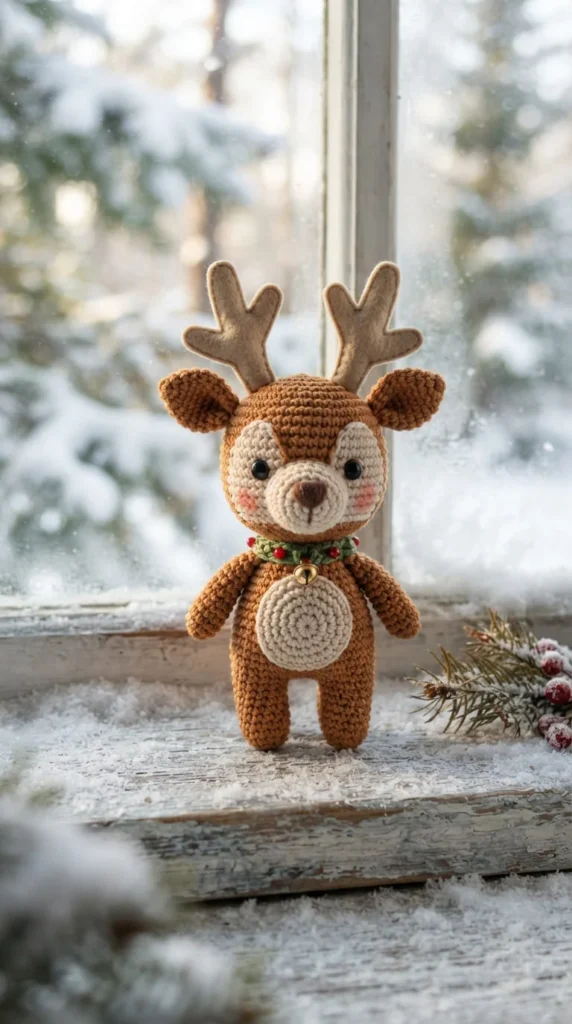
Reindeer are a reliable amigurumi choice because the shape breaks down into simple parts — a round body, a rounded head, and thin limbs — that don’t require advanced shaping skills. The antlers are usually the only tricky element, and even those can be simplified into two short crocheted branches instead of a detailed multi-point rack.
If this reindeer is meant for a child, a few safety details matter more than decorative ones. Safety eyes rated for children under three should be avoided in favor of embroidered or felt eyes, since small plastic pieces present a choking risk regardless of how securely they’re attached.
Other build notes:
- Stuff the body firmly but not overly tight so the shape stays rounded without straining seams
- Use a whip stitch rather than glue to attach antlers, since glue can loosen over time with handling
- Keep limbs short and thick rather than long and thin for better durability with rough play
A finished reindeer works equally well as a nursery decoration, a bag charm on a slightly smaller scale, or a plush gift on its own. Because the pattern is simple, it also adapts easily to different colors if you want a non-traditional palette.
11. A Fringe Wall Hanging That Blends Boho and Holiday Styles
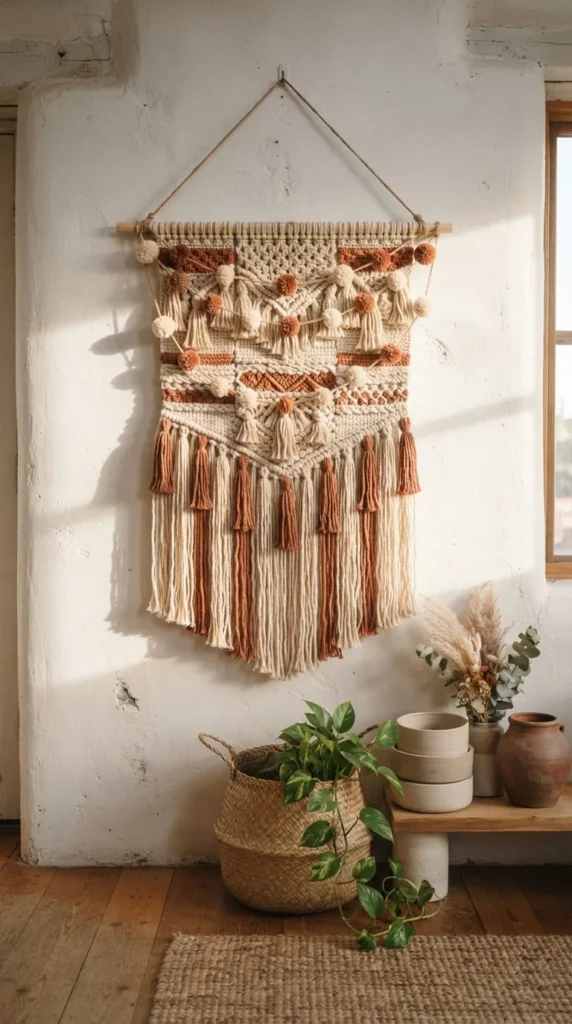
Wall hangings sit somewhere between macrame and crochet, and a holiday version doesn’t need to look like a traditional Christmas decoration at all. A geometric top panel worked in double crochet, finished with a long fringe and a few small pom-poms, reads as seasonal without relying on red, green, or literal holiday shapes.
This project works well for anyone comfortable with basic crochet but looking for something less repetitive than an ornament pattern. The top panel can be as simple as a rectangle or as complex as a triangle with color-blocked rows, depending on how much time you have.
Design choices that shape the final look:
- Attach the panel to a wooden dowel rather than a plastic ring for a more polished, boho feel
- Keep fringe length uneven for a more organic, less “kit-made” appearance
- Add small bells or wooden beads woven into a few fringe strands for subtle texture
Because this piece stays up well past the holiday season if you choose a neutral palette, it offers more long-term value than a decoration that gets packed away in January. It also makes a strong statement piece for someone who wants handmade decor without leaning into typical holiday imagery.
12. Ear Warmer Headbands as No-Sew Gift Basics
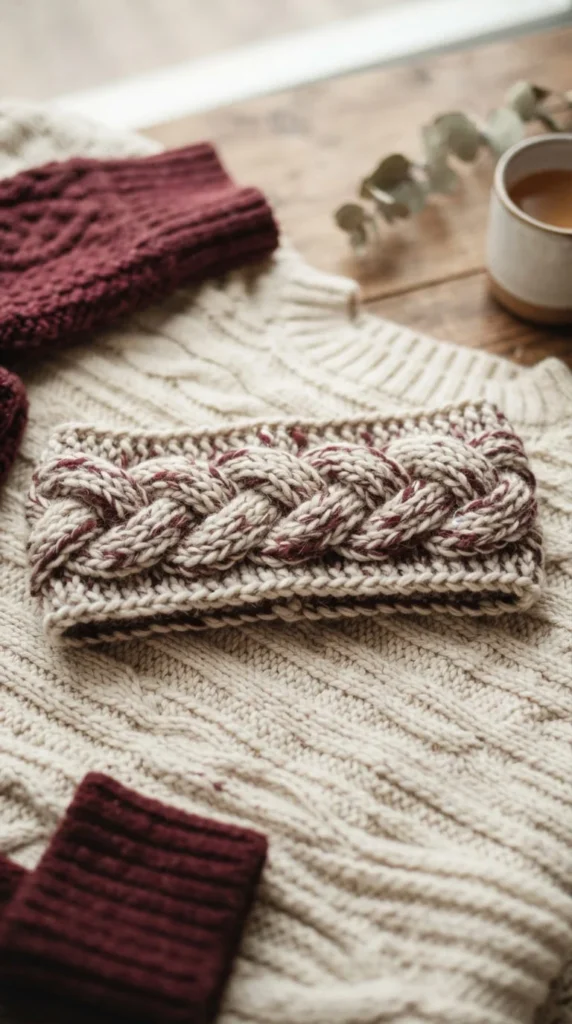
A crocheted headband is one of the fastest wearable gifts you can make, and most patterns require zero sewing — the ends simply join with a slip stitch or a single button closure. This makes it a strong choice for anyone who finds seaming intimidating.
The chunkier the yarn, the faster this project moves, and the finished texture also looks more intentional. A basic single crochet band can feel plain, but working in a post stitch or shell pattern adds visual interest without significantly increasing the difficulty.
Sizing and finishing tips:
- Measure the recipient’s head circumference and crochet the band about 2 inches smaller to account for stretch
- Use a button and loop closure instead of sewing the ends together, which makes future size adjustments possible
- Add a twisted knot or small bow at the front for a more finished, boutique-style look
Because headbands take relatively little yarn, they’re an easy way to use up partial skeins left over from bigger projects. A matching set made in slightly different sizes also works well as a gift for a parent and child, or for a small group of friends who want coordinating winter accessories.
13. Mug Cozies With a Geometric Pattern for Market Tables
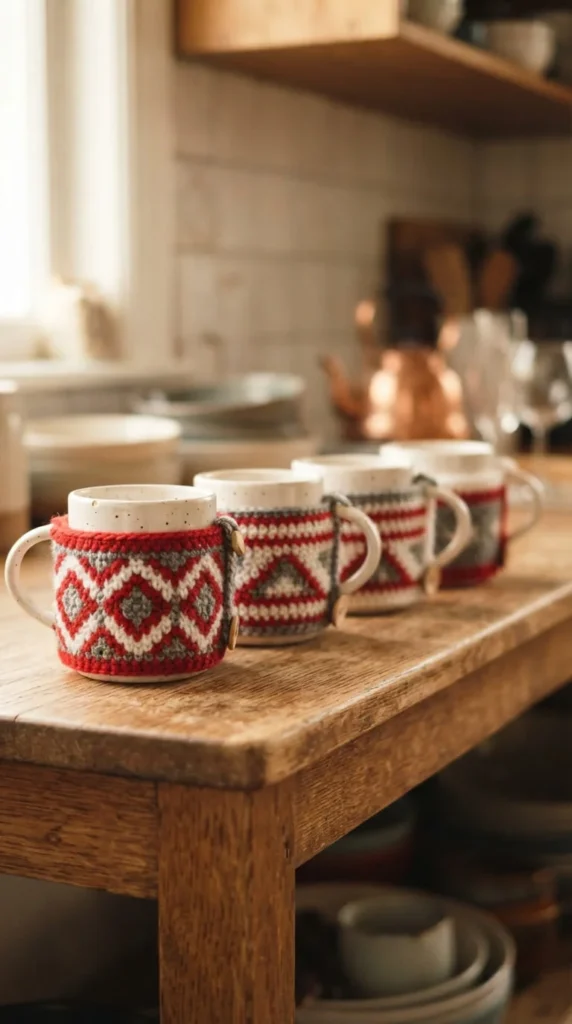
Mug cozies sell consistently at craft markets because they’re inexpensive to make, quick to demonstrate, and immediately useful. A geometric color-block pattern stands out more on a table than a plain solid-color cozy, and it’s a good way to use small amounts of multiple colors without wasting yarn.
The construction is simple: a flat rectangle worked in rows, closed with a button or snap, sized to fit a standard mug. Because the shape doesn’t require any increases or decreases, it’s approachable for someone who has only just learned single and double crochet.
A few ways to make a batch look cohesive as a set:
- Choose one consistent color scheme across the whole batch, varying only the pattern placement
- Add a small crocheted tag with care instructions for buyers unfamiliar with handmade textiles
- Offer a bundle discount for buying a mug cozy with a matching coaster
Because each cozy takes under 30 minutes, this is one of the more efficient projects for stocking a market table with volume. It’s also a low-risk way to test new color combinations before committing them to a bigger project like a blanket or sweater.
14. A Mixed-Motif Garland Instead of a Single Repeated Shape
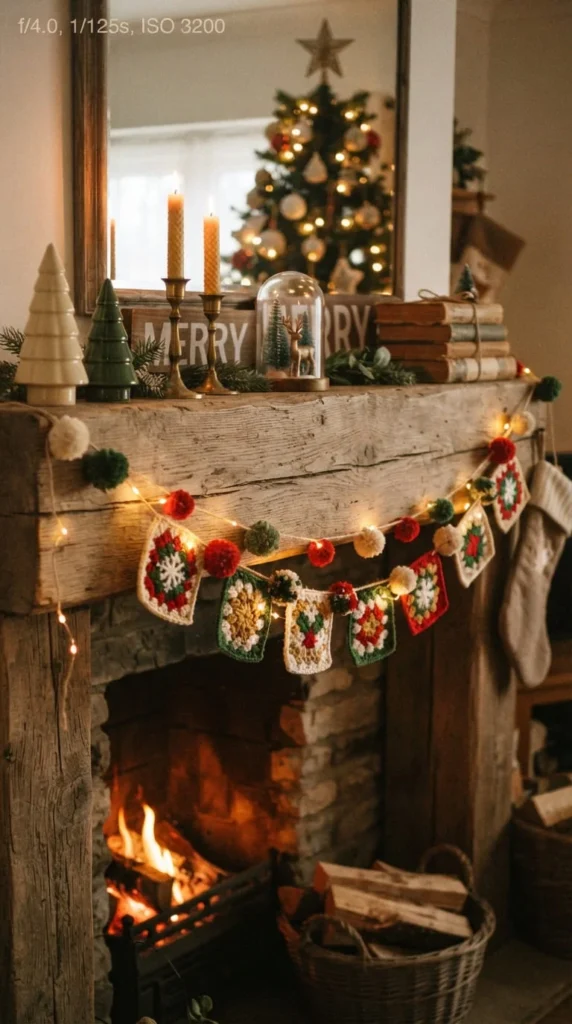
Most garland patterns repeat one small motif over and over, which can get monotonous to crochet. Alternating two or three different small shapes — a tiny granny square, a pom-pom, and a small crocheted bell, for example — keeps the process more interesting and gives the finished garland more visual texture.
Because each motif is small, this is a good project to work on in short sessions rather than committing to a long, uninterrupted crafting block. You can crochet a handful of pieces during a lunch break and assemble the full garland once you have enough.
Assembly approach:
- Crochet each motif separately, then join them along a length of sturdy cotton cord rather than crocheting the whole garland as one continuous chain
- Space motifs unevenly rather than in a strict repeating pattern for a more handmade, less mass-produced look
- Leave several inches of cord bare between clusters so the garland drapes naturally instead of looking stiff
A garland like this works well strung along a mantel, wrapped around a bannister, or draped across a window. Because the motifs are separate pieces, damaged sections can be replaced individually in future years instead of requiring the whole garland to be remade.
15. A Jewel-Tone Plaid Pillow for Modern Holiday Decor
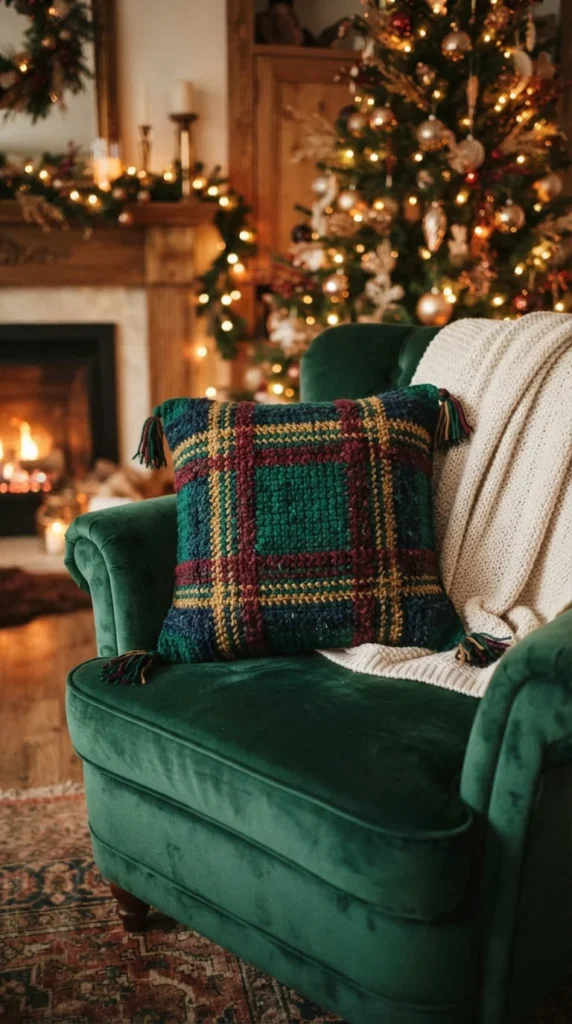
Plaid has become a popular alternative to the traditional red-and-green Christmas palette, and crocheting a plaid effect is more approachable than it looks. Rather than intarsia color changes within a single row, a simple approach uses surface slip stitches worked over a solid-color base to create the crossing lines of a plaid pattern.
This technique means you can crochet the base pillow cover in one solid jewel tone — emerald, sapphire, or deep plum — and add the plaid lines afterward without managing multiple yarn strands mid-row, which is where most colorwork projects become frustrating for beginners.
Steps to keep the technique manageable:
- Crochet the solid base cover first and block it flat before adding surface lines
- Use a contrasting metallic or lighter-toned yarn for the surface slip stitches so the lines stand out clearly
- Space vertical and horizontal lines evenly using a ruler or the stitch count as a guide, rather than eyeballing placement
A finished pillow in this style fits a modern living room without looking overtly seasonal, which means it can stay out well past December if the recipient likes the look. It also makes a strong gift for someone who prefers subtle holiday touches over full-on Christmas decor.
16. A Ribbed Eyeglass Case for a Five-Minute Gift
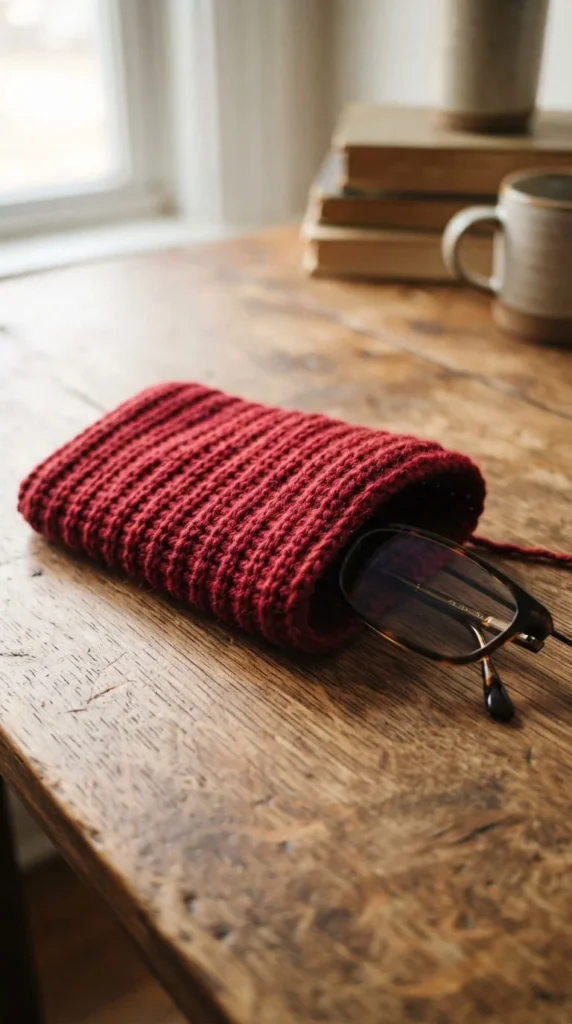
Small, no-sew accessories are some of the most practical stocking stuffers, and a ribbed eyeglass case is one of the simplest to crochet well. Worked in the round using front-post and back-post double crochet, the ribbing gives the fabric enough stretch to slide glasses in and out without a separate closure.
Because the case is a simple tube closed at one end, there’s very little finishing work — no buttons, no zippers, and no significant seaming. This makes it a good project for practicing post stitches without committing to a larger garment.
A few details that make the case more functional:
- Size the tube snugly so glasses don’t slide back out on their own
- Add a small loop at the closed end so the case can clip onto a bag or belt
- Use a slightly stretchy acrylic or acrylic-wool blend so the ribbing keeps its recoil over time
Because this project takes very little yarn and works up quickly, it’s a good option for using up short leftover lengths from bigger projects. A batch of these in different colors also makes a low-cost but genuinely useful gift set for coworkers or extended family.
17. Double-Thick Pot Holders Built for Actual Heat Protection
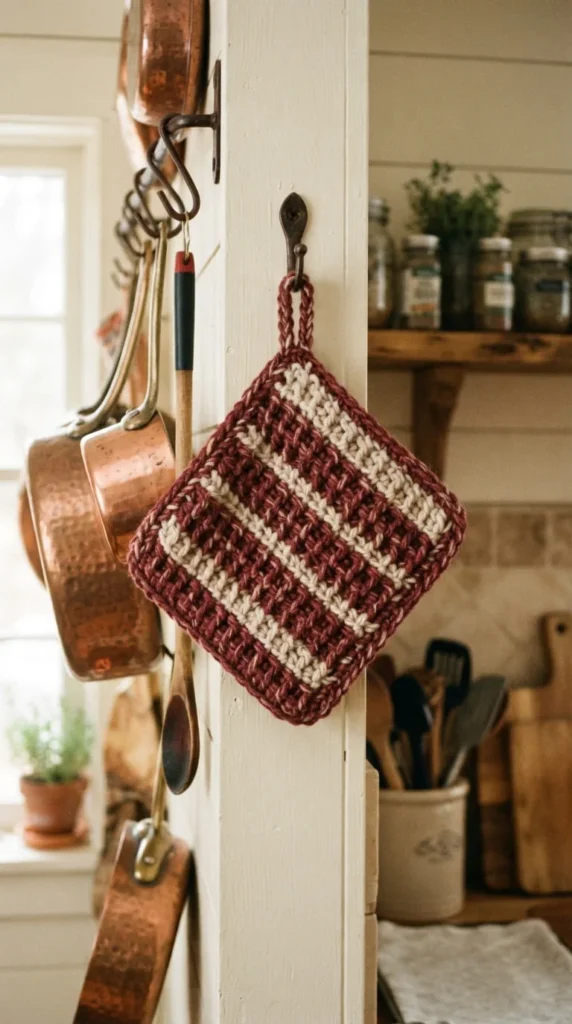
A lot of crocheted pot holders look decorative but aren’t dense enough to safely handle a hot pan, which is a common disappointment for anyone gifting them. Building the holder as two layers crocheted together, rather than one single layer, solves this problem directly.
Cotton yarn is worth using here specifically because it doesn’t melt or scorch the way acrylic can near heat, and it holds up much better over years of kitchen use. Working both layers in single crochet through the back loop only also adds density without significantly increasing bulk.
Construction approach:
- Crochet two identical square or round panels separately
- Join them together around the edges with a single crochet border, working through both layers at once
- Add a hanging loop at one corner as you complete the border round
Because the finished piece is thicker than a typical pattern, it takes a bit more yarn and time than a decorative-only version, but the extra durability makes it a gift people actually use instead of setting aside. A set of two in a coordinating color makes a stronger gift presentation than a single piece.
18. A Padded Book Sleeve for the Reader on Your List
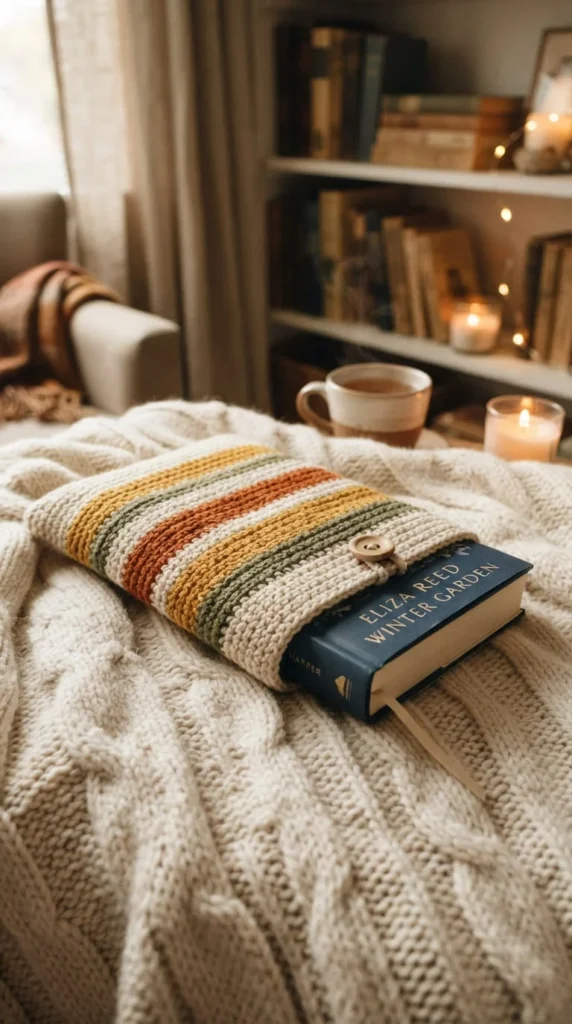
Book sleeves solve a specific, common problem — protecting a book’s cover from bag wear — and they’re rarely included in typical Christmas crochet lists despite being genuinely useful. The construction is similar to a laptop sleeve but scaled down, which makes it a faster project overall.
A simple stripe pattern using two or three colors adds visual interest without requiring any shaping skills, and it’s an easy way to use up leftover yarn from other projects on this list. Working in half double crochet gives enough density to cushion the book without adding excessive bulk.
To make the sleeve genuinely protective rather than just decorative:
- Measure the intended book (or a standard paperback size) before starting, adding an inch of ease on each side
- Close the opening with a simple flap and button rather than a zipper, which is harder to sew in neatly
- Consider a thin fabric lining if the sleeve will carry a book with a delicate dust jacket
This is a strong project for anyone gifting a favorite novel or a nice hardcover, since the handmade sleeve becomes part of the gift rather than an afterthought. It also works well as a design for e-readers or tablets if you adjust the dimensions slightly.
19. Tiny Keychain Ornaments for Bulk Market Sales
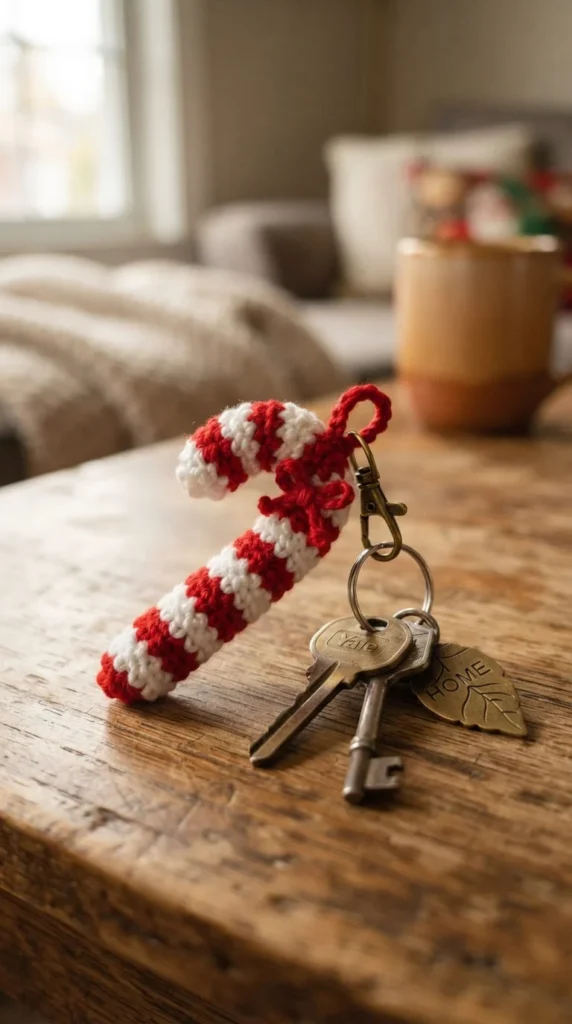
When you need a large number of low-cost items for a market table, keychain-sized ornaments are one of the most efficient options available. A miniature candy cane, star, or mitten takes only a few grams of yarn and a handful of minutes once you know the pattern, which means a large batch is realistic even with limited prep time.
Attaching a keyring rather than just a ribbon loop increases the item’s practical use, since buyers can clip it onto keys, a bag zipper, or a backpack rather than only hanging it on a tree.
A few tips for producing these efficiently in bulk:
- Standardize on one or two shapes rather than a wide variety, so you can crochet from memory without checking a pattern each time
- Pre-cut all keyring findings and stuffing before starting a batch, rather than stopping between each piece
- Store finished pieces in a labeled bin by color so restocking a market table is quick between customers
Because these are small and inexpensive, they also work well as impulse-buy items placed near a checkout area or register at a market booth, giving customers a low-commitment way to take home something handmade.
20. A Lace-Border Table Runner for Holiday Dinners
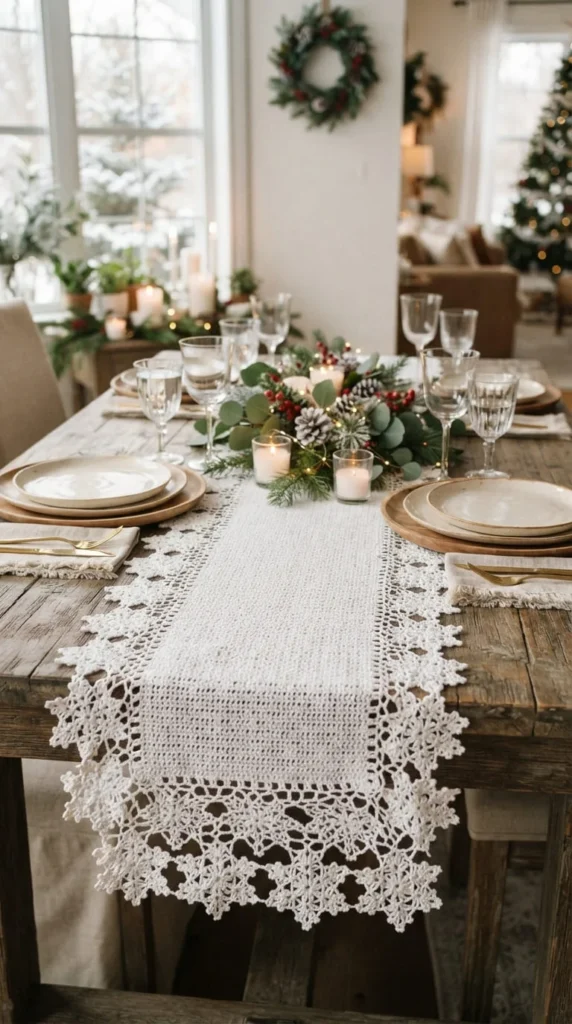
A table runner gives a dining table a finished, intentional look without the cost or time commitment of a full tablecloth. Working the body in a solid color and adding a lace snowflake or picot border keeps the project from feeling repetitive while still finishing in a reasonable timeframe.
Because a runner is essentially a long rectangle, the body itself requires no shaping skill — the interest comes entirely from the border and color choice. This makes it a good project for practicing a new lace stitch without the pressure of a shaped garment.
A few sizing and design notes:
- Measure the table length and subtract about a foot so the runner drapes slightly at each end rather than hanging awkwardly
- Use a cotton or linen-blend yarn for better drape than a springy acrylic
- Block the finished runner flat before use so the border lies smooth rather than curling at the edges
This project also works well as a longer-term family piece, since a well-made cotton runner holds up to years of holiday dinners if it’s washed gently. Adding a set of matching napkin rings from leftover yarn extends the same design across the whole table setting.
21. Oversized Scrunchies in Holiday Colors
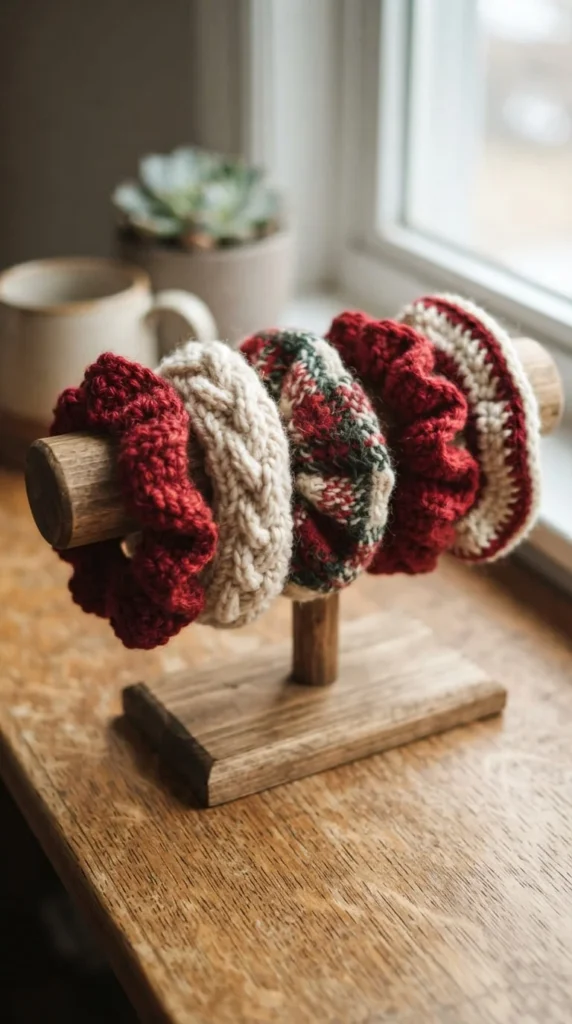
Scrunchies remain a strong seller because they’re fast to make, use very little yarn, and appeal to a wide age range. A slightly oversized, puffy scrunchie made with a thicker yarn or doubled strand reads as more premium than a thin, flat version.
The construction is genuinely simple — a tube of crochet gathered around an elastic band — which makes this one of the more approachable projects for someone newer to crochet who still wants a product with retail appeal.
Ways to differentiate a scrunchie batch:
- Use a double strand of worsted weight yarn instead of a single strand for a fuller, more structured shape
- Offer a plaid-inspired color combination alongside solid options for variety
- Package sets of two or three in coordinating tones for a stronger gift presentation
Because each scrunchie takes under 15 minutes and very little material, this is one of the highest-volume, lowest-cost items you can add to a holiday market lineup. It’s also a practical project for teaching a beginner the basics of working in the round before moving on to something more complex like an amigurumi.
22. Cotton Face Scrubbies for a Spa-Themed Gift Set
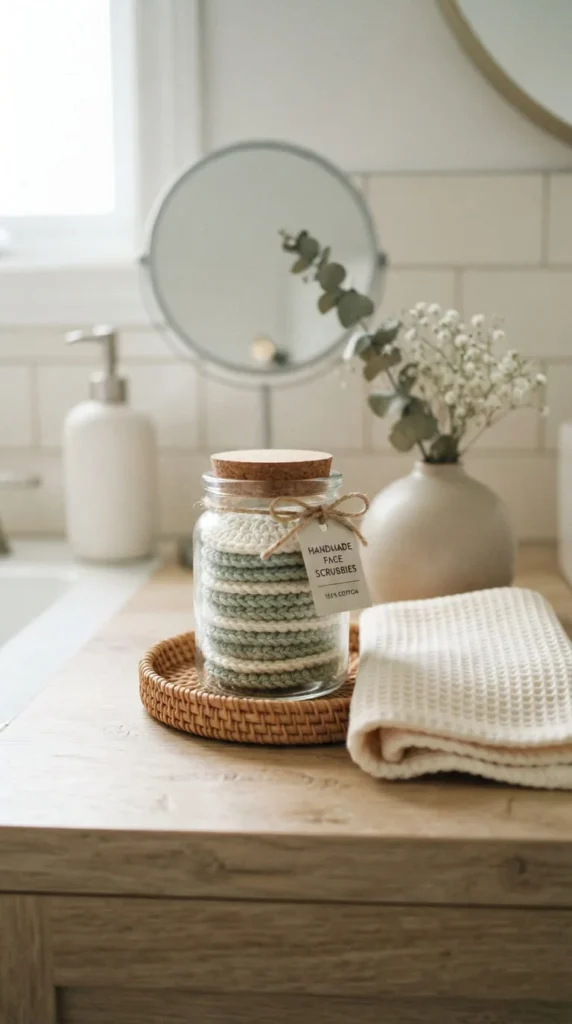
Face scrubbies are small, flat, reusable rounds crocheted from cotton yarn, designed as an eco-friendly alternative to disposable cotton pads. They’re quick to make, use almost no yarn per piece, and pair naturally with other small bath items into a cohesive gift set.
Cotton is essential here rather than acrylic, since it’s more absorbent and holds up better to repeated washing without breaking down. A simple textured stitch, like a shell or bobble pattern, adds a gentle exfoliating texture without requiring any special technique.
Building a full spa-themed set around scrubbies:
- Make 6–8 scrubbies per set, since they’re typically used and washed in rotation
- Pair them with a small crocheted soap saver pouch for a cohesive bathroom-themed bundle
- Present the set in a small glass jar or drawstring bag rather than loose, which improves the gift’s presentation significantly
This is one of the more genuinely practical items on this list, since scrubbies get used regularly rather than displayed once and stored away. For anyone interested in the zero-waste angle of crochet, cotton scrubbies made from scrap yarn are also an easy way to use up small leftover amounts that aren’t enough for a bigger project.
23. A Panel-Constructed Tree Skirt Without Endless Rounds
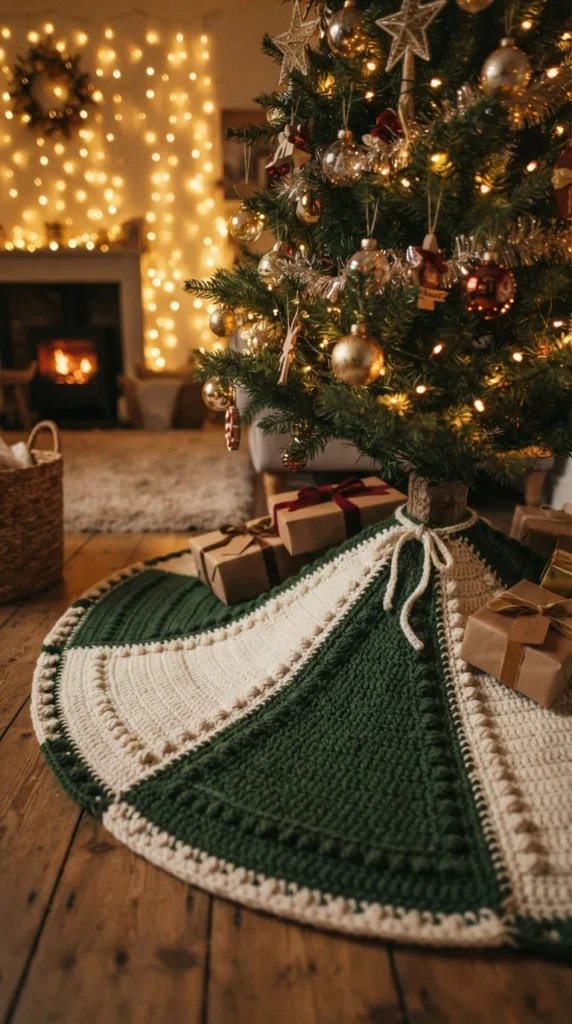
A traditional tree skirt worked entirely in continuous rounds can become a genuinely large, slow project by the time it reaches full size. Building it instead from six or eight identical wedge-shaped panels, crocheted separately and then joined, breaks the work into manageable, portable pieces.
Each panel is essentially a triangle that grows through simple increases, which is far less monotonous to work on than one enormous, ever-expanding circle. Because the panels are separate, this project also travels well — you can carry a single panel in a bag rather than an entire half-finished skirt.
Construction notes:
- Crochet all panels to the same row count before joining, checking sizes against each other as you go
- Join panels with a slip stitch seam on the wrong side for a nearly invisible finish
- Leave one seam open partway, with a button or tie closure, so the skirt can be removed without disassembling the tree
A color-blocked approach, alternating two or three tones across the panels, also adds visual interest without requiring any colorwork technique beyond changing yarn between panels. This project suits an intermediate crocheter with some patience, but not necessarily advanced technical skill.
24. A Simple Pet Sweater Sized for Small Breeds
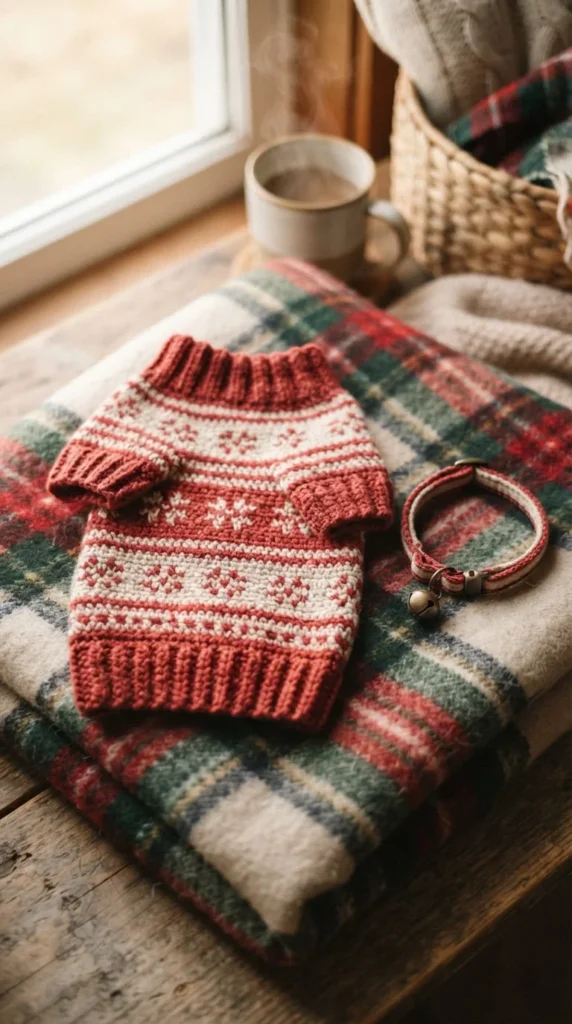
Pet accessories are consistently underrepresented in Christmas crochet lists, despite being a genuinely popular gift category. A basic pet sweater for a small dog or cat breaks down into just three main pieces — a tube for the body and two small tubes for the front legs — which keeps the shaping requirements low.
Getting the fit right matters more here than stitch complexity. Measuring the pet’s neck, chest, and length from collar to tail base before starting prevents the most common mistake: a sweater that’s too tight around the chest or too long along the back.
A few fit and comfort notes:
- Use a soft, stretchy yarn rather than a scratchy wool blend, since pets can’t communicate discomfort the way a person can
- Keep the neck opening slightly looser than you’d expect, since pulling a sweater over a pet’s head is often the hardest part of dressing them
- Avoid small buttons or beads as embellishments, since they can become a choking hazard if chewed loose
Because pet sizes vary so widely, this project works best as a customized gift for someone’s specific pet rather than a generic batch item, which also makes it feel more personal than a mass-made accessory.
Conclusion
Christmas crochet ideas don’t have to mean another repeat of the same ornaments and stockings every year. Between fast market items like coasters and scrunchies, genuinely useful gifts like book sleeves and pot holders, and decor pieces built to last well past January, there’s enough variety here to match whatever amount of time and yarn you actually have on hand. Start with one or two projects that fit your current skill level, keep a small stash of leftover yarn for the scrap-friendly ideas, and build up your holiday crochet list gradually rather than trying to tackle everything in a single weekend. Pick up a hook, choose the project that excites you most from this list, and get started on your first piece today.